Could Temple sacrifices resume before the Third Temple is built in Jerusalem?





The ancient Temple sacrifices could be offered today on Jerusalem's Temple Mount if the Israeli government would allow them, and doing so would bring people one step closer to receiving the Messiah and possibly usher in a better era of peace, according to one American-Israeli rabbi who has spent decades trying to reestablish such rituals.
Joshua Wander told ALL ISRAEL NEWS that it is only because of Israel's "apartheid system," which does not allow Jews and Christians free access to the Temple Mount – and is today under the control of the Jordanian Muslim Waqf – that such practices have not begun.
He made the statement a week after police arrested youths who tried to bring a sacrificial offering to the mount during the Jewish holiday of Shavuot, which this year took place on May 21-22, 2026.
"There are many people who mistakenly believe that we need to have either the mashiach [messiah] or the Beit HaMikdash [Third Temple] to start bringing sacrifices," Wander said. "That is faulty thinking."
He said that although the three concepts of messiah, Temple, and sacrifice are interrelated, they are not interdependent, and one can perform sacrifices without the others. According to Wander, there is a clear Torah analysis supporting this position. He pointed to the period following the Jewish return to Israel under the leadership of the prophet Ezra in the 5th century B.C.E. At that time, Wander said, sacrifices resumed even before the Temple itself was rebuilt.
"Not only is it possible, but it is also necessary to start bringing sacrifices," Wander said.
He said this is especially true of the Passover sacrifice because, unlike most communal offerings, it is brought by individual families. While communal sacrifices required funding through the half-shekel contribution that every Jewish family was expected to make during Temple times, the Passover offering was purchased and brought by families themselves.
During Temple times, the Israelites were commanded by God to bring a lamb or goat to the Temple and sacrifice it the afternoon before Passover began at sundown. They would then eat it that night together with matzah and bitter herbs.
In 1967, immediately after Israel won the Six-Day War and reunified Jerusalem, including the Temple Mount, the Lubavitcher Rebbe forbade his followers from coming to Jerusalem on Passover eve because he believed they might be obligated to bring the sacrifice and knew it still could not be done.
Wander said bringing the Passover sacrifice is one of only two positive commandments in the Torah that carry the severe punishment known as karet, often translated as "cutting off" or "extirpation" from the Jewish people, if it is not fulfilled. The only other positive commandment carrying the same punishment is brit milah, or circumcision.
"It's considered to be a very serious thing if we're able to bring the sacrifice and we don't," Wander told ALL ISRAEL NEWS.
He said that for nearly 60 years, the Jewish people in Israel could have done it, but political realities have prevented it.
He added that allowing Jews to offer sacrifices on the Temple Mount would not require destroying the Dome of the Rock, the Al-Aqsa Mosque, or any other existing structure on the mount.
"The political leadership has to start giving us access," Wander said. "As soon as they do, we can start the process of bringing sacrifices together."
Jews have not performed sacrifices for nearly 2,000 years, and only a handful of groups and individuals have attempted to revive the practice. Many Israelis consider Wander and his supporters to be part of a fringe movement.
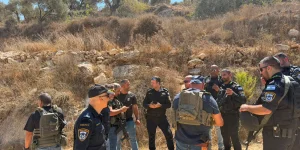
On Shavuot, police said they arrested more than a dozen youths who attempted to break into the Temple Mount compound to perform a sacrificial ritual. In this case, they were not bringing an animal but rather loaves of bread. According to Leviticus 23:17, Shavuot required worshippers to bring "two loaves of bread" as an offering.
In most previous cases, activists have attempted to smuggle live animals onto the mount for sacrificial purposes.
Over the past several months, police have reported other such incidents, including one on May 1, which coincided with Pesach Sheni, or Second Passover. During Temple times, Jews who could not bring the Passover sacrifice at its appointed time were permitted to do so exactly one Hebrew month later.
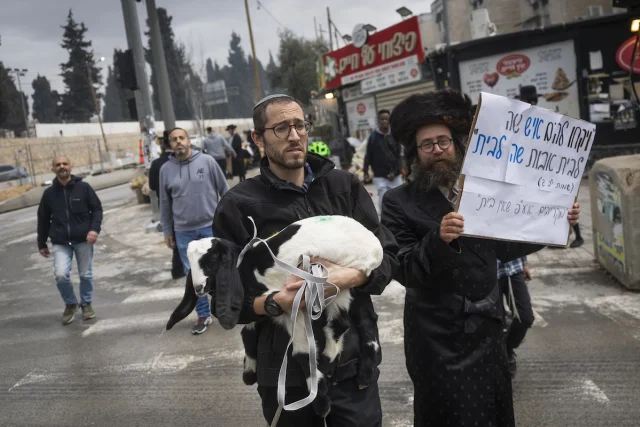
At the time, police said that the young rioters, who arrived at one of the Temple Mount entrances, tried to break through the gate and bring a baby goat there.
During Passover, more than a dozen young men and boys were arrested for attempting to bring goats onto the Temple Mount, according to a report by the legal aid organization Honenu.
Similar incidents occurred in 2024 and 2023 and have, in the past, sparked tensions.
But Wander said the idea of restoring sacrifices is beginning to gain traction. When he first began promoting preparations for the renewal of sacrifices, including educational reenactments outside the Temple Mount complex, only a handful of people attended. Today, around 1,000 people participate in these ceremonies.
He and others regularly petition Israeli authorities to allow such reenactments on the Temple Mount itself, though those requests have not been approved, he explained.
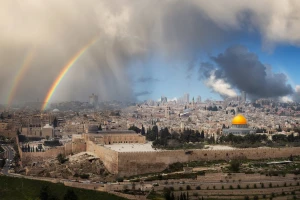
The Temple Mount, home to the Al-Aqsa Mosque and the Dome of the Rock, is believed to be the site of the First and Second Jewish Temples. For Christians, it forms part of the sacred landscape of Jerusalem and is associated with Jesus' life and ministry. Many Christians see discussions of Temple sacrifices and the rebuilding of the Temple as closely tied to biblical prophecies about the end times.
Although the status quo has traditionally restricted Jewish and Christian prayer on the mount – and Prime Minister Benjamin Netanyahu has repeatedly insisted that the arrangement remain unchanged – more Jews and Christians have ascended the Temple Mount in recent years and have increasingly been permitted to pray there.
According to a report by the Temple Mount Administration, more than 54,000 Jews visited the Temple Mount between January and August of last year.
Wander said many people once believed that Jewish prayer on the Temple Mount would "ignite World War III," but that the opposite has happened.
He said that as the practice has become more mainstream, it has also become more accepted among Muslims who worship there.
However, ascending the Temple Mount remains controversial within Judaism. Many rabbis continue to believe that Jews should not enter the site because they are ritually impure or because they may inadvertently walk through areas that once constituted the Holy of Holies, whose precise location remains uncertain.
Furthermore, ritual sacrifices and active efforts to rebuild the Temple are not accepted by most rabbis or other religious authorities. In 2022, Rabbi Shmuel Rabinovitch, the chief rabbi of the Western Wall, said in a statement that "bringing a sacrifice to the Temple Mount is contrary to the Chief Rabbinate of Israel's ruling."
But Wander argued that a rebuilt Temple would benefit the entire region.
He said the Temple is meant to be "a house of peace."
"Once we start doing this, building the Beit HaMikdash and offering sacrifices, it is going to unite all the nations of the earth," he said. "It is not going to create war. It is going to create peace."
Wander said that even many Jews are not aware of the "incredibly unique" and "historic" period that he believes this generation is witnessing - what he calls "redemptive times."
"We're living in redemptive times, and most people are just not aware of what is happening," Wander concluded. "We're fortunate enough to live in such a unique historic period of Jewish history where we get to watch this unfold before our eyes."
You might also like to read this: