Trump makes changes to Iran proposal, demands tougher terms, frustrated with slow regime response – report
Iranian parliament speaker says country obtains results ‘not through dialogue, but with missiles’




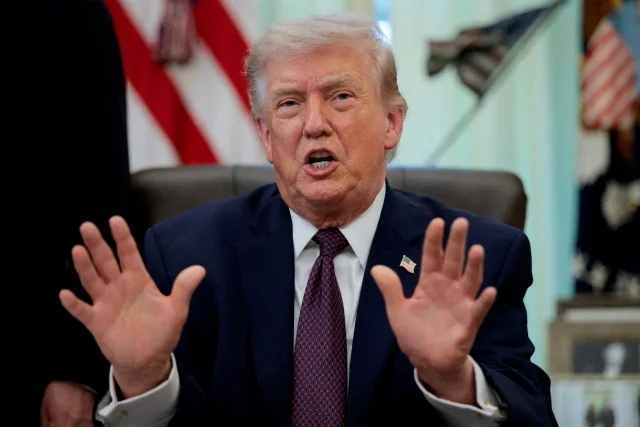
U.S. President Donald Trump has hardened his positions in the negotiations with Iran, sending proposed changes back to Tehran, The New York Times reported on Sunday.
According to the NYT report, which was based on two anonymous officials, Trump is concerned that the agreement would include unfreezing funds for the Iranian regime, including around $6 billion held in Qatar.
President Trump has harshly criticized former U.S. President Barack Obama for sending billions of dollars in cash to Iran as part of the 2015 Joint Cooperative Plan of Action (JCPOA), which enabled the regime to resume funding for its regional terror proxies, including Hezbollah, Hamas, and the Houthis.
One source told the NYT that Trump is frustrated with the speed at which Iran is responding to U.S. proposals, and believes a tougher proposal could prompt the Iranian regime to agree to the current text of the agreement.
Last Friday, President Trump met with top officials in the White House situation room for two hours to discuss the Iran situation. However, that meeting ended without any announcement.
According to Axios, a U.S. official told reporters after the meeting that Trump “will only make a deal that is good for America, satisfies his redlines and makes sure Iran can never possess a nuclear weapon.”
Trump is reportedly demanding the handover of Iran’s highly enriched uranium and is seeking limits on any further enrichment. This would represent a change from Trump’s previous demand of no nuclear enrichment.
Also on Friday, Trump published a lengthy post on his Truth Social account, stating, “Iran must agree that they will never have a Nuclear Weapon or Bomb.”
He also demanded that the Strait of Hormuz “be immediately open, no tolls, for unrestricted shipping traffic, in both directions,” along with the removal of all mines from the vital waterway.
“Iran will complete the immediate removal and/or detonation of any mines that are left, which will not be many!. Ships caught in the Strait due to our amazing and unprecedented Naval Blockade, which will now be lifted, may start the process of ‘heading home!’” Trump wrote.
According to the NYT, the current ceasefire framework would see the U.S. end military operations in Iran in exchange for the unrestricted reopening of the Strait of Hormuz, with the other issues, such as Iran’s nuclear weapons program, and possibly its ballistic missile program, and aid to proxies, being discussed in later negotiations.
Such a stance is opposed by Israel and by several Gulf states, such as the United Arab Emirates, which said any agreement must include limits on Iran’s ballistic missile program.
On Friday, Iranian Parliament Speaker Mohammad Bagher Ghalibaf said in a post on social media that Iran does not trust the U.S., and “We obtain concessions not through dialogue, but with missiles. In negotiations, we only make them understand this.”
“We have no trust in guarantees or words; only actions/behavior are the measure. No step will be taken before the other side takes action,” Ghalibaf continued. “The winner of any agreement is the one who, from the very next day, prepares even better for war.”
On Saturday, Defense Secretary Pete Hegseth said the U.S. military stands ready to resume strikes in Iran if a deal is not reached.
“Right now, we’re focused on being postured and prepared to reengage, if we have to,” Hegseth said in a statement to the media at the Shangri-La Dialogue summit in Singapore.
Hegseth appeared to contradict a statement by Navy Secretary Hung Cao the previous week, who told U.S. senators that the U.S. was pausing military operations to ensure sufficient supplies of munitions.
“Right now we’re doing a pause in order to make sure we have the munitions we need for Epic Fury – which we have plenty,” Cao told the senators.
Hegseth downplayed the risk of insufficient munitions, saying the U.S. has prepared for action “around the globe.”
“Our stockpiles are more than suited for that, both there and around the globe, so we’re in a very good place,” he affirmed.
Meanwhile, the U.S. military announced on Saturday that it has disabled or redirected 122 vessels since the start of the naval blockade imposed on Iran on April 13.
U.S. Central Command (CENTCOM) said in a statement on its official X account that the U.S. “enforced blockade measures by disabling a Gambia-flagged maritime vessel attempting to sail toward an Iranian port, May 29.”
After spotting the M/V Lian Star attempting to sail toward an Iranian port and issuing “more than 20 warnings,” informing the vessel it was in violation of the U.S. blockade, an American aircraft “disabled the vessel by firing a Hellfire missile into the ship’s engine room.”
“U.S. forces have disabled five commercial vessels and redirected 116 [in order] to fully enforce the blockade as a ceasefire with Iran remains in effect,” CENTCOM stated.
You might also like to read this: