Jewish return to the Promised Land—and how Israel’s Independence Day tells a bigger story



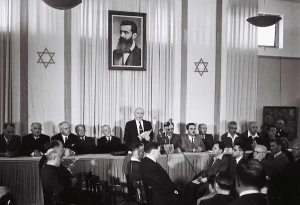
This week, Jewish people in Israel and around the world celebrate Yom HaAtzma’ut (Israel Independence Day), the national holiday commemorating the 1948 establishment of the State of Israel. It’s one of their most significant national holidays.
However, alongside Israel’s celebration of statehood lies the profound story of the events that made it possible: the return of the Jewish people to the land. This return began well before 1948 and has continued since from nearly 150 countries around the world.
The Return of the Jews to Israel
This Jewish return to their homeland is called “Aliyah,” a Hebrew word that describes modern immigration to Israel. Within this word lies a beautiful lesson: it is a special term drawn from the Hebrew Bible that means “to ascend” or “to go up.” In ancient biblical times, it was used in reference to Jewish pilgrims ascending to Jerusalem for the three great feasts—Passover, Pentecost, and Tabernacles. For example, David said in Psalm 122:3–4:
Jerusalem is built as a city that is compact together, where the tribes go up, the tribes of the Lord, to the Testimony of Israel, to give thanks to the name of the Lord.
Their ascent was both physical (because Jerusalem was located on a hill) and spiritual (because that is where the temple stood and God's presence was believed to dwell). Thus, making modern-day Aliyah carries both a physical and spiritual meaning.
Ancient Echoes of Aliyah
The concept of Aliyah goes back to the beginning of the biblical story, when God called Abraham to leave his country for the land He would show him (Genesis 12:1–3, 7). God’s promise of land to Abraham and his descendants initiated a movement toward Canaan—the promised land—that became foundational to the biblical narrative. God ratified this promise by covenant in Genesis 15 and 17, later reiterating it to Isaac and Jacob: their descendants would inherit a specific piece of real estate. From the outset, God tied the children of Israel’s identity to both covenant and land.
“Going up” language appears early in the Bible. Journeys to key places, especially toward the promised land, are described in terms of ascending. Israel’s deliverance from Egypt, for example, was not just freedom from slavery but a purposeful movement back to the land promised to their forefathers, echoing the core idea behind Aliyah.
Depart and go up (alah) from here, you and the people whom you have brought up out of the land of Egypt, to the land of which I swore to Abraham, Isaac, and Jacob. (Exodus 33:1)
God’s Instructions for Israel
Later, through the Mosaic covenant, God laid out instructions for the children of Israel living as His set-apart people. In Leviticus 26, He instituted a conditional relationship with them, linking their presence in the land to their faithfulness:
If you walk in my statutes and observe my commandments and do them, then I will give you your rains in their season, and the land shall yield its increase, and the trees of the field shall yield their fruit. . . . But if you will not listen to me and will not do all these commandments . . . I myself will devastate the land, so that your enemies who settle in it shall be appalled at it. And I will scatter you among the nations, and I will unsheathe the sword after you, and your land shall be a desolation, and your cities shall be a waste. (Leviticus 26:3–4, 14, 32–33 ESV)
God was clear: Israel would experience blessing in the land for obedience (the land would be productive) and removal from the land for disobedience. The children of Israel continually disobeyed, so God—faithful to His word—allowed them to be exiled out of the land, first to one nation, Babylon, and then to the four corners of the earth.
A Promise of Restoration
But within God’s instruction that warned of scattering, He also promised a future regathering linked to repentance. The Hebrew prophets spoke of a day when God would sovereignly gather His children back to the land from every nation where they had been dispersed:
Then the LORD your God will restore your fortunes and have compassion on you and gather you again from all the nations where he scattered you. Even if you have been banished to the most distant land under the heavens, from there the LORD your God will gather you and bring you back. (Deuteronomy 30:3–4)
This physical return to the land is what we are witnessing today.
God Will Vindicate His Name
Israel had tarnished God’s name among the nations (Ezekiel 36:20–21), misrepresenting His holiness. Despite their unfaithfulness to Him, He promised to vindicate that holiness by gathering them “from all the nations.” He also promised to cleanse them of their sin and of their worship of other gods (Ezekiel 36:25). This echoes His promise centuries before that Israel’s return would be both physical and spiritual.
Therefore say to the house of Israel, “Thus says the Lord God: ‘I do not do this for your sake, O house of Israel, but for My holy name’s sake, which you have profaned among the nations wherever you went. And I will sanctify My great name, which has been profaned among the nations, which you have profaned in their midst; and the nations shall know that I am the Lord,” says the Lord God, “when I am hallowed in you before their eyes.” (Ezekiel 36:22–23)
This regathering would happen not because of anything Israel does, but to be a witness of God’s greatness, to exonerate His name, and to demonstrate His holiness and faithfulness—whether His people are deserving of it or not. Ultimately, it will be so that they will know Him.
Profoundly, Isaiah speaks of another aspect of Israel’s return to the land: non-Jews would participate in helping to bring them home. The involvement of Gentiles in this process is remarkable—Isaiah 66:20 describes the Gentiles’ act of bringing God's people home as so sacred it is likened to bringing an offering before the Lord.
Conclusion
Aliyah is part of God’s long, unfolding covenant story—where obedience and exile, judgment and restoration, are ultimately governed by His faithfulness and the vindication of His holy name. What God began in the calling of Abraham, He has been carrying through in His warnings of the covenant, the sorrow of exile, and the promises of restoration.
Thus, Yom HaAtzma’ut, Israel Independence Day, is not separate from the biblical story, but a historic milestone within it—a visible sign of the ongoing regathering of the Jewish people to the promised land that Scripture has spoken about for generations.
And we are the privileged generation witnessing it.
You might also like to read this: