After heavy damage by Iranian fire, US weighs transferring military bases to Israel
Israel could become key regional node for US military



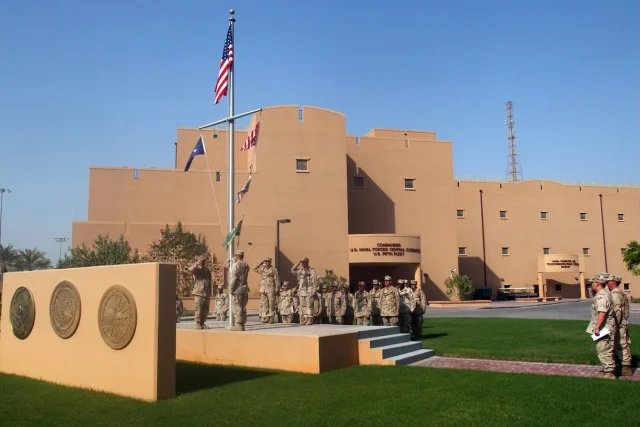
As the extent of the damage wrought by Iranian fire during the recent fighting is revealed to the public, the United States is increasingly considering transferring some of its bases in the Gulf further away from the Iranian mainland – with Israel becoming an increasingly attractive option.
According to The Wall Street Journal (WSJ), the U.S. naval base in Bahrain suffered heavy damage that will require hundreds of millions of dollars to rebuild.
Though the Pentagon noted that no one was killed at the base and operations that had been largely evacuated beforehand were not affected, the WSJ cited satellite imagery, social-media footage and interviews showing damage that the Pentagon had not acknowledged.
The report included apparent direct hits by what appeared to be ballistic missiles on the command headquarters, satellite communications terminals, and at least a dozen other buildings.
According to the report, the U.S. military is now considering reducing its presence in the entire Gulf area, which is within easy striking range of Iranian missiles and slow-moving drones. This includes bases in nearby Kuwait and Saudi Arabia, which could be moved further west.
Two officials said that Israel is one of the locations being considered, as it is around 1,000 km (600+ miles) from Iran’s western border.
U.S. military officials had reportedly warned before the war with Iran that the American bases in the Gulf were exposed to Iranian fire. Iranian officials have repeatedly threatened the bases, demanding they be completely removed from the area near its borders.
As far back as U.S. President Donald Trump’s first term between 2017 and 2021, American military commanders expressed concerns about the vulnerability of the U.S. bases in the region.
Reports suggesting Israel could become a key node in the U.S. military network in the region have surfaced repeatedly in recent months. During last year’s fighting with Iran, the U.S. also openly deployed forces in Israel for the first time, including F-22 fighter jets and air defense batteries.
This was repeated on a much larger scale ahead of this year's war with Iran, when U.S. and Israeli officers effectively integrated their operations, working side by side in top-secret Israeli underground bunkers to coordinate strikes and air defense against Iran.
A senior official told Israel Hayom in May, "There are American forces here that will not be moving in the near or even distant future. They have learned that Israel is a convenient fortress for operations, a country relatively far from the main threats and well protected by air defense systems."
The official also noted that "unlike other countries that restrict takeoffs for offensive operations or impose various conditions, Israel has no such restrictions."
In March, Channel 12 News reported that Israel was set to formally invite the U.S. to relocate some bases in the region to Israel after the fighting ended.
“We have proved our values of late as a central ally of the United States – one that provides not only stability, but also significant operational and intelligence capabilities,” the report quoted an Israeli source as saying. “American bases in Israel would create a strategic advantage for both sides.”
U.S. deployment raised concerns about potential disruption to operations at Ben-Gurion International Airport as a civilian hub, with the Transportation Ministry warning that the presence of U.S. Air Force refueling aircraft could require the cancellation of millions of flight tickets.
On Friday, the ministry announced that an agreement with the U.S. military would speed up redeployment to avert the threat of cancellation to more than 200,000 airline tickets in July and August.
Under the agreement, Israel pledged that the aircraft would be allowed to return to Ben-Gurion Airport within about 72 hours in the event of an emergency. According to Ynet News, the U.S. has already relocated 15 aircraft, with 30 more scheduled to be transferred to Israeli Air Force bases by Tuesday and an additional 20 to follow later.
In addition to aircraft, there are at least two THAAD batteries still stationed in Israel, as well as the Civil Military Coordination Center (CMCC) for the Gaza Strip in Kiryat Gat, and possibly other covert troop deployments.
A report from the Jewish Institute for National Security of America (JINSA) noted earlier this year: “Israel offers reliable access, favorable geography, and operational support unlike anywhere else in the Middle East.”
“Israel’s geostrategic location at the crossroads of Europe, Asia, and Africa enables it to support U.S. rapid global mobility by hosting tanker and transport aircraft. This same location puts shipping lanes that account for one-sixth of trade and one-third of container traffic worldwide, worth more than $1 trillion annually, within the unrefueled operational radius of U.S.-made fighter aircraft at Israeli bases.”
“To a much greater extent than other regional host nations, Israel’s basing infrastructure can support light U.S. footprints, ensure readiness, and minimize deployment costs and risks to U.S. forces,” JINSA concluded.
You might also like to read this: