Trump says Iran deal ‘largely negotiated,’ will see Strait of Hormuz reopened
Israeli officials concerned deal fails to achieve war objectives, weaponizes Hormuz




In a post to social media on Saturday evening, U.S. President Donald Trump said that a deal with Iran to end the war “has been largely negotiated” and that final details “will be announced shortly.”
President Trump said he had conducted calls, related to a “Memorandum of Understanding pertaining to PEACE, with several Middle Eastern heads of state, including those of Saudi Arabia, the United Arab Emirates, Qatar, Pakistan, Turkey, Egypt, Jordan, and Bahrain.”
“An Agreement has been largely negotiated, subject to finalization between the United States of America, the Islamic Republic of Iran, and the various other Countries, as listed,” President Trump wrote on his Truth Social account.
According to reports in U.S. media, the memorandum of understanding would see a 60-day ceasefire extension, during which the Strait of Hormuz would be reopened. At the same time, Iran would be able to sell its oil freely, as the U.S. would lift its blockade on Iranian ports while negotiations over Iran’s nuclear program take place.
Reports in Axios and The New York Times claimed that Iran would agree to give up its stockpile of over 400 kilograms (880 pounds) of highly enriched uranium as part of the deal. The draft agreement includes a commitment from Iran to never pursue nuclear weapons.
However, an Iranian official told Reuters that Tehran has not agreed to hand over its highly enriched uranium under the current deal.
“The nuclear issue will be addressed in negotiations for a final agreement and is therefore not part of the current deal. There has been no agreement over Iran’s highly enriched uranium stockpile to be shipped out of the country,” the official said.
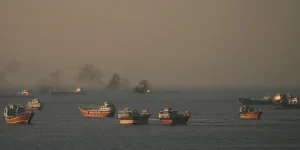
While President Trump claimed “the Strait of Hormuz will be opened” as part of the deal, Iran’s Fars news agency claimed the strait would be placed under Iranian jurisdiction, saying Trump’s statement is “inconsistent with reality.”
Iran’s Tasnim news agency reported that the Iranian regime reaffirms its “sovereignty over the Strait of Hormuz,” claiming the situation in the critical waterway would not return to the pre-war state.
Axios reported that during the 60-day ceasefire extension, the Strait of Hormuz would operate without tolls, while the U.S. would issue sanctions waivers, allowing Iran to sell oil freely. The Iranian military would also begin clearing the mines it had deployed during the conflict.
The Saudi news outlet al-Arabiya published what it claimed was the “final draft,” but which did not mention any of the key U.S. demands, including the dismantling of Iran’s nuclear weapons program, removal of its stockpile of highly enriched uranium, limits on its ballistic missiles, and ending support for terror proxies.
Iranian media are also claiming that the agreement would end Israel’s conflict with Hezbollah in Lebanon. An Iranian official told the NYT that the agreement “would halt fighting on all fronts, including in Lebanon.”
According to reports in Hebrew media, Israeli officials are concerned about the deal, believing it will be bad for Israel, failing to achieve many of the stated U.S. and Israeli goals for the war, while also allowing Iran to weaponize the Strait of Hormuz.
“The emerging agreement is bad because it signals to the Iranians that they have a weapon no less effective than nuclear weapons, and that is the Strait of Hormuz,” a senior Israeli official told Channel 12.
According to public broadcaster Kan News, Prime Minister Benjamin Netanyahu expressed concern over the deal in his phone call with President Trump, particularly over the postponement of the nuclear issue until later, and the inclusion of the Lebanon conflict.
Republican Senator Lindsey Graham (South Carolina) warned that the deal represents “a major shift of the balance of power in the region and over time will be a nightmare for Israel.”
“If a deal is struck to end the Iranian conflict because it is believed that the Strait of Hormuz cannot be protected from Iranian terrorism, and Iran still possesses the capability to destroy major Gulf oil infrastructure, then Iran will be perceived as being a dominant force requiring a diplomatic solution,” Graham wrote on 𝕏, after reports of the deal’s contents were published.
If a deal is struck to end the Iranian conflict because it is believed that the Strait of Hormuz cannot be protected from Iranian terrorism and Iran still possesses the capability to destroy major Gulf oil infrastructure, then Iran will be perceived as being a dominate force…
— Lindsey Graham (@LindseyGrahamSC) May 23, 2026
“I personally am a skeptic of the idea that Iran cannot be denied the ability to terrorize the Strait and the region cannot protect itself against Iranian military capability,” he added.
Republican Senator Roger Wicker (Mississippi) called the deal “a disaster.”
“The rumored 60-day ceasefire – with the belief that Iran will ever engage in good faith – would be a disaster. Everything accomplished by Operation Epic Fury would be for naught!” Wicker posted to 𝕏, using the U.S. name for the war.
In his post to Truth Social, President Trump said he “had a call with Prime Minister Bibi Netanyahu, of Israel, which, likewise, went very well.”
Israeli media claim that Israel is being excluded from the negotiations, despite being a major partner in the war.
You might also like to read this: