









'I'm calling the shots': Israeli strikes in Iran came despite heavy US pressure to avoid response, save peace talks
Trump: 'If Bibi strikes them back, it's just gonna keep going like the last 3,000 years'
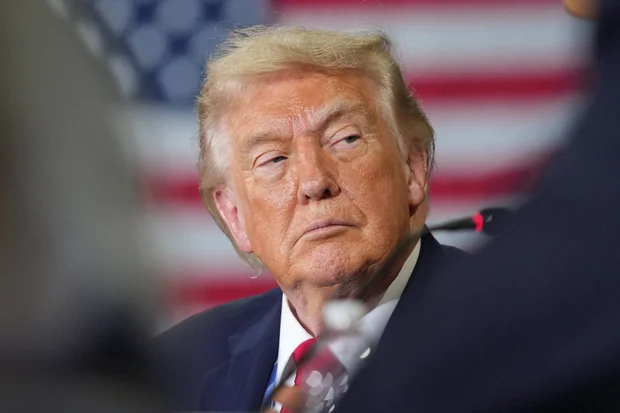
The Israeli military launched retaliatory strikes in Iran after suffering several ballistic missile attacks on Sunday, despite U.S. President Donald Trump telling several news outlets he intended to urge Israel not to strike back in order to preserve ongoing peace talks with the regime.
A U.S. official told the news outlet Axios overnight, “We are not part of this.” However, given the close integration of the U.S. and Israeli militaries in the region in both offensive strike capabilities and air defense, it is unclear whether the United States will be fully uninvolved in any future fighting.
On Monday morning, Iranian Foreign Ministry Spokesman Esmaeil Baghaei blamed the U.S. for the escalation, claiming that Israel does not take independent action. The exchanges of fire would only worsen a “chaotic diplomatic process” and exacerbate Tehran’s suspicion toward Washington, Baghaei warned.
Trump has claimed several times in recent days that a deal with the regime was imminent. In an interview with NBC News’ “Meet the Press” that was published hours before the escalation, he said the sides were “very close” to a deal, while reiterating his estimation that the current Iranian leadership is now “more rational” and “very smart.”
Before the Israeli strikes were launched, Trump told Axios that he would “call Bibi [Netanyahu] right now and tell him not to retaliate. Each of them had their fun. Israel had its strike [in Beirut], and Iran had its strike. We don't need another one.”
“The Iranian strikes didn't hurt anybody,” Trump argued. At the time of publication, all Iranian missiles were either intercepted or had fallen in open areas, with no reports of injuries caused directly by the attacks; however, several Israelis were injured while rushing to shelters.
“If Bibi strikes them back, it's just gonna keep going like the last 47 years – or the last 3,000 years,” Trump said, adding, “We are very close to a final deal with Iran. It is going to be a good deal. I don't want it to blow up because of what is happening now.”
Despite Trump’s comments, which included similar statements with two major Israeli news outlets, Netanyahu ordered IDF airstrikes in Iran overnight, including one on a petrochemical plant.
Army Radio reported that Netanyahu and Defense Minister Israel Katz held consultations with the IDF brass and heads of the security branches throughout the night before deciding to carry out the strikes, despite Trump’s appeals.
“Any fire from Iran will be met with a powerful response. Any fire from Lebanon toward Israel will be met with a strike in Dahiyeh,” officials told the radio station.
On Monday, Trump told the Financial Times that the Iranian missile attacks on Israel would not “have any impact on the deal” with Iran, which Netanyahu wouldn’t “have any choice” but to accept.
“I call the shots. I call all the shots,” the U.S. president stressed. “He (Netanyahu) doesn’t call the shots.”
“The deal may make it on its own merit, or not, but this will not have any effect on it,” Trump said.
The latest escalation began when Hezbollah broke the latest ceasefire agreement between Israel and the Lebanese government by launching two rockets at northern Israel on Sunday morning. In response, the IDF launched a symbolic airstrike on a Hezbollah headquarters in the Beirut suburb of Dahiyeh, the terror group’s main stronghold.
Regime officials in Tehran then claimed that this was a violation of the ceasefire in Iran, with Parliament Speaker Mohammad-Bagher Ghalibaf saying Israel and the U.S. had demonstrated they are “neither committed to a ceasefire nor believe in dialogue.”
Trump later told Fox News that, contrary to reports, he had not been briefed in advance on Israel’s strike in Beirut and said he was angered by the operation.
The Israeli military estimated on Monday morning that exchanges of strikes with Iran would continue for several days, Army Radio reported. The IDF began calling up several reserve battalions, the IDF's Home Front Command’s search-and-rescue units in particular, while reinforcing forces along all borders.
Netanyahu convened another high-level security meeting on Monday morning to discuss Israel’s next steps.
According to Channel 12 News, Finance Minister Bezalel Smotrich was expected to push for reversing what he described as the Iranian “equation” of ballistic missile fire in response to Israeli strikes on Beirut, by advocating for overwhelming Israeli strikes on Hezbollah targets after each missile launch.
Popular article:
interview Easter message of resurrection hope amid war at Jerusalem's Garden Tomb

biblical commentary Let my people go: a Passover message for today
4 IDF soldiers killed, 2 wounded in fighting in southern Lebanon, as Israel eliminates dozens of Hezbollah terrorists
Receive latest news & updates
A message from All Israel News
Help us educate Christians on a daily basis about what is happening in Israel & the Middle East and why it matters.
For as little as $10, you can support ALL ISRAEL NEWS, a non-profit media organization that is supported by readers like you.
Latest articles:
Founding trustee of Oxford’s Islamic studies department believed Muslims should ‘continue the work of Hitler’

'Peaceful dialogue is not a crime:' Petition urges Lebanon to abolish its Israel Boycott Law
Israeli defense companies expand global reach with new deals in Cyprus, Germany and Canada

Netflix’s ‘The Diplomat’ appears to pay tribute to slain Israeli hostage Hersh Goldberg-Polin

IDF kills Hamas terrorists involved in abduction of German-Israeli Shani Louk on Oct 7