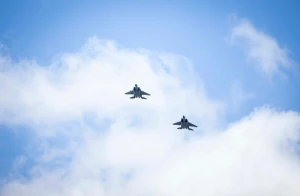
IDF expands F-35 fleet to 48 jets, strengthening Israel’s air dominance in the Middle East



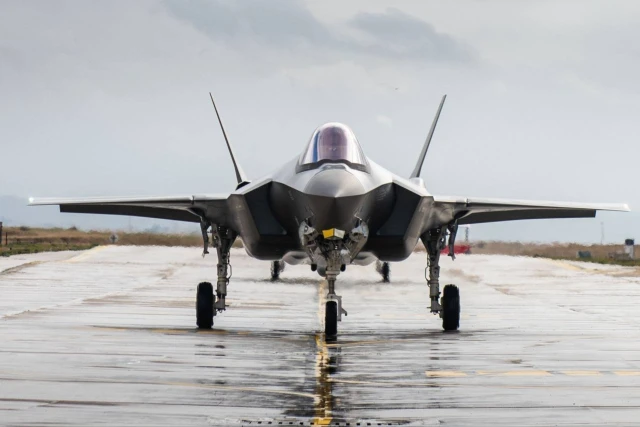
The Israel Defense Forces (IDF) confirmed on Sunday that the Israeli Air Force (IAF) had received three new F-35 fighter jets, which landed at Nevatim Air Force Base in southern Israel. The additional aircraft from the U.S. defense company Lockheed Martin expand the Jewish state’s fifth-generation fleet to 48 jets. With this delivery, the IAF has now received 48 of the 50 F-35 aircraft Israel purchased from the United States. The remaining two jets are scheduled to be delivered later in 2026.
The fighter jets have played an increasingly critical role in maintaining Israel’s aerial superiority across the Middle East. Israel joined the American F-35 program in 2010, and in 2017 its F-35 fighter jets became officially operational. Since then, the IAF has likely acquired more combat experience with the F-35 than any other modern air force in the world.
Unlike older fighter jet models like the F-16 and the F-15, the F-35 jets have stealth capabilities that enable them to evade enemy radar systems. In 2023, Israel’s then Defense Minister Yoav Gallant submitted a formal request to Lockheed Martin and Washington to expand Israel’s F-35 jet fleet from 50 to eventually 75 aircraft.
At the time, Joshua (Shiki) Shani, chief executive of Lockheed Martin Israel, hailed the close cooperation with the IAF.
“The Israeli Air Force has proven its capabilities in critical operation with the 116 and 140 Squadrons, and we are looking forward to building on this strong performance. With a combination of stealth, sensor fusion and electronic warfare, the 5th Generation F-35 will ensure the Israeli Air Force stays ahead of current and evolving threats,” Shani assessed.
Israel’s expanding fleet of F-35 fighter jets played a critical role in Israel’s historic Operation Rising Lion offensive against the Islamic Republic of Iran’s nuclear, military, and missile assets in June 2025. The Israeli stealth fighters enabled the IAF to evade and neutralize the Iranian regime’s radar systems.
The stealth capabilities of the F-35 fighter jets also paved the way for Israel’s older F-15 and F-16 aircraft to participate in the unprecedented aerial offensive against Iran, which involved some 200 Israeli Air Force aircraft.
While the F-35 fighter jets offer advanced stealth capabilities, the fifth-generation aircraft have a more limited payload capacity for carrying missiles and bombs. The Israeli Air Force has therefore paired the expansion of its F-35 fleet with upgrades to other offensive aircraft platforms. In January 2023, Israel requested to purchase 25 advanced F-15EX jets from U.S. defense company Boeing.
In September 2025, the Israeli Air Force signaled that it would consider upgrading its ageing fleet of F-16 Barak fighter jets due to their stellar performance during the military offensive against Iran in June 2025.
Israeli Air Force Commander Maj.-Gen. Tomer Bar admitted that the pilots eventually convinced him that the F-16 fighter jets could reach their targets in Iran.
"You sat, you thought, you calculated, and you called me for a visit, which proved the opposite: 'We can get to Iran without refueling, we can do it at a high rate, non-stop,' that's what you told me,” Bar stated during a ceremony at the Ramat David Airbase. “It was possible with the maturity, professionalism, and experience of the airmen here."
In June 1981, Israel used F-16 fighter jets to bomb and neutralize the Iraqi leader Saddam Hussein’s nuclear reactor Osirak outside Baghdad.
You might also like to read this: