How chess united Jews, Muslims, and Persians in the Middle Ages, Cambridge study reveals



Board games bring people together and conjure up ideas of cozy family time around a table, but one Cambridge historian presents evidence that chess even brought enemies to sit at the same table in the Middle Ages, switching swords for a battle of minds.
Dr. Krisztina Ilko, a historian at the University of Cambridge, has published research highlighting art from the Middle Ages that depicted Jews, Persians, and Muslims engaging in games of chess as intellectual equals.
“Chess was a powerful vehicle for people hailing from widely different places, even civilizations, to interact with each other. It was an intellectual exchange,” she told Ynet News.
Ilko pointed to Medieval artworks that show games of chess defying racial hierarchies of the time, and bringing rivals together.
“Chess was and remains a game of logic, where intellectual prowess matters. Chess operated on a different plane where people could engage with each other as equals, irrespective of their skin color,” said Ilko. “What mattered was ‘who's smarter?’ Who can win? Not who's more powerful or socially superior?'"
Chess in the Middle Ages was considered a form of war without bloodshed. In her research, Ilko proposes that a chessboard could metaphorically encompass the whole world. “Chess was a powerful vehicle for people hailing from widely different places, even civilizations, to interact with each other. It was an intellectual exchange,” she argued.
Ilko presents Persian and Arabic manuscripts that indicate chess contests facilitated cross-racial interaction: “Chess boards immediately had two contrasting colors and the opposing chess pieces were also differentiated through color.” He added, “This allowed medieval people to project ideas of skin color and race onto the game.”
All were equal in the “game of kings,” even in societies that were blighted with prejudice. In chess, it all came down to skill.
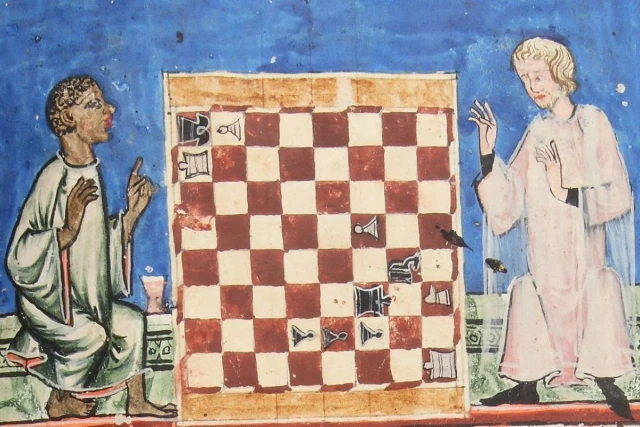
“Dark-skinned players were able to challenge and triumph over the socially dominant personae with lighter skin by demonstrating intellectual prowess,” writes Ilko, whose research explores pictures in a 13th-century manuscript commissioned by King Alfonso X of Castile. In one picture, a white clergyman is playing against a black player who is winning the game. The black chess champion is at ease, enjoying a glass of wine.
The true origins of chess are unclear, but a version of the famous Persian poem (the Shahnama) includes a picture showing how the game was brought from India to Iran.
“The dark skin color of intellectual Indian figures in Persian manuscripts challenged the value systems shared by both Christian and Islamic worlds that privileged whiteness,” Ilko said, describing the positive portrayal of the Indian statesman who is thought to have brought the game to Persia.
In the image, a Muslim is pitched against a Jewish player while a Mongol player rests on a sword, clearly not a threat in the scenario.
The epic poem Shahnama describes how the king of India sent an envoy to Khosrow I, the Sasanian “King of Kings” of Iran, who ruled from 531 to 579, with a challenge to figure out how the game was played or to pay tribute. Needless to say, they figured it out. By the Middle Ages, Muslim chess players also gained a reputation for their mastery of the game.
While Jews, Persians, and Muslims once played the game together and put swords to the side for the duration, more recently, chess tournaments have proven to be more of a battleground. Despite its long history in Iran, chess was banned for ten years after the Islamic Revolution in 1979. Even after its reintroduction in 1990, there have been multiple controversies when playing internationally, with the Iranian Chess Federation penalized for refusing to play Israeli contestants and female players exiled for refusing to wear a hijab during the game.
According to Ilko, medieval chess tournaments provided a place for people to meet in an atmosphere of peace and respect as equals. Time will tell if this historical record will come back to life.
You might also like to read this: