Situation analysis: One thousand days of war


On July 2, 2026, one thousand days have passed since that horrific morning of October 7. A thousand days of war is long enough to stop living solely on emotion and to honestly ask the central question: What has Israel achieved, and at what cost?
The answer is far more complex than many would have hoped. This article is dedicated to reflecting on the first 1,000 days of the war—examining what Israel has achieved, the price it has paid, and the challenges that still lie ahead.
Gaza: Winning the War, But Not Winning the Peace
From a military standpoint, Israel accomplished what seemed impossible just three years ago.
Hamas has effectively ceased to exist as a conventional fighting force. Its key commanders have been eliminated, its battalions destroyed, its command centers dismantled, and much of its underground infrastructure demolished. Today, the Israel Defense Forces (IDF) can enter virtually any part of the Gaza Strip within hours.
Yet this is precisely where the most painful question arises. If the enemy's army has been destroyed, why has the war not ended? Because while the army has been dismantled, the system has not.
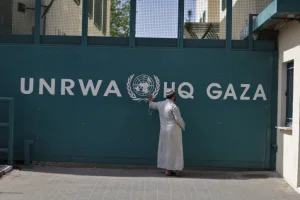
In areas that are not under permanent Israeli control, Hamas continues to govern civilian life. Government officials remain in place, salaries are still being paid, and municipal services continue to function. The organization has lost much of its military strength, but it has not lost its ability to regenerate that strength.
This is why new tunnels continue to be discovered, along with rockets that were manufactured after the war began. It demonstrates that the root of the problem has not yet been fully eliminated.
There is also another wound that has yet to heal.
Hostages gradually returned home. Every release became a national event. Yet the questions have never ceased: Could more people have been brought home sooner? Were political calculations placed above human lives? These questions will continue to resonate throughout Israeli society for many years.
Lebanon: A Rare Story of Genuine Success
If there is one place where Israel truly changed the rules of the game, it was on the northern front.
Hezbollah suffered devastating losses. Thousands of its fighters were killed, a significant number of senior commanders were eliminated, including the man who had symbolized the organization for decades. Residents of northern Israel have begun returning to their homes—and that alone is a tremendous achievement.
But even here, illusions should be avoided.
Hezbollah has been badly wounded, but it has not been destroyed. As long as Iran continues to provide money, weapons, and ideology, the organization retains the ability to rebuild. Not tomorrow. Perhaps not even within a year. But the history of the Middle East has repeatedly shown that such movements know how to wait.
Today, the northern border is experiencing a prolonged pause rather than a lasting peace.
Iran: Destroying Facilities Is Easier Than Destroying a Regime
The most dramatic event of the entire war was the direct confrontation between Israel and Iran.
Until recently, such a scenario seemed almost unimaginable. Everyone understood that the war had been underway for years, but it had been fought through proxies—Hamas, Hezbollah, the Houthis, and various Shiite militias.
That era has now come to an end.
Together with the United States, Israel demonstrated that it is capable of striking targets directly inside the territory of the Islamic Republic. Strategic facilities were hit, military infrastructure suffered significant damage, and members of Iran's senior military leadership were eliminated.
The myth of Iran's untouchability was shattered. Yet the central question remains unanswered. You can destroy a factory. You can destroy a weapons depot. You can eliminate a general. But you cannot eliminate an ideology through a single military operation.
The Islamic Republic survived the assault. It retained its power, its governing system, and its strategic objectives. Moreover, authoritarian regimes often know how to transform external pressure into a tool for internal mobilization.
For that reason, the struggle against Iran is far from over.
The International Arena
If the picture on the battlefield is mixed, the diplomatic front is, frankly, even more troubling.
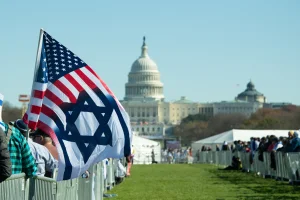
The wave of international sympathy that followed the events of October 7, 2023, has long since evaporated. In the United States, anti-Israel sentiment is rising across both the political left and the right. According to recent polling, roughly 60 percent of American voters now view Israel unfavorably, with the sharpest decline in support among younger Americans.
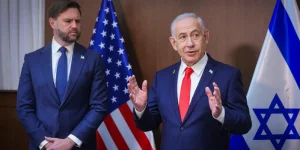
Public tensions between Washington and Jerusalem have become increasingly visible. In an unusually blunt public rebuke, U.S. Vice President JD Vance warned members of the Israeli government: "If I was in the cabinet of the Israeli government, I might not be attacking the only powerful ally that I have anywhere left in the entire world." The remark underscored the growing strains within what remains Israel's most important strategic partnership.
Europe has moved even further away. Sanctions are being discussed, some Israeli ministers have already been barred from entering certain countries, and proposals to suspend the EU–Israel Association Agreement are being restrained largely by Germany and Italy—and even that comes with no guarantee that their position will remain unchanged.
The Arab world's policy toward Israel has become increasingly pragmatic, but not necessarily more accommodating. While countries that signed the Abraham Accords have largely preserved their diplomatic and security ties with Israel, they have deliberately lowered their public profile since the outbreak of the war. At the same time, Saudi Arabia has made clear that any meaningful normalization will require credible progress on the Palestinian issue. Across the region, governments continue to view Iran as a strategic threat and quietly maintain channels of security cooperation with Israel, yet domestic public opinion and the humanitarian consequences of the Gaza war have made open political engagement increasingly difficult. As a result, regional cooperation has not disappeared—but it has become significantly less visible and far more cautious.
The one encouraging development has come from Latin America, where several governments have strengthened their support for Israel. Yet, with all due respect, this "blue-and-white wave" is not capable of replacing the diplomatic ground Israel has lost in Europe and across the world.
The Overall Outcome
Over the course of one thousand days, Israel proved one simple truth to the entire region.
After October 7, the country did not surrender. It rose, mobilized, and delivered the most devastating blow to its enemies in decades.
At the same time, however, the war revealed another, far less comfortable truth. Military victories do not always translate into political ones. It is possible to destroy terrorist infrastructure, but it is far more difficult to eliminate the ideas that produce new terrorists. It is possible to win battles while continuing to live in a state of war.
That is why, after one thousand days, it is more accurate to speak not about the end of the war, but about the conclusion of its first phase. Israel has changed the Middle East. But can it change it enough for future generations to live without another war?
In the book of Daniel, we have a great revelation about the Lord.
It is He who changes the times and the periods; He removes kings and appoints kings… He knows what is in the darkness, and the light dwells with Him. (Daniel 2:21, 22)
This is the God of the Bible—the sovereign Lord who rules over history, raises up kings, removes rulers, and accomplishes His purposes through every generation.
And you and I have been called to know Him, to trust Him, and to stand before Him in prayer for Israel during this profound season of human history. As the nations are being shaken and history unfolds before our eyes, our confidence rests not in political leaders or military strength, but in the God who reigns over all and whose purposes will surely stand.
You might also like to read this: