As Hezbollah attacks continue, Israel requests US approval for Beirut strikes
European leaders express ‘serious concern’ after Israel advances further into southern Lebanon





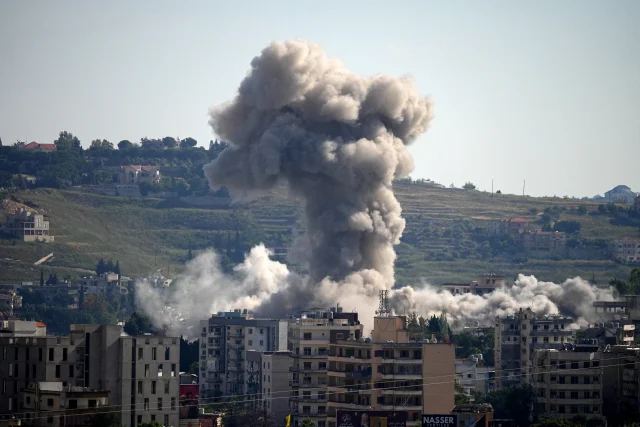
Washington's attempts to de-escalate hostilities in Lebanon have not proven successful, as Hezbollah continues to launch rocket and drone attacks on Israeli soldiers and civilians.
A U.S. official told Reuters on Sunday that U.S. Secretary of State Marco Rubio had held conversations with Prime Minister Benjamin Netanyahu and Lebanese President Joseph Aoun, presenting a plan that “would create space for gradual de-escalation and an effective cessation of hostilities.”
According to Reuters, President Aoun was willing to move forward with the U.S. proposal, however, Lebanese Parliament Speaker Nabih Berri, who previously claimed he could “guarantee” Hezbollah’s commitment to a ceasefire, demanded that Israel cease military strikes first.
This position contrasts with that of the U.S., which has demanded that Hezbollah halt its attacks first.
A U.S. official told media outlets, “Berri’s response was evasive and disappointing,” and claimed that the current round of hostilities was initiated by Hezbollah when it joined the war at Iran’s behest on March 2.
“Hezbollah is following Tehran’s lead. It clearly has no interest in the welfare of the Lebanese people,” the official said. “Iran wants to prolong the conflict in Lebanon so it can claim credit for ‘saving the day.’”
The official said that Washington “does not expect Israel to absorb ongoing attacks on its civilians by a terrorist organization.”
“The fastest way to de-escalate and protect civilians on all sides is for Hezbollah to stop firing immediately,” he added, while indicating that Israel would only agree to refrain from striking Beirut in exchange for Hezbollah de-escalating.
Since the announcement of the U.S.-Iran ceasefire, Israel has avoided carrying out strikes in Beirut in an effort not to undermine ongoing diplomatic efforts.
On Sunday evening, Prime Minister Netanyahu held a high-level security meeting as his government was preparing to seek U.S. approval for strikes on Hezbollah targets in Beirut.
“The Americans are showing greater openness, but there is still no final approval – at least for now,” an Israeli official told Channel 12 News.
Lebanese newspaper Al-Ahbar reported that Iran is unwilling to sign an agreement with the United States until Israel withdraws its troops from Lebanon. Meanwhile, U.S. President Donald Trump appears unwilling to ask Israel to stop fighting while drones and rockets continue to target civilian areas daily.
Israel has offered to begin withdrawing to its security perimeter in exchange for the Lebanese army taking steps to disarm Hezbollah, according to a Kan News report published on Sunday evening.
Another round of indirect talks between Israel and Lebanon is expected this week. If those talks do not produce results, the U.S. could approve Israeli strikes on Beirut, i24 News reported.
Meanwhile, Israel’s capture of the Beaufort Castle over the weekend, and Netanyahu’s instruction to the IDF to take more territory in southern Lebanon, was met with concern from European leaders.
France requested an emergency meeting of the UN Security Council on Sunday evening after news of the capture broke.
French President Emmanuel Macron also wrote in a social media post: “Nothing justifies the major escalation currently underway in southern Lebanon. France will continue its support for the Lebanese authorities in their efforts to restore state sovereignty and the country's territorial integrity.”
At the same time, British Foreign Secretary Yvette Cooper had harsher words for Israel than for the Hezbollah forces that started the latest round of hostilities.
“Israel's military escalation in Lebanon has killed and displaced civilians, destroyed infrastructure, and eroded space for diplomacy. It must end,” Cooper posted on social media.
“Hizballah must end attacks on Israel and disarm,” she added, without mentioning Hezbollah attacks on civilian targets across northern Israel.
Additionally, German Foreign Minister Johann Wadephul said Israeli advancement in Lebanon is cause for “serious concern.”
“The Israeli army’s advance further into southern Lebanon is cause for serious concern,” he stated. “Any further escalation will exacerbate the already tense situation and trigger new waves of displacement within Lebanon.”
Meanwhile, the Hezbollah drone and rocket attacks on Israeli soldiers and civilians continue.
Four soldiers were lightly injured in a drone attack on a military position near the northern border community of Beit Hillel on Sunday evening.
Overnight, Hezbollah launched several rocket barrages at northern Israeli communities, including Kiryat Shmona on the Lebanese border, and Tiberias, on the shores of the Sea of Galilee.
On Monday morning, the Israeli military announced the death of another soldier in a Hezbollah drone attack. IDF Staff-Sgt. Adam Tzarfati from Rosh HaAyin was killed in southern Lebanon on Sunday. One other soldier was seriously injured, and two were lightly wounded in the same incident.
You might also like to read this: