Veteran Israeli mariner warns global trade threatened by Iran's attempts to 'extort payments'



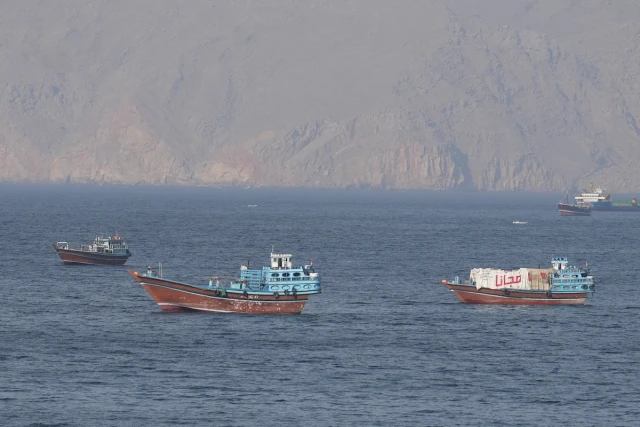
Veteran Israeli mariner Capt. Haim Shaham has warned that global maritime trade is under threat from the Iranian regime, which he says is “trying to extort payments” from vessels passing through the strategically vital Strait of Hormuz, where roughly one-fifth of the world’s oil supply transits. He addressed the current crisis by drawing on his own past experience in the waterway.
“These are international waters, and we used to sail there without any problems,” Shaham recalled. “We would load crude oil and transport it, and no one tried to stop us.”
“If one country starts claiming control over a passage and demanding payment, others may follow,” he warned, stressing that the Iranian regime’s conduct in the Strait of Hormuz could potentially set a dangerous global precedent that could threaten maritime trade.
He contrasted international waterways like the Strait of Hormuz with sovereign-controlled routes that legitimately charge tolls, such as the Suez and Panama canals.
“A strait is different,” Shaham argued. “It’s international. Ships pass through places like Gibraltar without paying anyone. Now the Iranians are trying to extract payments, but it’s unclear on what basis. They don’t provide services or actually control the strait. Under maritime law, you don’t need permission to pass,” he explained.
There appear to be internal divisions within the Iranian regime regarding the Strait of Hormuz. After a ceasefire in Lebanon came into effect on Thursday, Iranian Foreign Minister Abbas Araghchi wrote on social media that “in line with the ceasefire in Lebanon, the passage for all commercial vessels through Strait of Hormuz is declared completely open for the remaining period of ceasefire, on the coordinated route as already announced by Ports and Maritime Organisation of the Islamic Rep. of Iran.”
However, Araghchi’s statement was contradicted by the hawkish Islamic Revolutionary Guard Corps (IRGC), which reportedly reimposed the blockade on the waterway on Saturday by attacking at least two commercial vessels. Tehran subsequently announced it would prioritize vessels willing to pay the demanded fee.
Shaham warned that if Tehran succeeds in extracting payments from ships transiting the strait, it could embolden other regimes and organizations to disrupt global trade by asserting control over key chokepoints. For example, the Iran-backed Houthis in Yemen have already threatened to control the strategic Bab el-Mandeb Strait in the Red Sea.
“This is exactly why the move must not be allowed,” Shaham said. “Iran has economic problems, but global shipping should not pay the price.”
Looking ahead, he believes the United States should protect freedom of navigation worldwide.
“In my view, the United States is the world’s policeman, and this is exactly its role, to show Iran that Hormuz does not belong to them,” Shaham argued, acknowledging the challenges.
“Sailors are used to being at sea, but when you don’t know what you’re heading into, it creates psychological pressure. I’ve sailed during periods like the Yom Kippur War, and the crew becomes uneasy. Discipline can slip, and it’s harder to maintain normal operations,” he said.
In addition, commercial vessels currently face a serious security risk following reports that the Iranian navy has placed mines in the Strait of Hormuz.
“A Chinese tanker passed through recently, and its crew must have been under real tension, not knowing whether they might hit a mine,” Shaham concluded.
You might also like to read this: