Ukraine's reinterment of alleged Nazi collaborator draws strong Israeli criticism, sparks new tensions
Yad Vashem ‘deeply troubled’ over reburial, calls for respect for Holocaust victims



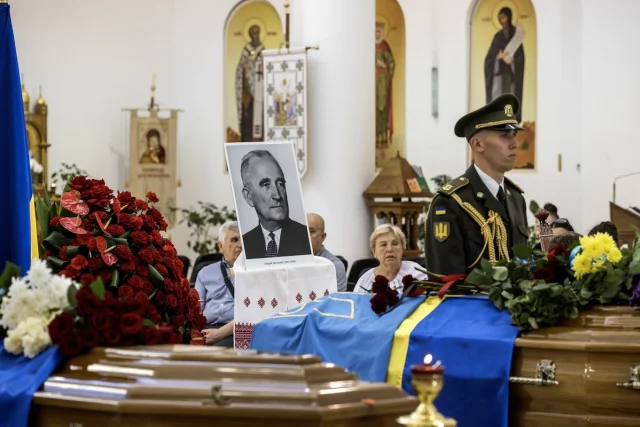
Amid ongoing diplomatic tensions between Ukraine and Israel in recent months, a state ceremony honoring a World War II era Nazi collaborator in Ukraine has drawn strong condemnations from Israel on Monday, heightening tensions even further.
Ukrainian President Volodymyr Zelenskyy presided over a ceremony marking the reinterment of the remains of a Ukrainian nationalist leader associated with an organization that collaborated with Nazi Germany during World War II, fighting the Soviets in a bid for Ukrainian independence.
The remains had been transferred from Luxembourg ahead of the ceremony. The event included full military honors, along with a commemorative address by Zelenskyy, who referred to Andriy Melnyk and his wife, Sofia Fedak-Melnyk, as “iconic Ukrainians of the 20th century who are deeply respected,” according to the New York Times.
Zelenskyy also posted on 𝕏, writing, “Glory to every Ukrainian hero! Glory to all our Ukrainian warriors! Glory to our people!” He added that he is “grateful to everyone who has worked to make such returns of great Ukrainian figures possible and to give the Ukrainian People their own pantheon of heroes.”
The ceremony took place amid ongoing debate over Ukraine’s approach to historical memory and national identity, particularly during its war with Russia. Supporters of such commemorations say they are part of efforts to strengthen national identity, while critics argue they serve to whitewash the darkest chapters of Ukrainian history.
The Israeli Foreign Ministry said Israel regrets "the decision to hold an official state reburial ceremony for the OUN [Organisation of Ukrainian Nationalists] leader Andriy Melnyk, who collaborated with the Nazis. There is no place for ignoring historical truth and the memory of the victims murdered by the Nazis and their collaborators."
Israel’s Yad Vashem Holocaust Memorial said in a post on 𝕏 that it was “deeply troubled by such national commemorations, which come at the expense of historical truth and the memory of Holocaust victims.”
“Honoring the leader of a movement that supported and collaborated with Nazi Germany during the persecution and murder of millions of Jews undermines the moral integrity essential to Holocaust remembrance,” the statement read.
The Organisation of Ukrainian Nationalists, the group led by Melnyk, has been criticized for its ideology that showed affinities to fascism, and because of the antisemitism of many of its members.
The OUN later splintered into a more moderate group led by Melnyk, and a radical group led by Stepan Bandera, another Ukrainian nationalist hero who received official glorification in recent years, despite being responsible for the killing of tens of thousands of Jews in pogroms during the Russian Revolution.
Andriy Melnyk participated in many of the most turbulent events of the first half of the 20th century, beginning with his service in a Ukrainian unit of the Austro-Hungarian army in World War I. During battles on the Eastern Front, he was captured by the Russian Imperial Army and later escaped to join the army of the nascent Ukrainian People’s Republic during an abortive attempt to establish an independent Ukrainian state.
Melnyk continued working toward this goal in various roles after the war ended and Ukraine was absorbed into the Soviet Union. As World War II approached, he took command of an armed Ukrainian partisan group that collaborated with Nazi Germany against the Soviet Union during the war. From early 1941 to late 1943, he was based in Berlin, where he coordinated activities of partisan groups operating alongside the German Army on the Eastern Front, while also lobbying the Nazi government to recognize an independent Ukrainian state.
During this time, members of Melnyk's group were involved in anti-Jewish pogroms and collaborated with the Nazi regime for large parts of the war, including in the round-up of Jews as part of the Holocaust.
However, in late 1943, Melnyk began to see that the USSR would defeat Nazi Germany and he attempted to leave Berlin. He was captured by the Gestapo and sent to the Sachsenhausen concentration camp, 22 miles north of Berlin, where he was held for several months. He was later brought back to Berlin in an attempt by the Nazis to pressure him into resuming his role coordinating activities between Ukrainian partisan groups and the retreating German army.
In early 1945, Melnyk and some of his aides, along with Sofia and her mother, managed to leave Berlin and move west to surrender to the advancing American forces.
After the war, Melnyk continued to lead Ukrainian diaspora communities until he died in 1964. He was buried in Luxembourg by his wife, who had long served as his secretary. In 1990, she died and was buried next to her husband.
Last week, their remains were removed from the cemetery and transferred to Ukraine for reburial.
You might also like to read this: