









'This is not a swipe at Israel': Why Congressman Marlin Stutzman wants to end US aid
For years, suggesting that America should stop sending military aid to Israel was the kind of idea that would get you laughed out of most Republican meetings. It was never seriously considered.
Not anymore.
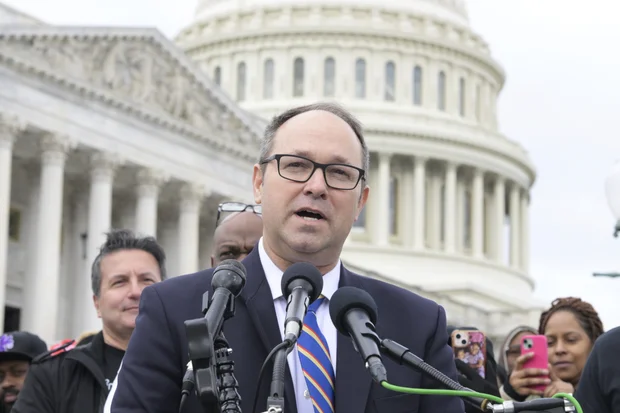
I recently spoke with Indiana Congressman Marlin Stutzman, who’s pushing a proposal that is making waves on Capitol Hill. Not because it’s anti-Israel. Quite the opposite. His argument is actually that Israel has become so successful that it no longer needs America’s financial help. More on what he told me in a moment.
Israel currently receives billions of dollars in military assistance from the United States under a long-standing agreement between the two countries. Congressman Stutzman recently introduced a resolution that would begin moving the U.S.-Israel relationship away from direct aid and toward something much different: deeper trade ties and stronger defense cooperation. Basically, a more formal strategic partnership.
Israeli Prime Minister Benjamin Netanyahu actually agrees. In a recent interview, he addressed America’s aid to Israel bluntly, saying there’s no time like the present to begin the financial cuts. “I want it to start now, I want it to start in the last two years of the Trump administration and I want it to keep going down, coming to zero.”
When I asked Congressman Stutzman about his proposal, he framed it as a sign of Israel’s success. “Let’s applaud Prime Minister Netanyahu by saying we don’t need the money and so we can stand on our own two feet,” Stutzman tells me. “Let’s have a defense agreement, let’s have trade agreements and he said, in the long run, our countries will be even stronger together.”
“I think it’s a great effort by both countries to say we can save money, but go together and formalize our unique relationship even stronger.”
That’s the key point here. Stutzman isn’t trying to weaken Israel. He believes Israel has reached a point where it can stand more independently.
“This is not a swipe at Israel at all. When your best friend says, 'Hey, you know what? I don’t need your $100 a week anymore.' That’s a true friend because he says, 'I’ve got a job. I’ve got the ability to support myself, and that’s what Israel is telling us.”
For decades, support for military aid to Israel has been one of the most enduring bipartisan issues in Washington. Republicans supported it. Democrats supported it. Pro-Israel organizations supported it. Most lawmakers didn’t even question it. Now the conversation is clearly changing.
The reason has less to do with Israel and more to do with America. The rise of populism and the 'America First' movement has created a new political environment where every dollar of foreign aid gets scrutinized. Ukraine, foreign assistance programs, international organizations and yes, even Israel. It’s all on the table.
Many younger conservatives simply do not like the idea of sending billions overseas when they feel squeezed at home. Stutzman acknowledges that reality.
“I think it may help with some of our young fiscal conservatives in the Republican Party, because there’s some out there that just don’t like the foreign aid when they can’t buy a house, when their cost of living has gone up. They’re just frustrated with foreign aid period.”
Stutzman also believes reducing aid could weaken one of the talking points often used by Israel’s critics.
“I think it does take away some of the arguments to some people that say Israel is dependent on the United States.”
Maybe. But that’s where I become more skeptical.
One theory behind this proposal is that if America and Israel are less financially tied together, some of the anti-Israel criticism inside the United States might cool down.
I’m not convinced.
The reality is that many of Israel’s loudest critics aren’t upset because of the dollar amount America sends to Israel. They’re upset because Israel exists, because of Israeli policies, or because they fundamentally disagree with the U.S.-Israel alliance.
Take away the aid and they’ll simply find another reason to criticize Israel. Stutzman himself recognizes that reality.
“If you’re a budget hawk, you’ll like this, because it reduces spending. If you’re pro-Israel, you’ll like this because Israel is growing and standing on their own two feet. If you’re antisemitic, you’ll find some sort of conspiracy theory behind it to oppose it.”
Not everyone on Capitol Hill is ready to jump on board.
Congressman John Rose of Tennessee told me he believes the proposal is getting ahead of itself.
“I think it’s premature, with all due respect to Congressman Stutzman….we can’t ignore the fact that Israel is our most important ally in the Middle East. We need them to be successful in the region.”
Rose says American support remains essential.
“Our support is critical for them not only for their security, but the security of democracy as a foothold that they provide in the Middle East.”
And while he can envision a future where Israel no longer needs assistance, he doesn’t believe we’re there yet.
“I think there may be a time that Israel can be self-sufficient and (don't need) the magnitude of aid that we’ve been giving them in the past, but I don’t think that time has arrived yet.”
Popular article:

interview Easter message of resurrection hope amid war at Jerusalem's Garden Tomb

biblical commentary Let my people go: a Passover message for today

4 IDF soldiers killed, 2 wounded in fighting in southern Lebanon, as Israel eliminates dozens of Hezbollah terrorists
Receive latest news & updates
A message from All Israel News
Help us educate Christians on a daily basis about what is happening in Israel & the Middle East and why it matters.
For as little as $10, you can support ALL ISRAEL NEWS, a non-profit media organization that is supported by readers like you.
Latest articles:

Thailand turns to Israeli anti-drone technology to counter growing battlefield threat

Israeli fighter jets flew to Iranian border in ‘power projection,’ deterrence exercise ahead of elections next week

Israel targets nuclear fusion leadership as AI drives soaring energy demand

Israel's Sheba Medical Center climbs to 6th in global smart-hospital rankings

Israeli intel chief Zini travels to France to give counterterrorism advice amid violent riots – report