








Roaring Lion Iranian missile launches decline by 90% as Israeli & US Air Force step up strikes on launchers, depots & underground bases
US uses heavy bombers to destroy buried underground missile sites
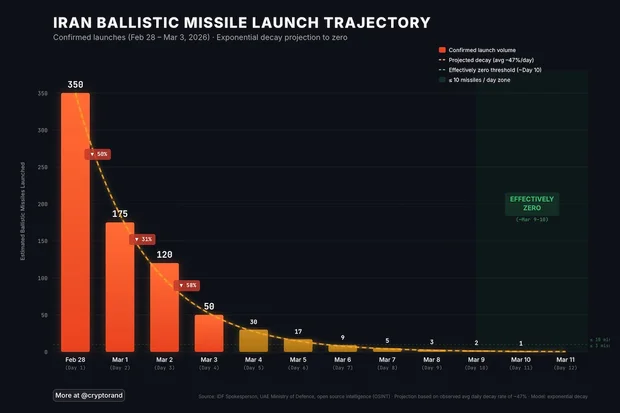
The number of missiles launched by the Iranian regime has dropped by 90% since the first day of fighting, according to the chief of United States Central Command (CENTCOM), as U.S. and Israeli fighter jets have established near-complete aerial superiority over the country.
In a briefing on Thursday, CENTCOM Chief Adm. Brad Cooper said ballistic missile attacks had fallen by 90%, while drone attacks had dropped by 83%.
Meanwhile, IDF Chief of Staff Lt. Gen. Eyal Zamir said that 60% of the regime’s missile launchers had been destroyed so far.
.@CENTCOM Commander Admiral Brad Cooper: "If I just look back over the last 24 hours of the operation compared to the where we were to start, ballistic missile attacks have decreased by 90%... Drone attacks have decreased by 83%... we’re now up over 30 ships [destroyed]." pic.twitter.com/tWKgheNfKv
— Rapid Response 47 (@RapidResponse47) March 5, 2026
“This is a very significant achievement that reduces harm to the home front and saves many lives. However, this is an ongoing effort, and I emphasize that the threat has not yet been removed – every missile is lethal and poses a danger.”
The Air Force has conducted some 2,500 sorties and dropped over 6,000 munitions so far, Zamir added.
⭕️Overnight Activity:
— Israel Defense Forces (@IDF) March 5, 2026
IAF aircraft struck and dismantled an armed ballistic missile launcher in the area of Qom that was ready to fire at Israel.
An Iranian aerial defense system was also struck in Isfahan.
❗️Prior to the strikes, the IDF took multiple measures to mitigate the… pic.twitter.com/Wdm5MbW95n
The daily number of missile launches and the missiles per attack by the Iranian forces have dropped consistently since the start of the war.
Overall, around 200 missiles were fired at Israel since last Saturday, Ynet News reported, noting that this was 80% lower than estimated, as the Israeli security system had prepared for the regime to launch around 150 missiles per day.
American airpower remains unmatched. The B-52 Stratofortress has been utilized in every major conflict since 1965. During the first 100 hours of Operation Epic Fury, B-52s struck Iranian ballistic missile and command and control posts. pic.twitter.com/zhSqgA4m37
— U.S. Central Command (@CENTCOM) March 5, 2026
According to statistics compiled by Israel's Alma Research Center, the first day of fighting saw 25 missile barrages launched, with an additional 64 barrages on the second day, though each contained fewer missiles.
On the third day, the regime launched 25 barrages on the fourth, only nine, on the fifth day, 11, while Thursday saw nine waves of attacks. The think tank has registered 143 waves of missile attacks on Israel overall.
.@CENTCOM Commander Adm. Brad Cooper: "In just the last 72 hours, America's bomber force has struck nearly 200 targets deep inside of Iran... In just the last hour, U.S. B-2 bombers dropped dozen of 2,000lb Penetrator bombs targeting deeply buried ballistic missile launchers." pic.twitter.com/GwsoQ37gJi
— Rapid Response 47 (@RapidResponse47) March 5, 2026
Both Zamir and Cooper noted that both U.S. and Israeli forces are now entering a new phase of fighting after establishing aerial superiority in Iran and taking out most of its air defenses.
The United States has already confirmed the use of every one of its three types of strategic bombers, including the stealth B-2 Spirit, the B-1 Lancer, and the B-52 Stratofortress.
The B-2 is allegedly the only plane capable of delivering the GBU-57 series MOP bunker buster bomb, while the other two bombers can carry a massive payload of up to 70,000 lbs (32,000 kgs).
Last night, U.S. B-1 bombers, struck deep inside Iran to degrade Iranian ballistic missile capabilities. As the President stated, "we're going to destroy their missiles and raze their missile industry to the ground." pic.twitter.com/tIkIo5ugWv
— U.S. Central Command (@CENTCOM) March 2, 2026
Cooper said on Thursday that the B-2s had dropped dozens of 2000-lb penetrator bombs targeting deeply buried, underground ballistic missile sites, adding that production facilities would also be targeted. This is expected to further degrade the regime’s ability to launch missile attacks.
The Israeli Air Force doesn’t have heavy bombers comparable to the U.S. in their ability to deliver the heavy payloads necessary to penetrate the missile and nuclear sites, which the regime has often buried deep under mountains.
On Thursday, Iran attacked Israel with eight missile barrages, though they were all either intercepted or had fallen in open areas. There were no reports of serious injuries or significant damage caused by the strikes. Since Saturday (28 Feb.), 19 Israelis have been killed by missile fire.
Alma reported nine attacks registered in the period from Wednesday evening to Thursday evening, of which five targeted the Tel Aviv area, and two each targeted the regions of Jerusalem and Beersheva.
Details on four of Iran's largest ballistic missile bases hit by US-IDF airstrikes updated in the last 48 hours of Operation Roaring Lion (Analysis according to imagery by Sentinel-2 and Airbus
— Israel-Alma (@Israel_Alma_org) March 5, 2026
– Visual aids are with pre-war imagery)
1. Hajiabad - In Hormozgan province, this… pic.twitter.com/PdgaeG1Y9i
It also noted that 2,800 Israelis have been forced to leave their homes due to damage from missile strikes and interceptor debris.
The Iranian regime has continued attacking the Gulf countries, particularly the United Arab Emirates, which has been targeted even more heavily than Israel. In total, roughly 300 missiles have been fired across the region – most at Gulf states far closer to Iran than Israel.
The UAE reported seven missiles were fired at its territory on Thursday.
Meanwhile, Iran-affiliated media said it has launched more than 500 missiles and 2,000 drones since the fighting began, noting that 40% of the attacks targeted Israel and the other 60% targeted American sites in the region.
Most of the U.S. bases are in the Gulf countries, though the attacks have often targeted civilian sites, including hotels and key economic installations like ports and energy facilities.
Popular article:

interview Easter message of resurrection hope amid war at Jerusalem's Garden Tomb

biblical commentary Let my people go: a Passover message for today
4 IDF soldiers killed, 2 wounded in fighting in southern Lebanon, as Israel eliminates dozens of Hezbollah terrorists
Receive latest news & updates
A message from All Israel News
Help us educate Christians on a daily basis about what is happening in Israel & the Middle East and why it matters.
For as little as $10, you can support ALL ISRAEL NEWS, a non-profit media organization that is supported by readers like you.
Latest articles:

Roaring Lion Israeli intel chief Zini travels to France to give counterterrorism advice amid violent riots – report

Roaring Lion Founding trustee of Oxford’s Islamic studies department believed Muslims should ‘continue the work of Hitler’

Roaring Lion 'Peaceful dialogue is not a crime:' Petition urges Lebanon to abolish its Israel Boycott Law

Roaring Lion Israeli defense companies expand global reach with new deals in Cyprus, Germany and Canada

Roaring Lion Netflix’s ‘The Diplomat’ appears to pay tribute to slain Israeli hostage Hersh Goldberg-Polin