Where David fought Goliath - Exploring Israel’s Elah Valley




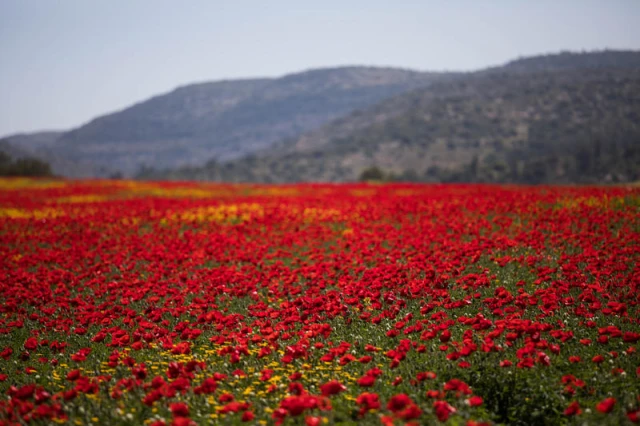
Climbing to the top of Tel Azaka, with the Elah valley spread out below, it is easy even today to imagine the dramatic story taking place. It is the location where a brave shepherd boy named David, who would later become the king of Israel, fought Goliath, the Philistine giant from Gath.
The Elah valley is just south of Beit Shemesh, between Jerusalem and Gaza, in the “Shephelah” or lowlands, but it is home to a high point in Israel’s history. It is one of five valleys found in the coastal plain and the foothills of Jerusalem, stretching from the east of Gath towards Bethlehem.
Tour guide Levi Simon paints the picture with ALL ISRAEL NEWS correspondent, Oriel Moran as they stand on top of the Iron Age tel and survey the Elah valley below. The word Elah means oak, or terebinth tree, often employed in the Bible as a symbol of God’s everlasting faithfulness.
“There's a big valley in front of me, which acts as a geographical borderline between the Philistines and the Judeans. We're on the Judean side,” Simon explains, setting the scene.
Goliath had been standing there in the valley, threatening the Israelites, daring them to fight him, and insulting their God. This took place around 3,200 years ago.
“So David comes and he sees this scenario,” Simon relays. “He asks if he can take the battle. King Saul then gives him his own armor and his own sword and his own helmet, and he says, 'May God be with you.'"
Moran continues, “Let's imagine this together. Let's just say you and I are David. You've been sent to give food to your siblings and you find that for 40 days and 40 nights this Philistine has come to this valley over here and he's intimidating your people, your brothers and sisters,” she says, recounting the biblical story.
“David… was a warrior in his spirit. And to see Goliath speaking against the God of Israel, there had to be something within him… like a fire that came out of him and said, no more! We're not going to do this anymore. Who is he to defy the God, the army of Israel? And so instead of caving in to that fear like the rest, he basically said, I know we can win this.”
Moran recalls that David had experienced what God can do from his life as a shepherd. “He would spend time with God. God would teach him who he is. And he taught him through the attack of the bear and the lion on his sheep. And he realized it's no different. If I've overcome the bear and the lion, I can do that with Goliath too. And his strength, his bravery was what allowed other people to sort of follow suit. Because the moment that they saw Goliath [brought] down, they went after him as well.”
Knowing that failure to defeat the Philistine army would lead to their inevitable enslavement, the Israelites knew they had nothing to lose. “All the Israelites raced down into the valley and they flushed out the Philistines and chased them out of the land of Judea back to their cities of Gath, Ashkelon, Ashdod, Ekron, and finally, one of their major cities was Gaza,” relays Simon, listing the famous five Philistine cities.
“You could just imagine the sense of freedom once we have conquered… and pushed the enemy on our front doorstep. Right beneath me here, we could see some of the ruins from the city of Azaka, during the period of time of that story,” Simon elaborates, pointing to some of the archaeological remains of the Israelite town. “These vertical and horizontal stones, just over here… we can see that circular stone possibly used for food or to collect water,” he adds.
“People knew where to find water. They had experts, obviously, in the field, but it was general knowledge.” Using the visual aids and models set up in the National Park for the benefit of visitors, Simon talks through the different geographical layers of the earth at Tel Azakah. “So the upper layer of most of the ground, 70% of Israel is limestone. Underneath we have dolomite. Underneath that, we have more limestone. Then we have something called... marl. The level where the limestone hits the marl, that's where the water then slowly comes out,” he says, emphasizing the importance of a reliable water source.
Simon also demonstrated how the topography was key in helping the Israelites defend their cities from the five Philistine enclaves. “If we're looking at our viewpoint down towards the west over there, we have the sea, we have Ashkelon, Ashdod, and Gaza, the three Philistine cities, and they were trying to make their way up toward the mountains,” he explained.
“You have beautiful basins of valleys here for great agriculture. So this was ... sought after land during that period of time. And this was where we are right now, it was essential for the security line because if they made it past here, then they can start marching their way towards Jerusalem. But if we controlled all of the hilltops and the foothills, then we controlled the entranceways to the important Judean cities like Lachish and Jerusalem.”
Many visitors to the site search for stones similar to those thrown by David, but Simon and Moran found something else surprising.
“Asparagus! Really? I've found asparagus! Amazing!” After saying the traditional Jewish blessing, Simon and Moran munched on stalks of wild asparagus growing naturally in the Elah valley. “Baruch ata Adonai Eloheinu, Melech ha Olam, boreh pri-adama” which means, “Blessed are you O Lord our God, King of the Universe, who creates the fruit of the earth.”
The Israelites of old lived in the land and ate its fruit, thanked their God for his miracles, and now 3,700 years later, they are doing the same thing.
Now, instead of defeating giants with stones, Moran explains her habit of throwing stones as a way of expressing her prayers, and as a way of releasing her fears, and frustrations. “Every time I throw them, I'm overcoming and conquering something with God. And you can do it too.”
The God of Israel still does miracles today.
You might also like to read this: