In first, IDF sinks Iranian missile ships in Caspian Sea, continues to strike hundreds of IRGC & Basij targets
Strikes destroy missile ships containing air defense systems and anti-submarine missiles




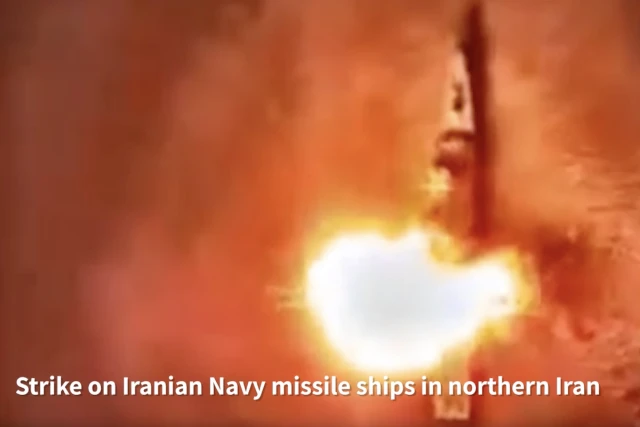
The Israeli Air Force (IAF) for the first time hit Iranian naval targets in the Caspian Sea on Wednesday, striking infrastructure and ships at the port of Bandar Anzali in northern Iran, at a distance of some 1,300 kilometers (over 800 miles) from Israel.
In addition, the IAF continued striking targets belonging to the Iranian regime’s Islamic Revolutionary Guard Corps (IRGC), the Basij militia, and the Air Force, among others.
The Israeli military confirmed on Thursday that the strikes in Bandar Anzali hit several ships, a repair facility, as well as a headquarters controlling naval operations in the Caspian Sea.
BREAKING: The IDF has released videos showing the destruction of the IRIS Jamaran (78) frigate of the Iranian Navy at Anzali Port (Pahlavi) on the Caspian Sea in northern Iran last night. In addition to this vessel, a number of other ships were also targeted and destroyed.
— Babak Taghvaee - The Crisis Watch (@BabakTaghvaee1) March 19, 2026
The… pic.twitter.com/KRsCNE4Ugf
The IDF said the operation that is “considered one of the most significant strikes carried out by the IDF since the start of Operation Roaring Lion” was conducted “in close cooperation between Air Force and Navy commanders.”
This was the first operation of the Israeli military in northern Iran. It destroyed missile ships containing air defense systems and anti-submarine missiles, as well as support vessels, and patrol boats. “The Iranian Navy used the targeted port to conduct operational activity, which has now been disrupted following the strike on the port and the vessels near it,” the IDF noted.
On March 18, the IDF carried out an airstrike against the Bandar Anzali area on the Caspian Sea coast, northwest of the city of Rasht. Among other things, several ships (of the Iranian Army Navy) were hit. There is another site in the area that, to our understanding, has not yet… pic.twitter.com/5FEL6tjvN8
— Israel-Alma (@Israel_Alma_org) March 19, 2026
The port is a key node in the smuggling corridor between Iran and Russia, and the regime has used Bandar Anzali to transport weapons to Russia via the port of Astrakhan.
After last year’s 12-Day War, the Iranian IRGC Navy held a joint military exercise with the Russian Navy in the Caspian Sea.
The Caspian Sea also connects Iran to Kazakhstan, Azerbaijan, and Turkmenistan via sea routes.
“Striking these infrastructures further deepens the damage to the regime’s capabilities and undermines the Iranian Navy’s control over the maritime domain in the Caspian Sea,” the IDF said.
For the first time since the beginning of the current war, Israel carried out airstrikes on the Iranian Navy assets in the port of Bandar Anzali located on the Caspian Sea coast, in northern Iran. pic.twitter.com/cNbwdv6vDs
— Status-6 (War & Military News) (@Archer83Able) March 18, 2026
Israeli fighter jets carried out strikes that hit over 200 targets of the Iranian regime on Wednesday, the IDF said. The strikes continued to “degrade the Iranian terror regime’s ballistic missile array and defense systems in western and central Iran,” destroying sites used to “store and launch ballistic missiles and drones, as well as air defense systems, ballistic missile launchers, and weapon production sites.”
On Thursday, the IDF said it struck an IRGC Air Force MI-17 helicopter at Sanandaj Airport in Hamadan, deepening the damage to the regime’s air array.
The IDF also released footage showing the elimination of a Basij soldier at the entrance to a Basij base in western Iran, highlighting that the Israeli military continues to hunt and eliminate soldiers of the force that is the regime’s main tool used to suppress popular protests.
“The IDF is operating with determination against the Iranian regime’s operatives, including the Basij Forces. Earlier this week (Tuesday), Basij soldiers operating at over 10 posts across Tehran were targeted. The IDF will continue to monitor, locate, and strike Iranian regime operatives, including the Basij Forces, wherever they operate,” the military said.
Meanwhile, the U.S. military has also continued striking targets of the Iranian regime, operating further to the east and south of the IAF's zone of operations.
U.S. forces are destroying Iranian naval targets that threaten international shipping in and near the Strait of Hormuz. pic.twitter.com/qR6FJyI5ZS
— U.S. Central Command (@CENTCOM) March 19, 2026
Chairman of the Joint Chiefs of Staff, Gen. Dan Caine, stressed in a briefing on Thursday that the US continues to “hunt and kill” Iranian facilities and assets .
He said the U.S. military had recently used A-10 Warthog attack aircraft and AH-64 Apache helicopters to counter Iranian drones and expand control over the Strait of Hormuz.
Caine said the U.S. military is now “flying further” east in Iran and “penetrating deeper into Iranian airspace,” striking one-way attack bases of the drone array to destroy “Iran’s ability to project power outside of its borders.”
Secretary of War Pete Hegseth said that the U.S. is “destroying and degrading” Iran’s ability to launch drones and missiles in “historic” proportions.
“As I’ve said from day one, our capabilities continue to build, Iran’s continue to degrade,” Hegseth said at the briefing.
You might also like to read this: