The enduring 1,500-year legacy of Mar Saba Monastery, carved into the stone of the Judean Desert



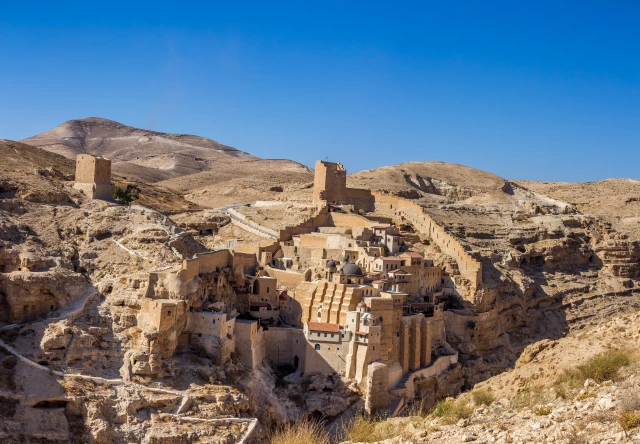
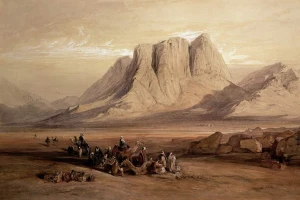
Carved into a mountain in the Judean Desert, the Mar Saba Monastery rises dramatically above the Kidron Valley, roughly halfway between Bethlehem and the Dead Sea. Remote and austere, the monastery functions without electricity, internet or modern conveniences and, in keeping with centuries-old tradition, women are not permitted to enter the main compound.
Officially known as the Holy Lavra (lavra meaning monastery) of Saint Sabbas the Sanctified, the site is called Mar Saba in Arabic and Syriac.
Mar Saba, a 5th–6th century Christian monk and monastic leader, was born in 439 in Cappadocia (modern-day Turkey) and died in 532 at the monastery in his 90s. The Encyclopedia Britannica describes him as a “champion of orthodoxy in the 5th-century controversies over the nature of Christ,” and his monastery set up a model for ascetic monasticism as the Eastern Orthodox church was developing.
In the 12th century, Crusaders brought his remains first to Constantinople and then to Venice, Italy, where they stayed until Pope Paul VI returned them to the monastery in 1965.
The monks of Mar Saba and its affiliated houses are known as Sabaites, according to the National Library of Israel. While hundreds once lived in the monastery, today the community typically numbers around 20 monks at a time. The monastery has remained in continuous use since its founding.
The name Mar Saba has echoes of the ancient Aramaic greeting, “Mar Haba” (ܡܪܚܒܐ), which was first used by the early Church members who faced persecution. According to Syriac Press, the greeting was used as a secret code in the language Jesus spoke, carrying both grace and strength. In Aramaic, Mar means saint, lord, or holy, and Haba means love. Similarly, the name Mar Saba speaks of sanctity (Mar) with Saba meaning “old man” in Aramaic, or in Hebrew, “grandfather.”
The idea of going into the wilderness to seek God has prevailed throughout the generations, and it is interesting that the Hebrew word for desert (midbar מדבר) comes from the same root as the word speak (medaber מדבר), suggesting that God speaks in the desert. Sabaite monks faithfully pray in the caves at the monastery night and day, communing with God in the quiet isolation.
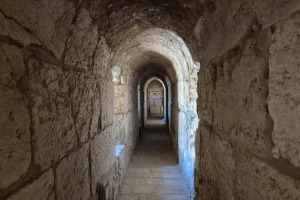
The monastery was built into the rock, offering no creature comforts. However, those who are committed to seeking God have embraced the challenge of training their minds purely on spiritual things without the distractions of the flesh. There’s no electricity, no internet or phones, and monks use olive oil lamps for light and get their water from natural springs.
Not only is Mar Saba a challenging place to live; it is also difficult to access. According to legend, the monastery was so impregnable that when Bedouins tried repeatedly to raid the monastery when it was first established, they could not get to it. Mar Saba eventually took pity on them and threw them the ladder. When the Bedouins entered and saw how he lived, they took pity on him in turn and began to bring him food!
Today, the Bedouins who live nearby are often ready to bless visitors with hospitality and help, as ALL ISRAEL NEWS correspondent Oriel Moran discovered on her journey to the ancient site. As a woman, she had to stay outside the monastery itself, but there is much to appreciate about the fascinating area for everyone.
Ever since Mar Saba’s body was returned to the monastery in 1965, there has been a special candle lighting event that takes place annually between Dec. 17-19. The monks, with the help of local Bedouins, bring candles to light at night, placing them all around the monastery and the banks of the Kidron valley. The candles commemorate the passing of the much-loved Mar Saba, lighting up the entire area in his memory.
You might also like to read this: