Trump wants a peacemaker legacy – Gaza may decide it




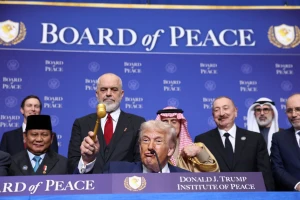
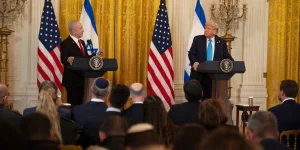
U.S. President Donald Trump’s newly formed international “Board of Peace” met in Washington on Thursday for the first time, launching an effort to oversee Gaza’s transitional governance once the war ends. The committee is meant to guide reconstruction and stabilization in a post-Hamas environment.
The first meeting opened with an announcement that nine countries have pledged a combined total of $7 billion toward rebuilding Gaza, while the United States pledged $10 billion. While it sounds like a significant amount of funding, the costs to rebuild the enclave are estimated at around $70 billion. Complicating matters even further is the fact that Hamas is still armed; so the real question isn’t funding – it’s feasibility.
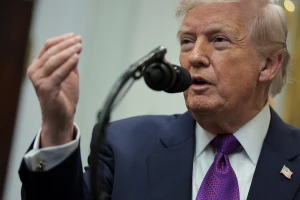
In a broader context, Trump said at his inauguration last year that he hoped his legacy would be that of a peacemaker – a comment that was not just throwaway rhetoric.
The U.S. president has portrayed himself as someone capable of brokering outcomes that others cannot. He has cited negotiated settlements abroad and the release of the Israeli hostages in Gaza as evidence that unconventional pressure tactics can be effective.
There is little doubt that Trump has embraced the role of a global dealmaker. He has signaled that he wants to be seen not only as an “America First” president, but also as a leader who brings stability beyond America’s borders. That ambition drives the Board of Peace concept, reflecting Trump's approach that favors structural terms that fall "outside the box" – a style that has characterized much of his career.
But here is a hard truth: reconstruction in Gaza cannot begin in any significant way until Hamas disarms. Without that, no transitional authority can govern effectively, regardless of President Trump’s will to make his Board of Peace successful.
If the Hamas terrorist organization retains its weapons and influence, any new governing body would operate at its mercy. Donor nations would be reluctant to send troops or invest billions of dollars into a territory where an armed militant group still calls the shots.
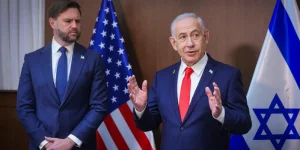
This is where the plan collides with reality. Israeli officials have made clear that disarmament is mandatory. Israeli Prime Minister Benjamin Netanyahu has said disarmament means all weapons, including small arms. He specifically noted the tens of thousands of rifles that are still believed to be in Hamas’ possession.
Meanwhile, on the ground in Gaza, there are new reports of Hamas reasserting control over much of the territory and that Gazans had to rely on Hamas institutions for identification papers, courts, and public services.
U.S. Ambassador to Israel Mike Huckabee put it bluntly when recently presented with the idea of leaving Hamas active in the area. “To leave Hamas in charge of running anything in Gaza would be like leaving some of the Nazis in place to help govern Germany after World War II. Nobody would think that’s a good idea.”
That quote is strong and direct, but it reflects a widely held Israeli concern – a transitional authority cannot coexist with an armed Islamist movement still embedded in security structures.
This is where Trump’s worldview comes into play. For him, the moral pedigree of a negotiating partner is secondary to whether that partner can deliver on a deal.
Trump does not appear overly concerned about sitting across from Russia, Qatar, Turkey, or other actors with complicated and nefarious reputations. In his framework, what matters is leverage and results.
He believes money talks, and so does action. If countries are willing to fund reconstruction efforts and contribute security forces, that is the real currency he values.
There are legitimate questions about whether the Board of Peace will ultimately benefit Israel or complicate its security. But Trump has earned political capital with Israel so far, whether it be playing a huge role in getting the Israeli hostages released, relocation of the American embassy to Jerusalem, the Abraham Accords, Operation Midnight Hammer against Iran, among many other accomplishments.
Because of his record, Trump must be afforded space to try something unconventional. To be sure, this board is unquestionably outside the traditional diplomatic playbook.
There is little doubt that Trump’s comments at times fall outside the traditional playbook. He can complicate matters when he makes remarks that Israelis strongly disagree with.
For example, during the Board of Peace meeting in Washington on Thursday, Trump credited Hamas with continuing to dig up the bodies of dead Israeli hostages. “Hamas really did a lot of that work, and you’ve got to give them credit for that,” he said.
If a Democratic president had made the same comment, the outrage would likely have been immediate and sustained. Trump receives more latitude because his overall record toward Israel has been strong, but troubling remarks should still be called out.
Sometimes one wishes he would simply stay on script. Yet, his improvisational style has been cited as a factor in his winning the presidency and as a reason why some foreign leaders view his unpredictability as meaningful.
Ultimately, the Board of Peace appears to represent Trump’s belief that bold frameworks can break long-held stalemates, seeing himself as the conductor who can align money, security forces, and political pressure into some sort of workable arrangement.
Whether that alignment holds depends on Hamas’ willingness to disarm. Without that, all of these reconstruction pledges remain theoretical at best.
However, if disarmament occurs, Trump could claim a signature peacemaking achievement. If it does not, the region risks sliding back into conflict, and the board becomes an ambitious idea without any sort of Plan B.
For now, Trump is likely betting that leverage, funding, and international coordination can create momentum. He has already indicated that he wants history to remember him as a leader who pursued peace not just at home, but across the world - that is ultimately the legacy he says he hopes to leave behind.
You might also like to read this: