The Palestinian Draft Constitution – What does it say and is it a path to peace or a continuation of conflict?




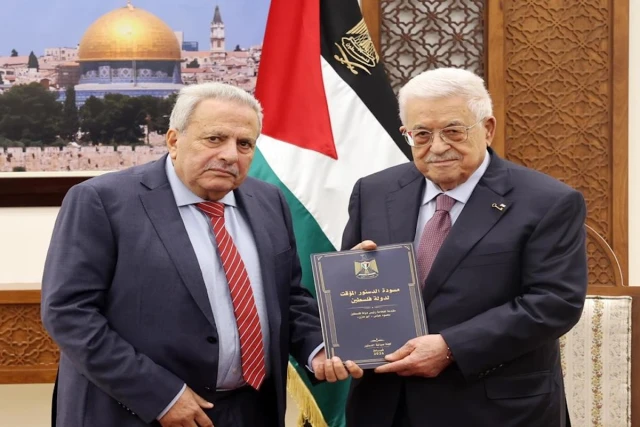
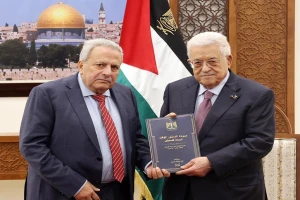
As part of its promised reforms, the Palestinian Authority (PA) recently announced that a draft constitution for the future Palestinian state had been received by President Mahmoud Abbas.
Several days later, the PA posted the draft constitution in both Arabic and English versions for public comment.
The draft constitution was produced by a committee that was appointed by Abbas in August 2025. The PA even claimed that the French government had helped to create the document, and French President Emmanuel Macron declared in November that a joint committee would be established for that purpose.
“This committee will be responsible for working on all legal aspects: constitutional, institutional and organizational,” Macron told reporters after his November meeting with Abbas, in which he was presented with a draft version of the document.
“It will contribute to the work of developing a new constitution, a draft of which President Abbas has presented to me, and will aim to finalize all the conditions for such a State of Palestine," Macron said at the time. However, it appears that French input was practically non-existent in the document released last week.
Now that the document has been released, many are wondering what it says, and how it will help bring resolution to the Palestinian-Israeli conflict.
President Abbas issues decree ordering publication of first draft of interim constitution 👇🏼 pic.twitter.com/3GbBclrQbx
— State of Palestine (@Palestine_UN) February 10, 2026
However, even a quick perusal of the document raises significant concerns about its role in bringing a resolution to the conflict.
What is written in the Palestinian Draft Constitution?
The draft constitution contains 162 articles, covering a range of issues, from general provisions to public rights to the branches of the new government. However, even a glance at the article names already raises troubling questions.
The very preamble of the constitution assumes the condition of “occupation,” which is stated in the first sentence: “We present this constitution, which was drafted while the land remains under occupation.”
The preamble also declares the “genocide” in Gaza and the “West Bank” as a foundational fact, stating that “settlement expansion and genocide continue in the Gaza Strip and the West Bank.” The constitution later creates a constitutional duty to “pursue the perpetrators of these crimes before the judiciary,” in Article 25, while declaring that such crimes “are not subject to a statute of limitations and may not be pardoned,” in Article 69.
In fact, the preamble appears to undercut its very legitimacy by declaring that the Palestine Liberation Organization (PLO) is “the sole legitimate representative of the Palestinian people in all their places of residence.” The constitution repeats this declaration several times, clearly indicating that this is a matter of some importance.
The preamble also declares the city of Jerusalem, the capital of Israel, to be the “eternal capital” of the Palestinian state.
Article 12 of the Constitution raises several issues. The article states, “The State of Palestine works toward the unity of the land and the people in the homeland and the diaspora, and is committed to achieving independence and ending the occupation and ensuring the right of return for refugees according to international legitimacy resolutions.”
Historically, such statements by Palestinian groups have indicated their claim to the entirety of the land, “from the river to the sea.” Since the constitution mentions no borders for the land, and repeats much of the same language from the militant groups opposing Israel, it appears to be proclaiming a continuation of the conflict with Israel, not an end to it.
In fact, the Constitution claims to base itself on the PLO National Covenant, which does state the right to all the territory of Mandatory Palestine, when it says that the PLO “continues to perform its national responsibilities according to the National Covenant.” This is repeated in Article 25, which declares the constitution and the PLO’s Declaration of Independence (1988) to be “a single indivisible unit.”
The Constitution declares that Palestinians are Arabs, and the Palestinian state is part of the Arab homeland: “Palestine is part of the Arab homeland, and the Palestinian Arab people are part of the Arab nation.”
Ethnically, the Arab homeland is considered to be the Arabian Peninsula, while Arabic language and culture was spread through conquest and trade during the period of Muslim expansion.
The constitution also appears to recognize that the term Palestinian is a national referent, not an ethnic one, in contrast to the past few decades of pro-Palestinian propaganda.
However, it later attempts to enforce an ethnic understanding of "Palestinian" by claiming a right of return for all Palestinians of all generations. If Palestinian is a reference to nationality, there has not been a Palestinian nation in human history. Even under the British Mandate period, the British received a "mandate" to govern a territory called Palestine, however, that territory never had an autonomous, functioning government of its own.
This attempt to enshrine the Palestinian “right of return” into the founding document is clearly aimed at the Jewish “Law of Return” in Israel, but with a major distinction. Being Jewish is a matter of ethnicity for the majority of the Jewish people, as converts represent a very small number of Jewish people. Even more importantly, the “Law of Return” was legislated because of the repeated harassment, persecution, and even massacring of Jews specifically on account of their ethnicity throughout the past 2,000 years.
The founders of the State of Israel, just a couple of years after the end of the Holocaust, understood that the Jewish people needed a safe haven from the phenomenon of Jew-hatred.
An equivalent phenomenon does not exist for the Palestinians, who, if they are indeed Arab, as the draft constitution declares, should be able to be absorbed into the population of any Arab nation in which they fled as refugees, because they are “part of the Arab nation.” Thus, the article on the "right of return" is not focused on a genuine need, but on challenging the Jewish population of Israel.
The draft constitution enshrines Islam as the “official religion in the State of Palestine,” while declaring, “The principles of Islamic Sharia are a primary source for legislation.” It then states, “Christianity has its status in Palestine, and its followers' rights are respected.” However, if Sharia law forms the basis for those rights, it is clear that Christians will not have the same status as Muslims, which is the de facto reality in most of the Muslim world.
Another aspect of the constitution that belies claims of reform is Article 24, which enshrines the support for “families of martyrs and the wounded and prisoners” as a foundational law for the state. Thus, instead of ending “pay-for-slay,” the new Constitution makes it the law of the land. In fact, this support is restated in Article 44.
More troubling, Article 156 prohibits amending the fundamental rights provisions (Articles 1-72) in which the “right of return,” “pay-for-slay,” and the declaration of the legal unity between the Constitution and the PLO’s Declaration of Independence are found. This means that the most problematic areas of the document are unable to be amended if the Constitution were to be adopted.
Probably the most troubling aspect of the Palestinian Draft Constitution is its complete erasure of any Jewish connection to the land.
While Article 3 says the Palestinian state “is committed to preserving its religious character and protecting its Islamic and Christian sanctities, as well as its legal, political, and historical status,” there is no reference to any Jewish sanctity or commitment to preserve it. In fact, the next line in Article 3 reads, “Any measures to change its character or historical identity are considered null and void.”
There is not one mention of “Israel” or “Jew” anywhere in the Constitution.
It is difficult to view this constitution as anything other than the enshrinement of the Palestinian Authority’s rejection of the State of Israel’s right to exist, the right of Jews to return to their ancestral homeland, or even their freedom to live openly as Jews anywhere in the land.
The Palestinian Constitution is, for all intents and purposes, the enshrining of “the resistance” as the law of the land, until the land has been purged of Jews. It will not bring an end to the conflict; it assumes the conflict will be over with the eradication of the Jews.
Want to help more people find our reporting from Israel? Leave a quick Google review of our website HERE .
You might also like to read this: