Does Israel have the right to exist?




”Israel has a right to exist,” is something we often say, but in Tucker Carlson’s interview with Mike Huckabee, he flipped the script and asked the U.S. ambassador, “Does any country have a right to exist?” Carlson was implying that by insisting on Israel’s right to exist, we’re giving Israel preferential treatment over other countries.
So let’s take a step back and actually answer this question seriously. What gives a country – any country – a right to exist? What is it that Israel, Mexico, and Mauritius have that Tibet, Kurdistan, and Texas do not? Is it UN membership? Is it international recognition? Is it just raw military force?
I suggest that, besides recognition from other countries, there are two basic foundations of a state’s right to exist. Let’s call them Foundation One and Foundation Two.
· Foundation One: Indigenous connection
· Foundation Two: Sovereign control
That’s it. Some countries base their right to exist on Foundation One only, some on Foundation Two only, some on both. In practice, at least one of these must be present for a state’s existence to be taken seriously. And Israel meets both requirements.
We keep insisting on Israel’s right to exist because we often feel like no other country’s existence is ever questioned. But that’s not true. Kosovo, North Cyprus, Somaliland, and many other nations have a highly disputed status and limited recognition. But they all govern areas claimed by other countries. Israel is, in fact, the only country that, despite being unrecognized by 26 UN members, is still a full UN member, has a fully functioning government, and has sovereignty over territory within its internationally recognized borders that no other UN member state claims as its own.
Foundation One, indigenous connection, gives a people an inherent right to their land, no matter what. Even if they are occupied, expelled, or defeated, they still have an inherent basic right to the land. This is the argument often used when people advocate for Kurdish or Tibetan independence. Foundation Two depends on sovereign control and the ability to defend it through military power. One is the ideal. Two is the reality check. The United States, Canada, and Australia have a right to exist based on Foundation Two but not One. Countries with a right to exist based on Foundation One but not Two, which actually exist, are rare, but there are countries like Iceland or Palau that come close. Their sovereignty is secure enough that those nations don't require large military forces of their own, relying instead on alliances or security guarantees.
Today, many people argue that Foundation One should be the only criterion for statehood, but that introduces a lot of problems because we can’t erase history. As noble as it may seem, using Foundation One exclusively is neither practical nor historical. But using Foundation Two exclusively creates a world in which “might equals right,” and that’s not the world we want either.
Historically, Foundation One is fairly new. In ancient times, Foundation Two was really the only way. If you were unable to defend your land, it meant that your gods had given you into the hands of your enemies, and you lost your right to it. Thus, when God gives the land of Israel to the people of Israel, he is also commanding them to take the land from the Canaanites, which they do in a series of military conquests described in the Book of Joshua. A few centuries later, the judge Jephthah justifies this in diplomatic correspondence with the king of Moab:
“Now since the Lord, the God of Israel, has driven the Amorites out before his people Israel, what right have you to take it over? Will you not take what your god Chemosh gives you? Likewise, whatever the Lord our God has given us, we will possess” (Judges 11:23-24).
Back then, just a few centuries after Joshua’s conquests, and with Canaanites still around, Israel’s right to the land was Foundation Two only. But now? It all happened over 3,000 years ago; there has been a continuous Jewish presence in the land ever since in an unbroken chain until today, and the Canaanite civilizations no longer exist. Therefore, no one can dispute Israel’s indigenous claims any longer. Over time, the Jewish people’s claim to the land came to rest on both foundations.
But then the Babylonians came. And then the Romans. And for thousands of years, the Jewish claims on Israel fulfilled Foundation One but not Two. Everyone knew this. In 19th-century Christian literature, Jews living in Europe were sometimes described as “Palestinians living among us,” meaning a people whose ancestral homeland was Palestine. The ruin of Israel’s last stronghold against the Romans, Beitar, is still called “Khirbet al-Yahud” – the ruin of the Jews - in Arabic, so even they know it. Before Zionism, they didn’t even try to deny it. They proudly declared that they live in what used to be the land of the Jews. Everyone knew that Israel is the Jewish homeland.
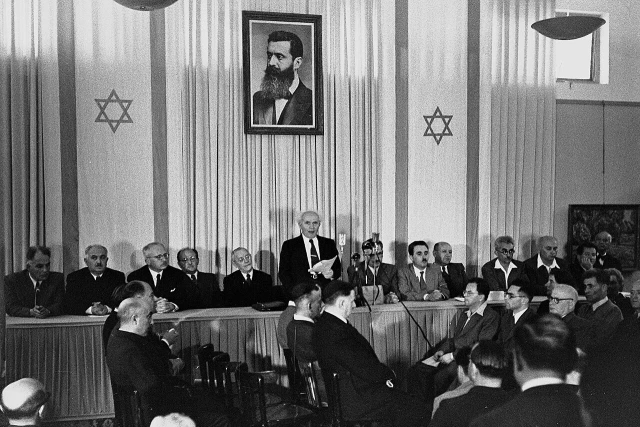
Until 1948, people could still claim that we might fulfill Foundation One but not Two, but since 1948, that’s not true either. We live in an era today when the Jewish people’s right to the land of Israel, for the first time since the Roman conquest in 63 B.C., actually fulfills both foundations. We are both indigenous to the land, and we also conquered and defended it.
Shortly after 1948, people could still argue over the validity of Israel’s conquest, but now we are a generation later, and we’ve successfully defended our land against all invaders. Discussing the merits of Zionism and whether they're valid or not – and if Jews can and should come back to Israel and establish an independent state – was a relevant discussion in the early 1900s, but today that ship has sailed.
We exist here now, and the old claim from the late 1800s against Zionism that “your pretty ideals don’t matter, you have to accept the reality,” has now turned into an argument in favor of Zionism. The reality is that we are here and we are not moving.
Foundation One and Two are fulfilled. We have a functioning government; we have sovereignty over land that we have successfully defended against invaders; and we are recognized by the vast majority of the UN member states.
If that does not constitute a “right to exist,” then what does?
You might also like to read this: