Cardinal says Palm Sunday dispute should not promote anti-Israel, anti-Jewish sentiment
Dispute highlights lack of understanding of Jerusalem’s indigenous and historic Christian community




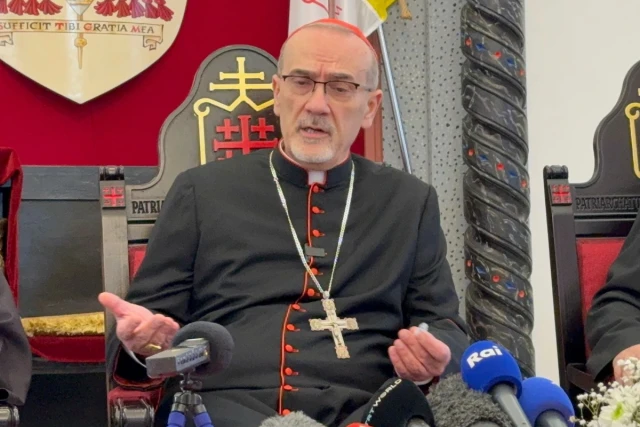
JERUSALEM — An incident that quickly spiraled into an international controversy when police denied the Holy Land’s top Catholic access to the Holy Sepulchre was resolved amicably between church and Israeli officials – but not before being seized upon by both pro- and anti-Israel groups.
The situation played out in dramatic headlines and diplomatic rebukes, underscoring the fragility of religious rights determined by the centuries-old understanding governing sites in Jerusalem, known as the Status Quo.
Speaking at a press conference on Tuesday, Cardinal Pierbattista Pizzaballa, the Latin Patriarch of Jerusalem, downplayed what he called a “misunderstanding” that exploded in the public arena on Sunday morning when he and three other clergy were barred by police from entering the church to carry out a private liturgy.
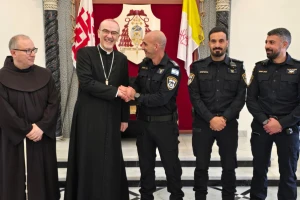
The decision of the police was reversed later that day. The cardinal credited international and Israeli intervention – including an immediate call from Israeli President Isaac Herzog – with playing a strategic role in reaching a fast resolution.
Pizzaballa received multiple calls from various individuals “within Israeli society,” both including religious and nonreligious Jews as well as others, which was “important to bring attention to the importance and sensitivity that the holy places have, especially at this period.”
The cardinal also recognized that the brouhaha was used to promote polarized narratives, in this case pitting traditional Christian churches against Israel.
“We don’t want to become instrumental to any anti-Jewish, anti-Israeli, anti-Semitic attitude,” Pizzaballa said. “We don’t want this. Also, because of that, we are insisting that we solve the problem and that there is full cooperation with local authorities.”
“We cannot avoid people to use these events according to their attitude,” he said. “We want only to preserve the right and duty to pray at the Sepulchre in full cooperation as much as possible with all the authorities in charge of this.”
However, it was important for the church to clarify its rights and access in light of the incident.
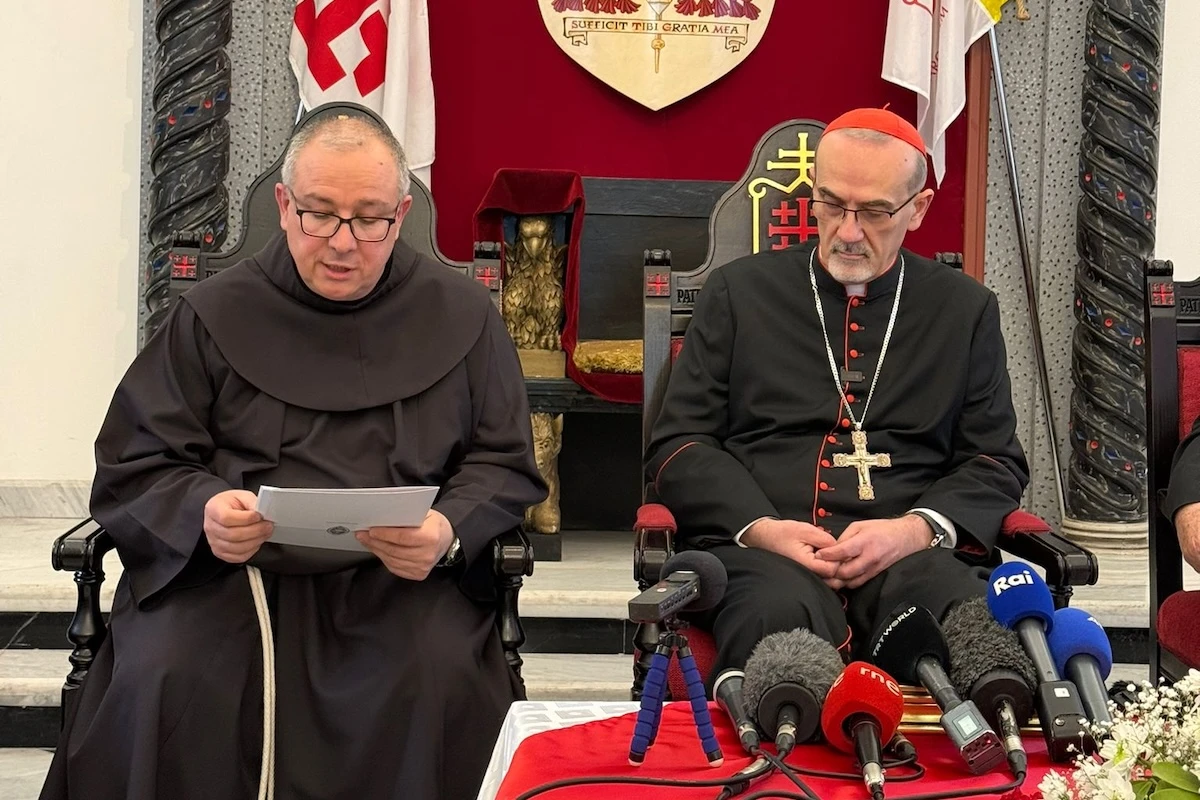
Francesco Ielpo, who was with Pizzaballa on Palm Sunday and serves as Custos of the Holy Land, said the position “does not require permission from the police to access the basilica. This is not a privilege but a recognition of a long-established right.”
Many of the churches in the Holy Land predate the modern State of Israel. The Status Quo, established in 1852, now rides a delicate balance between religious freedom and laws of the governing authority.
“This is a continual presence recognized over time and respected by various authorities that have governed this land,” Ielpo said. “For seven centuries, a stable community of Franciscan friars has lived and celebrated within the Holy Sepulchre without interruption in various circumstances and situations … even during the most difficult periods of history, even times of war.”
Neither has the liturgy been interrupted, he said.
The custodians of the Holy Sepulchre include the Catholic, Greek Orthodox and Armenian Apostolic churches, which represent billions of Christians worldwide.
“The government of Israel must bear this in mind and the responsibility placed on it toward the Christian world to continue to ensure, at all times and despite the difficulties, the holding of prayers,” Ielpo said.
Even U.S. Ambassador to Israel Mike Huckabee, an ardent Zionist, said the incident on Sunday was “difficult to understand or justify.”
It also exacerbated a sense among minority groups that a double standard is applied to non-Jewish communities in Israel, such as the ongoing closure of nonessential shops in the Old City, which disproportionately impacts Arab merchants.
Because most of the Old City lacks adequate shelters and its narrow alleyways prohibit easy access in the event of a mass-casualty event, police have kept the area in a tight lockdown.
Restrictions set by the IDF's Home Front Command rendered the Al-Aqsa Mosque closed during most of Ramadan and limited worshippers at the Western Wall, where a nearby safety shelter permits only 50 visitors at a time.
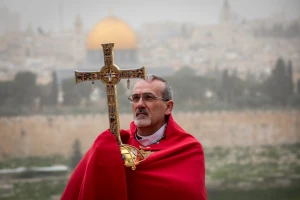
Both Pizzaballa and Ielpo noted that the church has complied with restrictions, canceling celebrations and public gatherings, including the Palm Sunday procession on the Mount of Olives.
At the same time, Pizzaballa insisted that some religious observances are non-negotiable.
“No one – not even the pope – has authority to cancel the liturgy of Easter,” he said.
Pizzaballa, who has served in Jerusalem for decades, speaks fluent Hebrew and has been considered a moderate, empathetic figure who gracefully navigates complicated relations between the Arabic-speaking Christian community and the Israeli and Palestinian governments.
During the war between Hamas and Israel, Pizzaballa offered himself in exchange for the release of Israeli hostages. He also visited parishioners of the tiny Christian community in Gaza in coordination with the Israeli military.
He was appointed as a cardinal in September 2023 and was believed to be a contender for Pope in 2025.
Nevertheless, criticism of the cardinal from Evangelical Christian circles highlighted a lack of understanding of the indigenous and centuries-old Christian community, which has maintained the sites and Christian traditions for centuries. Vitriolic comments on social media questioned the churches’ right to be in the “Jewish state” at all.
In recent years, spitting attacks, vandalism and sometimes violence against Christians and Christian sites in the Old City by ultra-Orthodox and extremist Jews have risen.
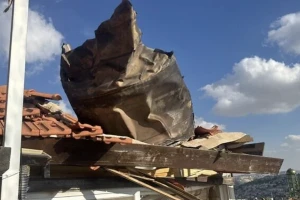
Recently, however, the threat has come from Iran. Pieces of shrapnel from missiles have landed in the Old City on several occasions, including near the Church of the Holy Sepulchre.
Church leaders and police arrived at a compromise that will allow a handful of clergy to celebrate and broadcast a mass for each of the Holy Week liturgies.
These select clergy will join the 10 friars that live continuously in the Church of the Holy Sepulchre, which Pizzaballa referred to as “our home.”
You might also like to read this: