Amid leadership vacuum, Iranian president & foreign minister attend pro-regime rally in Tehran
Pezeshkian unable to meet with Supreme Leader Mojtaba Khamenei



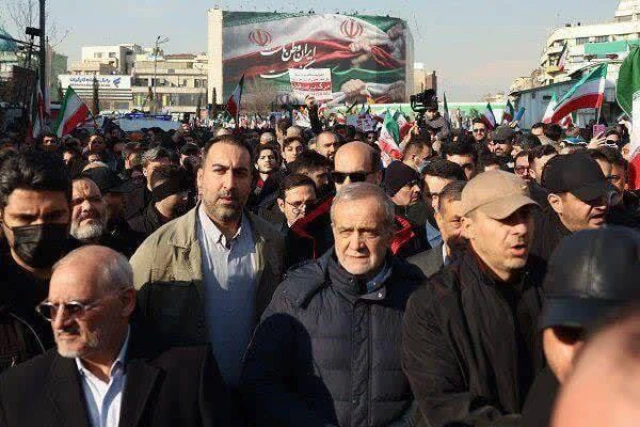
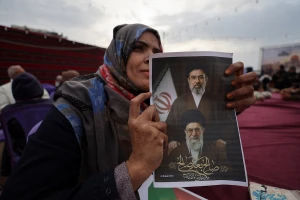
Iranian President Masoud Pezeshkian and Foreign Minister Abbas Araghchi were seen at a pro-regime rally on Tuesday, along with several other senior officials, in the capital Tehran to mark Islamic Republic Day.
“I came to get a boost of morale,” Araghchi told a reporter at the rally. “Seeing these people really gives everyone a huge boost of morale.”
While some international news outlets described Araghchi and Pezeshkian as “casually mingling with attendees, taking selfies and walking through crowds without apparent security,” a video uploaded to social media shows Araghchi removing a hood before talking with Iranian reporters on the scene.
“It really overwhelms a person” — the interview with Abbas Araghchi about sitting among the people and their morale boost is now ready with translated captions on this attached video.
— TranslateMom (@TranslateMom) April 1, 2026
Add captions and translations to any video — just tag @TranslateMom + your language.
— made by… pic.twitter.com/zWRlfRGFXM
Araghchi and Pezeshkian were last seen publicly during the celebration of Quds Day, along with former National Security Council Secretary Ali Larijani, who was killed by Israeli strikes a few days later.
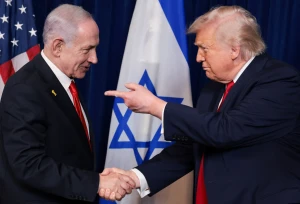
The appearance of the two leaders comes after Prime Minister Benjamin Netanyahu spoke of the “10 plagues” that Israel had inflicted upon the Islamic Republic, in a Passover speech to the nation on Tuesday night.
Meanwhile, Iranian President Masoud Pezeshkian said on Tuesday that his country has the "necessary will" to end the war, but is seeking guarantees that the conflict will not be resumed.
"We possess the necessary will to end this conflict, provided that essential conditions are met, especially the guarantees required to prevent repetition of the aggression," Pezeshkian said in a phone conversation with European Council president António Costa, according to a statement from Costa’s office.
In a post on 𝕏, Costa called for de-escalation, saying that “the current situation in the Middle East is extremely dangerous.”
“The current situation in the Middle East is extremely dangerous. Today, in my phone call with the President of Iran, Dr. Pezeshkian, I urged for de-escalation and restraint, the protection of civilians and civilian infrastructure, and the need for all parties to fully respect international law,” he wrote on 𝕏.
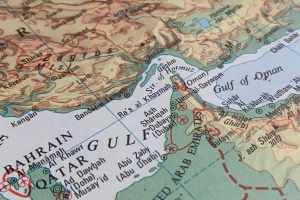
“To de-escalate the situation, I urged Iran to stop the unacceptable attacks on countries in the region and to engage positively on the diplomatic track, notably with the UN to ensure the freedom of navigation in the Strait of Hormuz,” Costa continued, before calling for diplomacy.
Pezeshkian's comments regarding a willingness to end the conflict came on the same day that U.S. Secretary of War Pete Hegseth said that the next days of the Iran war will be “decisive.”
“The upcoming days will be decisive. Iran knows that, and there's almost nothing they can militarily do about it," Hegseth said.
Both Araghchi and Pezeshkian are reportedly not on Israel's or America's target list, as the U.S. engages in backchannel negotiations with members of the Iranian regime regarding an end to the war.
Pezeshkian has publicly disagreed with the leadership of the IRGC, but his comments appear to carry little weight inside the Iranian regime.
According to the opposition-linked Iran International, President Pezeshkian has limited political power amid a leadership vacuum created by recent Israeli and U.S. strikes that have disrupted Iran’s command structure.
In recent days, Pezeshkian has reportedly had serious disagreements with the head of the Islamic Revolutionary Guard Corps (IRGC), Ahmad Vahidi. Pezeshkian criticized the IRGC’s decision to attack neighboring Gulf states and warned that the country faces the probability of economic collapse within a month, if there is no ceasefire.
Iran International reported that a recent attempt by Pezeshkian to appoint a new intelligence minister last Thursday was blocked by Vahidi, with senior commanders insisting that “all critical and sensitive leadership positions must be selected and managed directly by the IRGC.”
Normally, the president nominates intelligence ministers with the approval of the Supreme Leader. However, with the status and whereabouts of Supreme Leader Mojtaba Khamenei unclear, it appears that the IRGC has taken control of the government.
Pezeshkian has repeatedly sought to meet with Khamenei, Iran International reports, but has been unable to secure a meeting or receive direct communication.
According to the news outlet, a “military council” of senior IRGC officers exercises full control over the core decision-making structure, while enforcing a security cordon around Khamenei.
It remains unclear who is effectively running the Iranian government, or whether U.S. diplomatic efforts are engaging officials with the authority to implement any potential agreements.
You might also like to read this: