The treasures of the Negev


With our “HaShorashim” group – Rediscovering the Roots by Honoring the Pioneers – we set out to explore the Negev, in the area of Mitzpe Ramon.
Revivim, the Founding Fathers
Located about thirty minutes south of Beersheva, Kibbutz Revivim was founded in 1943 by pioneers, notably from Rishon LeZion. The first volunteers came from long-established Jewish communities in Austria, Italy, and Germany. Today, they are regarded as the founding fathers of the modern development of the Negev.
When Jewish pioneers first began settling in this region, the Negev was sparsely populated and inhabited mainly by Bedouin tribes. David Ben-Gurion understood the strategic importance of establishing yishuvim in this vast desert region, where water posed a major challenge.
Surrounded by often hostile populations, the pioneers succeeded in maintaining the three Jewish outposts in the Negev. Among their achievements, they built the first underground and “air-conditioned” hospital in the Negev and developed innovative agricultural techniques that made it possible to cultivate particularly difficult soils by “desalinizing the land.” Revivim quickly became a true open-air agricultural laboratory.
Ben-Gurion and the Dream of the Negev
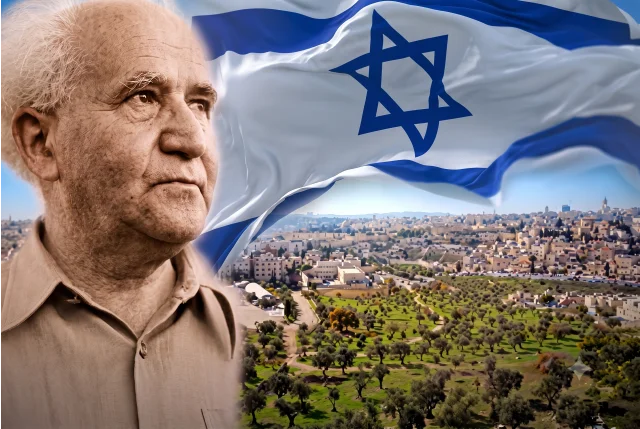
David Ben-Gurion, Israel’s first leader, often repeated that “the future of Israel lies in the Negev.” For him, the development of this region, which represents more than half of Israel’s territory, was essential to the country’s future.
His move to Sde Boker in 1952 was a powerful symbolic act: he wanted to demonstrate that human ingenuity could overcome the challenges of an environment marked by extreme temperatures and chronic water scarcity.
Ashalim, the Solar Beacon in the Heart of the Desert
It is impossible to miss the Ashalim Tower. Visible from dozens of kilometers away, it rises like a true beacon in the middle of the desert.
The yishuv of Ashalim traces its origins to one of three Nahal settlements established in 1956 between Mashabei Sadeh and Nitzana. Today, Ashalim is best known for its exceptional solar power station.
The complex combines several energy-generation technologies: solar thermal energy, photovoltaic energy, and natural gas. The solar tower concentrates the sun’s rays using more than 50,000 heliostats—huge computer-controlled mirrors that reflect sunlight toward a receiver at the top of the tower.
With an installed capacity of approximately 121 megawatts, it can supply electricity to nearly 120,000 households. Commissioned in 2019, the facility produces several hundred gigawatt-hours annually. At 260 meters in height, it remains one of the tallest concentrated solar power towers in the world.
Hatzerim, the Princes of Drip Irrigation
Who today is unfamiliar with drip irrigation (tiftouf), which is used worldwide, particularly in arid regions?
It was at Kibbutz Hatzerim, about ten kilometers from Beersheva, that this agricultural revolution was born. Here, in the Negev desert, the heat is intense, and the calm is regularly interrupted by fighter jets from the nearby air force base. Yet this community has long attracted many candidates.
Its success is largely due to Netafim, founded in 1965 and now the world leader in precision irrigation. The original idea came from Israeli engineer Simcha Blass, who noticed that one tree was growing better than the others because of a slow and continuous water leak. This observation led to the principle of micro-irrigation.
Thanks to this system, water is delivered directly to plant roots, resulting in substantial water savings while improving agricultural yields. This innovation has transformed agriculture in many desert regions around the world and has been a true blessing to numerous countries.
Kibbutz Hatzerim has retained a significant share of Netafim’s capital, and the company’s operations have expanded across several continents, employing thousands of people.
Another Treasure of the Desert: Jojoba
But Hatzerim owes its prosperity to more than just drip irrigation.
For several decades, the kibbutz has also cultivated jojoba, a plant native to Mexico and particularly well suited to the arid conditions of the Negev. Jojoba oil has a composition very similar to that of human sebum.
Originally, the pioneers envisioned using this oil in the precision engineering industry. However, cosmetic manufacturers ultimately became the primary buyers.
Today, Israeli jojoba oil is recognized worldwide for its quality. Once again, Israel has succeeded in transforming the constraints of the desert into opportunities, making the Negev a laboratory of innovation where vision, perseverance, and human ingenuity come together.
When the Desert Blossoms
Traveling through the Negev today, it is difficult to imagine the immense challenges faced by the first pioneers.
Where many saw only a hostile desert, they saw a land of opportunity. Through their work, perseverance, and faith, villages, farms, research centers, and cities emerged where there had once been almost nothing.
This transformation inevitably recalls the words of the prophet:
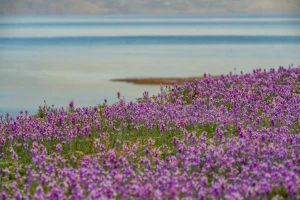
“The wilderness and the dry land shall be glad; the desert shall rejoice and blossom like a crocus.”
— Isaiah 35:1
Seeing fields, orchards, vineyards, and cutting-edge technologies flourishing in the heart of the desert today reminds us that the God of Israel remains faithful to His promises.
You might also like to read this: