









Ancient olive groves burn in Galilee wildfire, threatening 1,400-year-old trees
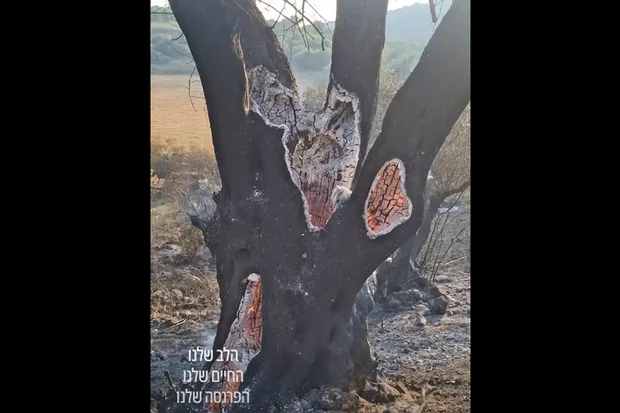
A wildfire tore through much of Moshav Zippori in the Galilee over the weekend, damaging or destroying ancient olive trees that have been cultivated for generations, including some estimated to be nearly 1,400 years old.
Ayala Noy-Meir, a local farmer whose family has tended the groves for decades, is now appealing to the public for assistance in recovering from the damage. The cause of the fire remains under investigation. Police have not ruled out arson, although Noy-Meir noted that the extremely dry conditions in the Galilee as summer begins mean the blaze could also have been sparked accidentally, even by something as small as a discarded cigarette.
“So many bad things have been happening in our country lately, and we don’t want this to come across as a sob story,” she said the morning after the fire at their farm, Rish Lakish.
The trees grow on roughly 4,000 dunams of land that her family leases from the Israel Lands Authority. While maintaining the groves requires significant investment of both time and money, income from olive oil and related products generally helps cover costs and can sometimes generate a modest profit.
“Not all our land burned, and we have about 6,000 olive trees here, but the damage amounts to several hundred thousand shekels that we will have to absorb,” Noy-Meir said. “That means no profit for the next two years. To survive financially, we will have to take bank loans and pay the highest interest rates in the economy, the ones given to farmers.”
“We have been doing this for more than 20 years because it breaks our hearts to see these ancient trees untreated and unpruned,” she explained. “There is no proper irrigation system in these ancient groves, and apart from us, there is no one who takes care of the trees in an organized way.”
Israel’s open landscapes are increasingly under strain as declining herd grazing reduces land maintenance, a trend linked to cattle farming becoming less economically viable amid government-supported imports of cattle and frozen meat.
“Today, with less grazing, as raising cattle in Israel is no longer truly profitable because of theft and competition from imports, herds are gradually disappearing. We try to clear weeds in sensitive areas, along roads and near picnic sites, especially now as they dry out and become highly flammable, but we cannot clear everything, and the costs are enormous.”
“We would like there to be bodies in the country that coordinate all of this, certainly now before fire season,” she added. “It is not only us. This happens to everyone. We see this struggle with every farmer still left in the country.”
Noy-Meir said she understands that the Israeli public is currently under significant stress and pressure due to the war, but believes that government authorities could improve coordination with farmers to help them remain in business. She added that many Israeli farmers have already sold their land and greenhouses to large conglomerates or developers, and that some have even left the country in search of opportunities elsewhere.
The family is appealing to the public for support as it works to recover from the fire damage to its olive groves.
In a statement on its crowdfunding campaign, the family said that recent months have been financially challenging, with fewer visitors and tourists and reduced demand from restaurants in central Israel for olive oil, making it difficult to absorb the costs alone. “We need the public’s help,” the campaign notes.
As part of the fundraising effort, the family is offering a range of incentives for donors, including guided tours of the affected groves, educational seminars, and packages of olive oil products.
Popular article:
interview Easter message of resurrection hope amid war at Jerusalem's Garden Tomb

biblical commentary Let my people go: a Passover message for today
4 IDF soldiers killed, 2 wounded in fighting in southern Lebanon, as Israel eliminates dozens of Hezbollah terrorists
Receive latest news & updates
A message from All Israel News
Help us educate Christians on a daily basis about what is happening in Israel & the Middle East and why it matters.
For as little as $10, you can support ALL ISRAEL NEWS, a non-profit media organization that is supported by readers like you.
Latest articles:

Israeli fighter jets flew to Iranian border in ‘power projection,’ deterrence exercise ahead of elections next week

Israeli intel chief Zini travels to France to give counterterrorism advice amid violent riots – report

Founding trustee of Oxford’s Islamic studies department believed Muslims should ‘continue the work of Hitler’

'Peaceful dialogue is not a crime:' Petition urges Lebanon to abolish its Israel Boycott Law

Israeli defense companies expand global reach with new deals in Cyprus, Germany and Canada