The case for lower apartment prices in Israel



For nearly two decades, the dominant narrative surrounding Israel's housing market was straightforward: demand exceeded supply, population growth guaranteed long-term appreciation, and any slowdown in activity would eventually give way to higher prices. The latest data suggest that assumption deserves closer scrutiny.
The risk facing Israel's housing market is not a crash. There is little evidence to support comparisons with the United States in 2008. Israeli banks remain well capitalized, mortgage underwriting standards are relatively conservative, and unemployment remains low by historical standards. The greater risk is something less dramatic but potentially more consequential: a prolonged period of declining apartment prices driven by weakening demand, deteriorating affordability, and a growing disconnect between what sellers want and what buyers can afford.
Recent data from the Finance Ministry's Chief Economist Division suggest that this adjustment may already be underway. In April 2026, only 5,081 homes changed hands nationwide, including both new and second-hand apartments. That represented a 19% decline compared with April 2025 and a 31% decline compared with the previous month. Transactions in the free market fell 20% year-over-year and 36% from March, placing activity near some of the weakest levels recorded since the early 2000s.
Transaction volumes matter because housing markets rarely adjust through prices first. The adjustment usually begins with activity. Buyers hesitate. Sales slow. Inventory accumulates. Developers offer incentives. Only later do price declines become visible in official statistics.
That sequence increasingly resembles the current Israeli market.
The roots of today's situation can be traced back to the extraordinary conditions that prevailed between 2008 and 2022. During that period, interest rates remained near historic lows for much of the time. Borrowing became unusually cheap. At the same time, rising equity markets and the rapid expansion of Israel's technology sector boosted household wealth and purchasing power.
The result was one of the strongest housing booms in the developed world. Housing prices rose roughly 160% between 2007 and 2025.
The problem is that the factors supporting those gains have either weakened or disappeared.
Although the Bank of Israel has begun reducing interest rates, financing costs remain substantially higher than they were during most of the previous decade. Mortgage payments have risen much faster than rents. What once appeared affordable at near-zero interest rates becomes considerably less attractive when financing costs normalize.
The affordability problem is becoming visible across virtually every category of buyer.
Purchases by first-time homebuyers fell 12% in April compared with a year earlier. Home upgraders, traditionally one of the strongest sources of demand, reduced purchases by 34%. Investor purchases declined 12%, while purchases of second-hand homes fell 24%. Viewed individually, none of these figures would necessarily signal a turning point. Taken together, however, they suggest demand is weakening across the market rather than within a single segment.
The slowdown appears particularly pronounced in Tel Aviv, long regarded as Israel's most resilient housing market.
According to the Ministry of Finance, the purchase of second-hand apartments in Tel Aviv fell to just 86 transactions in April, a 60% decline from the same month a year earlier. The first four months of 2026 recorded a 34% decline in such transactions, compared with a national decline of only 6%.
Perhaps more telling is who is no longer buying.
Technology workers have historically been among the most important marginal buyers in Israel's most expensive housing markets. Yet the share of high-tech employees among second-hand apartment buyers in Tel Aviv fell from 26% in April 2025 to just 11% in April 2026.
That shift matters because housing prices at the upper end of the market are often determined by the willingness of high-income households to stretch valuations. If even that buyer base is becoming more cautious, the implications extend well beyond a temporary slowdown.
Supply conditions meanwhile continue to deteriorate.
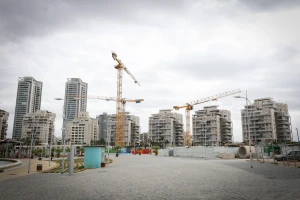
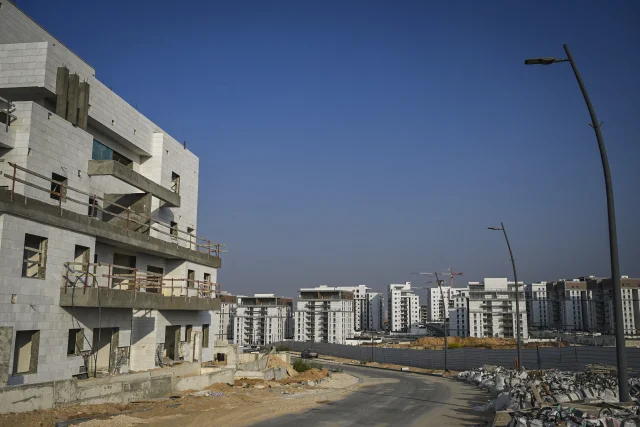
The stock of unsold new apartments has climbed above 86,000 units, according to Israel's Central Bureau of Statistics data cited in the Finance Ministry report. At the same time, developer sales continue to weaken. Sales of new apartments in the free market fell 12% from a year earlier and 37% from March.
Developers have so far resisted large headline price cuts. Instead, they have relied on financing incentives and promotional offers to stimulate demand. The Ministry estimates that 21% of free-market transactions still involved financing incentives in April. While this is down from the levels seen before the Bank of Israel imposed restrictions on such programs, the practice remains widespread.
More importantly, the Ministry notes growing evidence that developers are shifting toward less visible forms of support, including mortgage-interest subsidies and alternative financing arrangements. These measures can reduce the effective cost of purchasing an apartment without necessarily appearing in official housing-price statistics.
In other words, the market may already be adjusting even if headline price indices have yet to fully reflect it.
Financial pressure is also becoming more apparent.
One of the report's most striking findings concerns developer cash flow. After accounting for construction inputs but before financing expenses, developers generated negative cash flow of approximately NIS 200 million (about $67.5 million) in April.
That figure alone does not imply financial distress. However, it highlights the increasingly difficult balancing act facing developers. They can maintain prices and carry growing inventories, or they can reduce prices and accept lower margins. Neither option is particularly attractive.
Foreign demand, often viewed as a source of support for the market, also appears to be weakening. Foreign residents purchased only 77 apartments in April, down from 106 a year earlier and less than half the level recorded in March. Americans still accounted for roughly half of those purchases, but both their share and total number of transactions declined.
This does not mean foreign buyers are disappearing. It does suggest that they are becoming less able to offset weaker domestic demand. Part of the explanation may lie in the currency market. The sharp appreciation of the shekel over the past year has significantly increased the cost of Israeli property for dollar and euro-based buyers, reducing the purchasing power that once helped sustain demand in cities such as Jerusalem.
The broader significance extends beyond real estate itself.
Residential property occupies a central place in Israel's economy. It influences household wealth, construction activity, consumer confidence, bank lending, and investment activity. For much of the past two decades, steadily rising prices reinforced the belief that housing was a reliable store of wealth. If that dynamic begins to change, the consequences are likely to extend well beyond the real estate sector, shaping consumer behavior, investment decisions, and the broader pace of economic activity.
Importantly, such an outcome would not necessarily be negative for the economy. Improved affordability would eventually expand the pool of potential buyers and reduce one of the most significant financial burdens facing younger households.
The transition, however, could be uncomfortable. Housing markets are shaped as much by expectations as by fundamentals, and expectations formed during an era of ultra-low interest rates and steadily rising prices may prove difficult to sustain. Developers are already relying more heavily on incentives, transaction volumes have fallen sharply, and inventories continue to accumulate.
For years, investors worried that Israel was building too few homes. The greater risk today may be that, at current prices and current financing costs, it has built more than the market is willing to absorb. If so, a gradual decline in apartment prices would not represent a crisis. It would represent the market's attempt to restore equilibrium after one of the longest housing booms in its history. For prospective homebuyers, however, that possibility carries an important implication. After years in which delay often meant paying more, patience may no longer be the most expensive option.
You might also like to read this: