Israeli tech transforms construction waste into new building materials




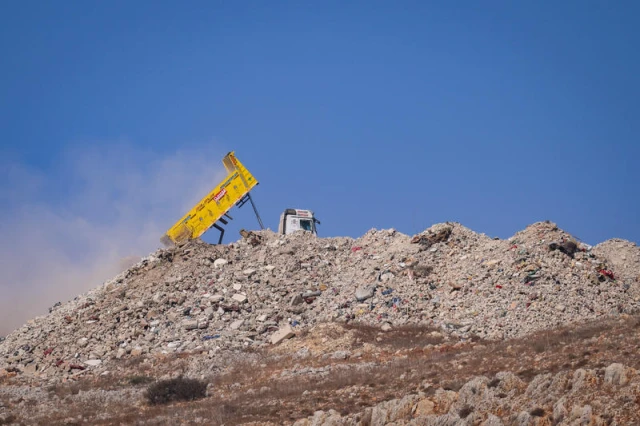
Vast amounts of construction waste are buried each year in Israel and around the world, often illegally, at great cost, and with significant harm to the environment.
The Israeli company ROM, founded in 1991 and part of the Luzon Group, has addressed this challenge by developing "Morphit," a technology that transforms what is typically seen as waste into profitable, reusable building materials. The Morphit technology enables the production of durable, high-strength construction materials without the need for the expensive and time-consuming process of sorting and separating waste by type.
Ariel Avram, ROM CEO, noted the large amount of waste left behind after construction projects in Tel Aviv.
“That image is burned into my mind as something that makes no sense. It does not fit our era,” Avram said. “We are constantly looking for ways to become more efficient, to work in a more modern and greener way.”
“We wanted to change this sense of inevitability around construction waste, so we entered the world of recycling and reusing the massive quantities of waste that, ironically, we also pay millions of shekels every year to bury,” he explained.
Avram revealed that the new Morphit patented technology was born out of necessity.
“This technology was born from our day-to-day operations and a real need, not just ideology. As a company building hundreds of millions of shekels worth of projects each year, we have a platform to integrate these materials ourselves,” he revealed.
“We took all kinds of waste, crushed it and tried to understand what we needed to do to create a new building material,” he continued.
“The major challenge we overcame is that for years people talked about reusing construction waste, but it always required sorting,” Avram recalled. “Here, we used all types of waste without separation and still achieved very strong results across all parameters.”
Yael Hirsch Shemesh, ROM's head of development, said, “We carried out a very strong waste treatment process together. We build teams of experts in relevant fields and develop the product with them.”
“We built a product concept, conducted extensive testing and research, and saw that feasibility was very high,” Shemesh explained. “From the laboratory compounds, we obtained a material that met the performance requirements we set.”
The Israeli technology could potentially have global implications far beyond Israel's borders. Data from the European Union shows that the construction industry generates roughly 40% of all carbon emissions.
Avram said that the technology is particularly relevant in Israel, which is characterized by a less focused approach to the environment compared to European countries and more intense construction due to higher population growth.
“I think Israel is among the less advanced countries in this field,” he explained. “Everyone talks about the massive scale of illegal construction waste here. We are very far from those numbers .”
Morphit is far from the only Israeli technology that benefits the environment. Last month, Israeli researchers announced a new technology that reduces industrial emissions by accelerating a carbon capture process that takes thousands of years in nature into one that can be completed in just a few hours.
You might also like to read this: