Surprising statistics for Israel's Muslim population – declining birthrate, rising education and employment




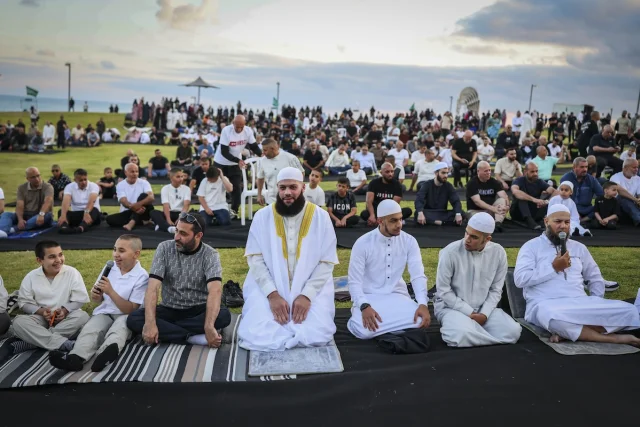
Ahead of the Muslim holiday of Eid al-Adha, which begins on Wednesday, the Central Bureau of Statistics (CBS) released new data showing a slowdown in the growth rate of the country’s Muslim population in 2025 compared to the previous year.
At the end of 2025, Israel’s Muslim population was estimated to be approximately 1.849 million people, accounting for approximately 18.6% of the country’s population. This figure represents an increase of around 34,000 in 2025, compared to roughly 35,100 in 2024. According to the data, the Muslim population growth rate stood at 1.8% in 2025, down from 2.2% the previous year. The CBS noted that the sector’s growth rate has steadily declined over the past two decades.
Despite the slow growth rate, the Muslim population's growth rate remains higher than that of the Jewish population (1.2%), the Christian population (-0.4%), and the Druze population (0.8%).
The majority of Israel’s Muslim population remains relatively young, with children aged 0–14 accounting for about 31% of the population, while those aged 65 and older make up just 5.4%. According to the data, the total fertility rate among the Muslim population has been declining since 2001.
In 2025, the total fertility rate for Muslim women stood at an average of 2.76 children per woman, compared to 3.08 among Jewish women, 1.69 among Druze women, 1.62 among Christian women, and 1.14 among women with no religious classification.
Muslim and Jewish women have significantly higher average fertility rates than Christian women, with birth rates generally higher among religious women (around 2.74 children per woman) than among moderately religious or secular women (2.05).
According to the CBS data, the highest fertility rate among Muslim women was in the Southern District, which has a significant Bedouin population, at 4.55 children per woman. The lowest rate among Muslim women was in the Tel Aviv District, at 1.63 children per woman. The Northern District was slightly higher, at 2.17.
The percentage of single Muslim women in the 20–24 age group was lower, at 68%, compared to 80.7% among Jewish women in the same age range. At the same time, the average marriage age within the Muslim population continues to rise.
First-time Muslim grooms were, on average, 27.2 years old, while brides averaged 23.7 years old – an increase for both genders compared to previous years, though still younger than the average marriage age among Jewish Israelis.
Life expectancy among Israeli Muslims in 2025 was 77.4 years for men and 83.1 years for women – lower than the averages for Jews, which stood at 82.6 years for men and 86.4 years for women.
In the field of education, the Muslim population has shown significant gains over the past two decades. In recent years, 42.2% of Muslim women who graduated from high school went on to pursue undergraduate studies within eight years, more than double the rate among Muslim men, of whom only 20% continued to higher education.
Some 49,800 Muslim students studied in higher education institutions in Israel in the last academic year, representing 16.4% of all students in the country. Additionally, about 12,300 received an academic degree in the same year.
In secondary education, 75.8% of Muslim students who took matriculation exams received a certificate, an increase compared to the previous year.
The number of Muslim students in natural sciences, mathematics, agriculture, engineering, and architecture was lower than in other fields of study, while the highest representation was in health professions, excluding medicine.
In the labor market, 50.5% of Muslims aged 15 and over were employed, with a higher employment rate among men (63.8%) than among women (37%).
According to CBS data, nearly half of Israel’s Muslim population resides in the north of the country: 33.6% in the Northern District and 13% in the Haifa District. Another 22.2% live in the Jerusalem District, with the remainder residing in the Southern District (19%) and Central District (10.8%). Jerusalem is the city with the largest number of Muslims, around 395,000.
The CBS results demonstrate a slow trend towards more Western demographic numbers, with increasing education rates, slowly rising marriage ages, and a downward trend in fertility rates. In Western countries, these trends have often accompanied an increase in economic status.
You might also like to read this: