Satellite imagery shows Iran was developing nuclear sites in violation of MoU, nuclear watchdog says
Repair work at sites known for previous nuclear weapons research raise concerns over regime’s intentions



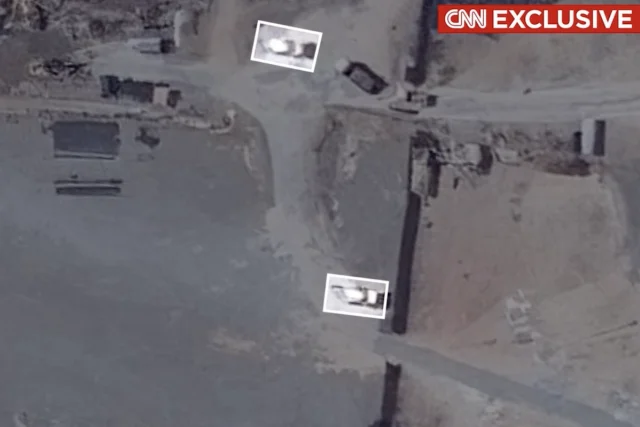
Iran appears to be taking concrete steps to rehabilitate its nuclear and ballistic missile programs, according to reporting by CNN and the Institute for Science and International Security (ISIS).
In a video released over the weekend, CNN presented satellite images of four nuclear and ballistic missile sites across Iran, which show evidence of repair work undertaken by the Islamic Republic.
One of the most significant sites is the Parchin military complex, located about 50 kilometers (31 miles) southeast of Tehran, which includes the Taleghan 2 site, linked to past nuclear weapons-related activities as well as ballistic missile research.
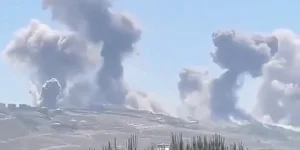
Both Israel and the United States struck the Parchin site several times during recent military operations, with the U.S. using “bunker buster” bombs to penetrate a concrete shield installed by the regime in early February.
Imagery from early June showed that workers had cleared the area around the impact holes left by U.S. munitions and covered the holes with rebar mesh in preparation for covering them with concrete.
The report raises questions about Iran’s adherence to the Memorandum of Understanding, as several of the repairs were carried out on sites with a known history of nuclear weapons research. The work at Parchin continued past the signing of the MoU, possibly indicating that the regime had no interest in honoring the agreement.
“This work shows a commitment by Iran to rebuild and reconstitute the capabilities previously lost, despite the immense damage at the site,” the Institute for Science and International Security (ISIS) said.
ISIS also indicated that this would be the second recent attempt at reconstruction, as the site was first destroyed in an Israeli airstrike in October 2024. It was subsequently rebuilt in May 2025, and was not attacked in June 2025, during Operation Rising Lion.
ISIS said it is not clear “whether the facility had reached operational status by the time Israel destroyed it again in March 2026.”
At the time of that strike, Iran was still working on hardening the site.
The IDF announcement about the strike on the site described it as one “used by the Iranian regime to advance nuclear weapons capabilities,” and “used in recent years to develop advanced explosives.”
Another significant site of activity shown in the recent images is Pickaxe Mountain, just south of the Natanz Nuclear Complex, which has seen consistent construction work since the U.S. and Israeli strikes on nuclear facilities during Operation Rising Lion in June 2025. The site was not hit during Operation Midnight Hammer, as no nuclear material has been confimred to be present.
Earlier this year, two tunnel entrances were partially blocked, in an apparent attempt to prevent vehicular access into the hardened site, buried under Pickaxe Mountain.
This may be an attempt to prevent ground troops from being able to gain access to the site, following reports that the U.S. had weighed conducting a special operations mission to retrieve nuclear materials from similar sites.
“This material would appear to be sufficient to significantly hinder rapid ingress/egress by vehicles and would require the use of heavy earth moving equipment to gain such access and clear an unobstructed path inside,” ISIS reported in early May.
IRAN NUCLEAR UPDATE: Possible NEW Passive Defensive Measures Noted at Pickaxe Mountain
— Inst for Science (@TheGoodISIS) May 6, 2026
Based upon newly available satellite imagery of the Pickaxe Mountain underground complex, just south of the Natanz Nuclear Complex, it appears that as early as April 22nd, the two eastern… pic.twitter.com/KGAhBkLks8
However, in early July, ISIS noted that vehicle activity seen on roads leading to the Western tunnel portals, which are unblocked, indicate that “construction inside the tunnel complex, as well hardening of the tunnel entrance, are ongoing.”
This activity, at another nuclear weapons related site, indicates that the Iranian regime was ignoring restrictions on such activities as part of the MoU.
Recent satellite imagery from late June 2026, of the Natanz Nuclear Complex and the nearby Pickaxe Mountain facility, Fordow, and Esfahan, were provided to the Institute by @vantortech.
— Inst for Science (@TheGoodISIS) July 2, 2026
At Natanz, little activity can be seen. The access points to the below ground enrichment… pic.twitter.com/on6isIGhNA
Similar activity happened at the Fordow nuclear research site in May, with the placing of chicanes and other temporary road obstructions, intended to prevent rapid vehicle ingress and egress.
Only at the Natanz and Isfahan nuclear sites, which were both heavily targeted by the U.S. during Operation Midnight Hammer in June 2025, has there been no significant activity. Tunnels at Isfahan are believed to hold over half of Iran’s stockpile of 60% highly-enriched-uranium (HEU), estimated at around 265 to 287 kilograms (584-633 pounds).
The Washington-based ISIS argues that Iran’s reconstruction efforts at Parchin’s Taleghan 2 site, and the work at Pickaxe Mountain, violate the MoU, because the regime agreed not to advance its nuclear program during the 60-day period initiated by the agreement.
While Iran’s placing of chicanes and earthen piles was apparently done to make foreign access to the site more difficult, in the event of International Atomic Energy Agency (IAEA) inspections, or a possible U.S. or Israeli special operations raid to secure the nuclear materials, it has the added benefit of making Iranian access to the same material subject to foreign observation via satellite and other intelligence.
According to ISIS, this reduces the chance that Iran could attempt a “sprint” towards weapons-grade enrichment or use the material for weapons testing.
However, the work done, also indicates that Iran has not given up on its nuclear weapons program, despite assurances made by negotiators.
You might also like to read this: