The Oct 7 miracle: How Hamas tried and failed to convince Hezbollah to join the deadly invasion






When Hamas launched the invasion and bloodbath in southern Israel on Oct. 7, the Israeli military on the ground scrambled to stop the thousands of terrorists pouring over the border.
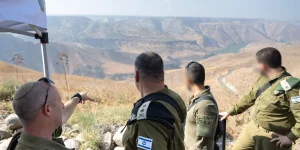
But while this remained the main military effort for the first few days of the war, the IDF’s top brass was also busy moving tens of thousands of troops in the other direction—to the northern border, where the threat of Hezbollah was possibly an even bigger concern for Israel’s leadership than the ongoing Hamas attack.
The fear of the massive Iranian-funded terror militia was so intense that the military and political leadership reportedly considered launching a first strike offensive in Lebanon, even before the eventual ground offensive against Hamas.
But this second front was never opened, as Hezbollah did not join Hamas that day.
For reasons that might never fully be understood, Hezbollah leader Hassan Nasrallah did not give the attack order to his Radwan troops, which had trained for this scenario for years and were stationed only meters from the Israeli border, and instead launched an attrition campaign of rocket and drone attacks against northern Israel.
Listen to IDF Spokesperson RAdm. Daniel Hagari as he reveals Hezbollah’s plan to “Conquer the Galilee” and commit another October 7-style massacre: pic.twitter.com/4AdYsoJDLv
— Israel Defense Forces (@IDF) October 1, 2024
A report published by Israel’s Amit Terrorism and Intelligence Research Institute last week, containing internal documents found by Israeli troops in the Gaza Strip, shed some new light on the cooperation between the two terror groups in the years leading up to Oct. 7, highlighting how close Israel came to a much larger catastrophe that day.
Despite sharing goals, most notably the destruction of Israel, the two Islamist terror groups’ nominal ideologies still differ significantly.
Hamas was born out of the Sunni Muslim Brotherhood (MB), and always had a natural affinity with other Sunni, MB-influenced terror groups in the region. Hezbollah, on the other hand, was created with direct influence of the Iranian regime among the Shiite population of Lebanon. It sees the Iranian Supreme Leader as its spiritual leader and is loyal to him.
The time of the Syrian Civil War pitted the two groups on different sides. Hamas sided with the Sunni terror groups fighting against the Assad regime, which was then a central cog of the Iranian network in the region and only survived due to Hezbollah’s support.
In the last 24 hours, Hamas and Islamic Jihad have launched continuous attacks on Israel from Gaza.
— Israel Defense Forces (@IDF) May 11, 2021
The IDF is operating in response to these attacks by striking terror targets and operatives in Gaza.
This is Operation Guardian of the Walls. pic.twitter.com/sa9UwYfIcV
When Yahya Sinwar came to power as Hamas’ Gaza leader in 2017, he gradually steered it toward the Iranian axis; however, they never swore loyalty to the Supreme Leader and therefore retained greater independence than full axis members like the Houthis or the Iraqi Shiite militias.
“Sinwar regarded Hezbollah not only as a role model for confronting Israel, but also as an intermediary for Iran and a way to make Hamas an integral part of a regional alliance,” according to the report. Therefore, “he worked to establish a strategic partnership with Hezbollah while employing the [unifying] religious motif of defending al-Aqsa [mosque].”
Operation Guardian of the Walls in May 2021 was a crucial step in building this alliance. It was the first time that Hamas, Hezbollah, and other Palestinian terror groups, as well as Israeli Arabs, fought against Israel at the same time, leading Sinwar to believe that through this “unity of the fronts,” the dream of destroying Israel could truly be achieved.
The sheer scale of rocket fire against Israel from seven fronts in the last three years is insane. pic.twitter.com/iyKJy2hEYZ
— Eylon Levy (@EylonALevy) July 11, 2026
Hamas documents showed “details of bilateral coordination through a joint operations room which functioned throughout the hostilities, including the transfer of real-time intelligence and Hezbollah's authorization for Hamas to fire rockets from Lebanese territory.”
During the fighting, “the operations room provided Hamas with intelligence at its request on various subjects, including IDF deployments, aerial intelligence activity and Israeli Air Force operations… every 12 hours a report was prepared and distributed to Hassan Nasrallah, the commander of the Revolutionary Guards, the Iranian leader and all relevant leaders.”
Maybe the most significant achievement of this cooperation, and the most surprising single fact revealed by the report, is that Hezbollah warned Hamas through this operations room ahead of the Israeli deception that was meant to score a devastating blow against Hamas.
On May 15, the Israeli military implied that a ground invasion had begun, which was intended to cause Hamas terrorists to man all the underground battle stations in the tunnel network called the “Metro” ahead of a massive planned bombardment.
But somehow, Hamas had apparently been warned ahead of time, and the losses were much less significant than the IDF had planned. Now we know that the tip came from Hezbollah, though it remains unclear how the terror group had gathered this intelligence.
In any case, Guardian of the Walls was a massive success in the Hamas leadership’s eyes and increased its appetite for more.
“Within weeks of the end of the hostilities, Hamas had already defined its objective as achieving ‘the great victory and removing the cancer’ and ‘eliminating the entity and removing it from our land and our holy sites’.”
However, already at that time, Hamas leaders expressed disappointment with the direct military support from Hezbollah—which would become a recurring motive.
Likewise, Hamas had taken the initial decision to start the war by firing rockets at Jerusalem, a significant escalation at the time, without any prior coordination.
And so, when the time came for Hamas to launch the fateful Oct. 7 attack, once again, Hezbollah’s leadership was aware of a general intention but not explicitly told ahead of time, according to the report.
“Alongside principled support for Hamas' plans, senior Hezbollah were hesitant and reserved,” the report notes. “One reservation concerned the urgency of the attack as Hamas presented it. Another concerned its objectives, and senior Hamas figures were asked to formulate them in greater detail.”
Several conversations between Hamas leaders in 2022 show that the group was not certain about how far Hezbollah’s cooperation and support would go and discussed the need to convince its leaders of their own plans for attacking Israel.
🔴ELIMINATED: Saeed Izadi, a founder of the Iranian regime’s plan to destroy Israel, was eliminated in a precise IDF strike in the area of Qom.
— Israel Defense Forces (@IDF) June 21, 2025
Izadi was also the commander of the Palestine Corps of the Quds Force, a key coordinator between the Iranian regime and Hamas, and… pic.twitter.com/ICPna4O4no
In May 2022, a high-level meeting was held which included Hamas officials Saleh al-Arouri and Khalil al-Hayya, Hezbollah leader Hassan Nasrallah and the chief of the IRGC Quds Force Palestine Branch, Saeed Izadi, a key player in orchestrating the Iranian terror axis.
The Hamas leaders explained that there was a golden opportunity to attack Israel from several fronts, and that several factors supported this timing, including “the weakness of the Palestinian Authority and the rise of the ‘resistance’ inside Israel as well, Israel's ‘fragile’ internal situation, the centrality of the ‘struggle’ for Jerusalem… and preoccupation with the Russia-Ukraine war.”
Nasrallah welcomed the idea in principle but continued to hold reservations. According to Hamas’ documents, the Hezbollah leader asked detailed, business-like questions about the exact objectives of the war. Hamas then came up and presented Hezbollah with a three-tier plan for a major strategic war against Israel, highlighting its breathtaking self-assurance and ambition.
The first scenario would see all groups of the axis, except the Iranian regime itself, join in the “Wad al-Akhira campaign,” apocalyptically named after a Quran verse. The goal of this campaign would be to “completely change the face of the region, its systems and its political reality, while also bringing about the realization of the great Islamic revolution.”
“The symbol of the campaign must be al-Aqsa and Jerusalem, since they can cause a nuclear explosion throughout the region,” Hamas’ planners noted, adding that the best timing would be an attack on one of the Jewish holidays, preferably Passover.
The “intermediate” scenario would see Hezbollah only offer partial support to Hamas. The goal would be to “liberate” the West Bank and the Palestinian prisoners, causing many Israelis to emigrate and laying the foundation for Israel's final elimination.
The third, least drastic scenario would leave the main burden on Hamas without direct support from Hezbollah, though some forces from the Iranian axis would help.
Hamas’ political leader Haniyeh later updated Sinwar in a letter about the meetings, telling him that Nasrallah and Izadi expressed support for the first option, though they again didn’t commit themselves and asked for more time for consideration. Nasrallah said he would brief Iran’s supreme leader about the plans.
While there was no concrete commitment from Hezbollah and the Iranian axis, at the end of 2022, Hamas' military council agreed to convey to Nasrallah that if Iran and Hezbollah were attacked, Hamas would be prepared to take part in the fighting with full force—with the expectation being that, in case of an open confrontation between Hamas and Israel over the al-Aqsa Mosque, the Iranian axis would intervene.
At this point, Hamas’ leadership was apparently convinced that it had Hezbollah on its side.
In a speech less than two months before the invasion, Sinwar said “significant progress” had been made in recruiting the axis, promising that “many fronts” would open against Israel in the case of a war.
On the morning of Oct. 7, as Hamas’ hordes massacred and pillaged the towns of southern Israel, Hezbollah, the broader Iranian axis, and even some senior Hamas officials were surprised.
The IDF Spokesperson announced the completion of the elimination of the senior leadership of the Iranian terror axis in the Middle East.
— Joe Truzman (@JoeTruzman) March 1, 2026
Ali Khamenei's elimination constitutes the culmination of a sustained effort to eliminate the senior leadership of the Iranian terror axis… pic.twitter.com/xOoCH7KJJ7
But immediately after the terrorists breached the border, Sinwar and his military chiefs Muhammad Deif and Marwan Issa sent a letter to Nasrallah and Izadi, urging them to activate the axis forces and send them into battle.
They pleaded: “There should be cooperation from all the other forces of the Axis of Resistance (the various groups), from all fronts, using their maximum strength. A continued concentrated and intensive bombardment and drone attack for two or three days is expected to achieve the objective, God willing.”
But the objective was not achieved.
Nasrallah never fully committed to helping Hamas, for reasons yet unknown, and the feared ground invasion of other axis troops via Syria or Jordan also never materialized.
Israel survived its most dangerous day since the Yom Kippur War; and, over the next years, the Israeli military systematically picked off and killed Sinwar, Deif, Issa, Haniyeh, Nasrallah, Izadi and Iran’s supreme leader, Ali Khamenei.
Please take a moment to join believers worldwide praying for Israel right now. Add your light to the live prayer map—and show the world one more watchman praying for the peace of Jerusalem.

You might also like to read this: