What is it like to be a student in the Palestinian Territories?
A personal testimony of one Palestinian's experience in the PA's education system



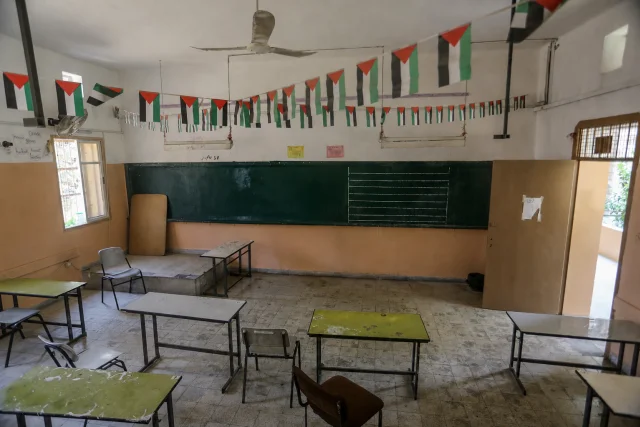
When people around the world talk about the West Bank, they usually talk about checkpoints, the separation barrier, and the Israeli-Palestinian conflict. Many see the region through a political lens. But few stop to ask a different question: What is it actually like to grow up as a student in a West Bank school?
This is not a political report. It is the story of my own experience.
For me, school was not a place where I felt safe or respected. It was often a place where I learned fear more than knowledge. I learned that weak students were expected to fend for themselves, and that fairness did not always apply equally to everyone.
One memory has stayed with me for years. During a surprise exam, I attempted to cheat. Before the teacher caught me, I confessed what I had done. I believed that honesty would make a difference. Instead, I was publicly humiliated in front of the entire class. The teacher shouted at me and stripped me of my dignity. I left the room feeling ashamed and broken. To this day, I have never forgotten that moment.
As I grew older, I learned another lesson: if you were not strong, the strong would take advantage of you. If you did not come from a well-connected family, you could easily feel like a second-class citizen. I often felt that justice was applied selectively, even within the school system itself.
What affected me even more than these experiences was the ideology that surrounded us.
From a young age, we were taught that Israel would one day disappear and that the conflict defined our identity and future. Political narratives were deeply present in our education and daily conversations. We learned who our enemies were long before we learned how to build successful lives.
Over time, I began asking difficult questions. Why was there so much emphasis on conflict and so little emphasis on innovation, entrepreneurship, critical thinking, and personal responsibility? Why were students taught how to blame others before being taught how to solve problems?
In my view, the Palestinian Authority (PA) became less a project for building the Palestinian people and more a system sustained by slogans and failure.
My generation grew up hearing promises about statehood, strong institutions, and the rule of law. Yet what many of us witnessed was corruption, favoritism, and a steady decline in the quality of education and public services.
I believe the PA squandered a historic opportunity. Instead of investing in a generation capable of innovation, competition, and progress, it helped entrench a political culture centered on grievance, blame, and victimhood. It became easier to convince students that the world was against them than to teach them how to overcome challenges and take responsibility for their own future.
For me, government schools under the PA were among the most disappointing institutions I experienced. Rather than learning independent thinking, responsibility, and respect for human dignity, I often encountered an environment shaped by conformity, fear, and political messaging.
I did not feel that the goal was to develop thinkers, leaders, entrepreneurs, or innovators. Too often, it seemed that the goal was to produce students who would repeat what they were told rather than question it.
Even more troubling was the fact that the educational system, as I experienced it, did not merely fail to prepare students for the future. At times, it appeared to reinforce hostility and resentment toward the other side. While children in other societies were being encouraged to innovate, create, and compete in a global economy, many of us were being raised within a culture of perpetual anger and conflict.
Over time, I came to believe that some of the most damaging wounds suffered by Palestinian society did not come only from external forces, but from within.
When education fails, when favoritism replaces merit, when accountability disappears, and when ordinary citizens become an afterthought, a society begins to decay from the inside regardless of outside circumstances.
That is why I believe the PA deserves not only criticism for its failures, but serious moral scrutiny for the impact those failures have had on an entire generation.
Nations are not built on slogans. They are built on education, discipline, freedom, personal responsibility, and institutions that serve their people. Until there is an honest reckoning with these failures, it will continue to be ordinary Palestinians who pay the price.
As I matured, I became increasingly skeptical of the claim that Israel was responsible for every problem in Palestinian society. Certainly, the conflict is real, and its impact cannot be denied. But I also saw corruption, favoritism, poor governance, and injustice that had nothing to do with Israel.
Who was responsible for humiliating students in classrooms? Who was responsible for corruption in public institutions? Who was responsible for the lack of accountability and equal opportunity? These were questions that could not simply be answered by blaming an external enemy.
After becoming a Christian, I met people from different backgrounds, including an Israeli believer who became one of my closest friends. One day he told me something that stayed with me:
"Even if your washing machine breaks, you'll probably blame Israel."
At first, I was offended. But the more I reflected on his words, the more I realized there was truth in them.
Too often, Israel became the explanation for everything, while internal failures were ignored. In my opinion, one of the greatest tragedies for Palestinians has been the unwillingness of many leaders to confront problems within our own society. It is easier to point outward than to look inward.
The greatest injustice that can be done to a child is not poverty or hardship—it is teaching that child to hate.
Every child deserves an education that encourages curiosity, responsibility, and critical thinking rather than resentment and division.
The most important change in my life, however, did not come through politics. It came through Jesus Christ.
Before I came to faith, I carried a great deal of anger. I blamed others for everything and believed that hatred was a natural response to pain.
But Jesus taught me something different.
He taught me how to seek truth without hatred, how to confront injustice without becoming unjust myself, and how to pursue change without losing my humanity.
Today, I believe that genuine reform begins with honesty. A society cannot build a better future if it refuses to acknowledge its own failures. Real progress requires the courage to examine ourselves before we blame others.
This is not the story of every Palestinian. It is simply my story. The story of a student who lost faith in the system around him, but found hope, truth, and purpose in Jesus Christ.
Want to help more people find our reporting from Israel? Leave a quick Google review of our website HERE .
You might also like to read this: