Potential 2028 Democratic contender Rahm Emanuel warns Israel-US ties are at ‘tipping point’


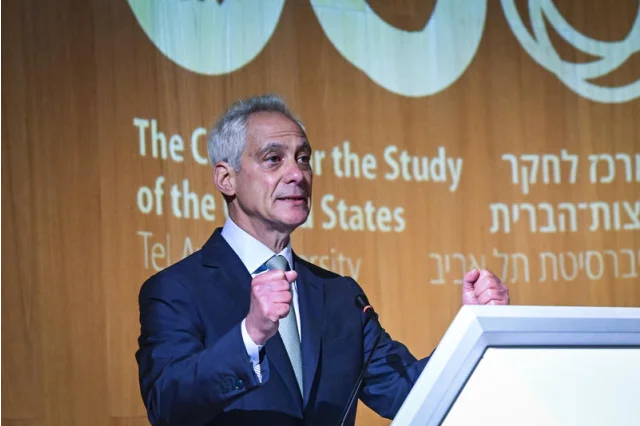
Rahm Emanuel, a leading potential contender for the Democratic presidential nomination in 2028, used a speech at Tel Aviv University on Wednesday to argue that Democrats can reclaim the White House while remaining supportive of Israel – but only if the long-standing approach to the U.S.-Israel relationship changes.
Speaking at a seminar organized by Tel Aviv University, the former congressman, White House chief of staff under President Barack Obama and former Chicago mayor said the traditional political consensus surrounding Israel is no longer sustainable.
This means that the long-standing parameters, which include a quiet acknowledgment that “you can’t say anything negative and there is an implicit endorsement” of Israel, are unsustainable going forward, he argued.
Emanuel's remarks come as debates over Israel have become increasingly divisive within the Democratic Party.
Recent primaries in New York and Colorado saw victories by candidates aligned with the Democratic Socialists of America, whose platform includes strong opposition to Israel, while public support for Israel has declined among significant segments of the party's traditional base.
Emanuel has longstanding personal ties to Israel. His father was an Israeli citizen who fought in the 1948 War of Independence, and Emanuel himself has visited Israel numerous times in both official and private capacities, including serving as a civilian volunteer with the IDF.
During his speech, Emanuel forcefully rejected efforts to justify or minimize the Hamas-led Oct. 7, 2023, terrorist attacks.
“For those that paraded, celebrated and cheered on October 8, what happened on October 7, your moral bankruptcy speaks louder than any words today,” he said. “Those chanting ‘from the river to the sea’ need to hear this loud and clear: they will never have their way.”
At the same time, he criticized Israelis and supporters who advocate annexing Judea and Samaria while rejecting the possibility of a future Palestinian state.
“Both are fantasies chanted by fanatics,” he said, adding that he had come as a “friend” to tell Israelis that their relations with the United States are at a “tipping point” because of the policies pursued by the current governing coalition in the Knesset, led by Prime Minister Benjamin Netanyahu.
Emanuel argued that those policies have turned Israel into a “pariah” nation that has already “lost Europe” and is rapidly losing support in both major American political parties, warning that they could leave the Jewish state at a diplomatic and political “dead end.”
He elaborated that “Israel has failed to convert its military wins into strategic advantages,” while also acknowledging, “I understand why, even if you oppose the Netanyahu government, you’re so prone to dismiss criticism from the outside world.”
Emanuel also said he understood that Israelis are weary of dealing with a “corrupt Palestinian leadership (that) has never lived up to the Palestinian people’s legitimate aspirations for sovereignty and self-determination.”
However, he argued, the future of Israel and the region must not be “held hostage to a past defined exclusively by recriminations.”
He further warned that “Israel will be alone if its leaders choose to attempt to annex the West Bank. America will not and cannot be complicit or complacent in that endeavor.”
Emanuel also lamented what he described as Washington's previous approach toward Israel, saying there had long been an assumption that “the best thing Washington could do for Jerusalem was to blindly and silently stand behind your government, without conditions, without demands, and without consequences.”
He said that approach had been a mistake that contributed to a situation in which “Israel has never been so isolated.”
Among his policy proposals, Emanuel called for ending U.S. military aid grants to Israel, arguing that Israel should instead purchase American weapons and equipment under the same financial terms and restrictions as other U.S. allies “that abides by our laws.”
He also outlined his vision for Israel's future, centered on the establishment of a Palestinian state, which he argued would pave the way for Israel's broader integration into the Middle East and unlock significant economic growth across the region.
Emanuel added that Arab states would also have responsibilities in supporting a future Palestinian state and shaping its policies toward Israel and the West.
“The political benefits for all parties would be far greater than a two-state solution could ever offer. But to get there, everyone would need to make good on their piece of the bargain,” Emanuel said, adding that Israel “cannot fight indefinitely against a world that has stopped believing you have the right to fight. You must instead find a new sustainable path to peace, security and prosperity.”
You might also like to read this: