Israeli defense company unveils concept to launch drones from commercial cargo ships



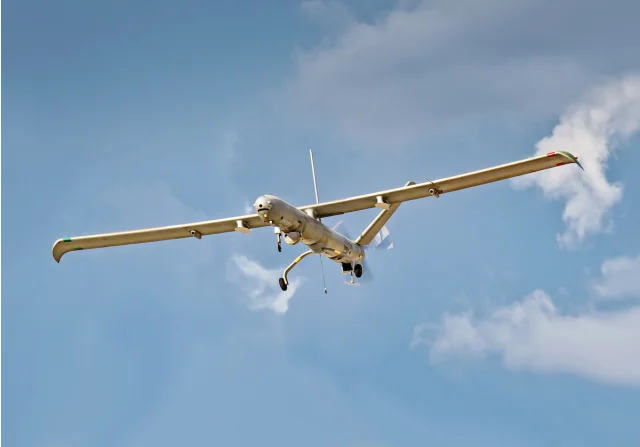
Israeli defense company Elbit Systems announced this week that it is developing a new maritime warfare concept that would allow commercial cargo ships to launch and operate unmanned aerial vehicles, potentially giving militaries a lower-cost alternative to dedicated aircraft carriers for surveillance and combat missions.
The proposal centers on fitting commercial vessels with modular platforms capable of launching and controlling between nine and twelve Hermes 650 Spark unmanned aerial vehicles (UAVs). If adopted, the system could allow countries to rapidly expand maritime air capabilities without building specialized warships.
Each platform would include deck infrastructure, control systems and mission support subsystems, including radar, communications, weapons control and guidance.
The Hermes 650 shares many of the same support systems as Elbit's larger, land-based Hermes 900, allowing both platforms to operate together or independently using either ground- or ship-based infrastructure.
The common architecture also means militaries that already operate the Hermes 900 could integrate the Hermes 650 without purchasing large quantities of new equipment or retraining personnel.
The Spark features a front-mounted engine that provides short takeoff and landing (STOL) capability, making it well suited for operations from ships while allowing it to carry heavier payloads over extended ranges.
The aircraft has two payload bays and can conduct long-range missions using satellite communications and onboard diagnostic systems.
Elbit officials have pointed to the extensive maritime security requirements of countries in the Indo-Pacific, as well as Denmark's need to monitor Greenland, as examples of where the concept could provide a relatively quick and cost-effective capability.
The proposal could also be relevant for Israel as it seeks to protect its expanding offshore natural gas infrastructure.
Both systems are competing in a growing market for medium-altitude, long-endurance UAVs, where systems produced by Turkey's Baykar and South Korea's Hanwha have gained significant traction among allied nations.
While Elbit has not announced a timeline for when the maritime concept could become operational, the proposal appears to address capabilities that several defense ministries have identified as priorities for expanding maritime surveillance and strike operations.
A message on the company's website noted that Elbit described itself as "a leading global defense technology company" that develops and manufactures defense systems across multiple operational domains.
The company said it employs more than 20,000 people in dozens of countries across five continents and reported $US 2.19 billion in revenue for the three months ending March 31, 2026, with an order backlog of $US 30.2 billion.
You might also like to read this: