Church of England votes in support of Palestinian declaration accusing Israel of genocide, colonialism, apartheid




After debating documents from Palestinian Christians including the controversial “Kairos Palestine II” declaration, the Church of England’s General Synod voted yesterday supporting a text which describes Israel as a “colonial enterprise built on racism.”
While the votes were cast heavily in favor of Motion GS 2451A, which called for the church to “receive” the documents and engage with them at all levels, the debate leading up to the vote differentiated between “hearing” the text and “receiving” it, allowing for differences of opinion.
However, as Bishop Philip North said in his speech of opposition, that nicety will make no difference to its impact. Anglicans who love Israel have expressed concern and sorrow about the vote.
“As a vicar in the Church of England I am truly sorry this motion was even proposed, let alone passed with such support,” Rev. Ian Fletcher of Eastleigh parish told ALL ISRAEL NEWS.
“At a time like this, when Israel is contending with numerous enemies and when Jews in our own nation are regularly experiencing increased antisemitism, I would have hoped that our General Synod would have found a way of expressing a desire to find peace without endorsing a report that appears to be full of problematic - even hateful - language,” he said.
Members of the General Synod, which is the national assembly and legislative body of the Church of England, were encouraged to respond “prayerfully, theologically, and practically to the ongoing trauma in Israel and Palestine, and to stand in solidarity with Palestinian Christians and all who seek a just and lasting peace,” in the motion.
Established to replace the Church Assembly in 1970, the General Synod is responsible for shaping doctrine, approving budgets and debating matters of national and international importance. It is the only other body apart from Parliament with powers to pass national laws for England.
The documents debated in the motion brought by the Carlisle Diocesan included the Kairos Palestine Declaration (2009), the Cry for Hope (2020), the Call for Repentance (2023), and most controversially, Kairos Palestine II (2025), which is entitled, "A Moment of Truth: Faith in a Time of Genocide."
The Kairos Palestine II declaration (KPII) accused Israel of malevolent motives in its war waged against Hamas, describing it as “genocidal”:
“Zionists do not want us to remain on our land. Their plan for us is displacement, death or submission. The genocidal war on Gaza is the continuation of the Zionist project to seize all of Palestine, emptied of its Palestinian people.”
Minimizing the horrors of Oct. 7, 2023, the document defended the motives of the Hamas terror group, saying, “the Hamas attack of that day was itself born out of decades of injustice, oppression, and displacement since the Nakba of 1948, and more than 16 years of an immoral, suffocating blockade on Gaza.”
Stating that “settler colonialism and the apartheid system” had been built on “Jewish supremacy,” the document slammed all forms of Zionism as “wrong” all the way back to the Balfour Declaration and the rise of the movement at the end of the nineteenth century, and claimed that the system should be “dismantled.”
Like the January statement by the patriarchs and heads of the Churches in Jerusalem, KPII rejects Zionism, saying it has been “produced by the theology of racism, colonialism, and ethnic supremacy.”
The document is so extreme that anyone reading the content out loud in the synod would be ruled out of order for using antisemitic language, according to Reverend Dr. Ian Paul who spoke out strongly against the motion. As it was, the text was discussed and accepted regardless.
“Can you make sense of that?” asked Ian Paul. “I cannot.”
The motion was presented by the Venerable Stewart Fyfe on behalf of the Diocese of Carlisle, who said the document spoke on behalf of Palestinian Christians.
“Kairos does not just describe their suffering. It describes their imminent extinction from the land of the Savior, a land where they have kept a consistent witness since the day of Pentecost,” said Fyfe. “If the language is challenging, it is because it comes from a place of deep trauma.”
The texts were presented to the 467 synod members from the House of Bishops, the House of Clergy, and the House of Laity. Father Fadi Diab, vicar of Ramallah and Birzeit and co-author of the document, was also in attendance.
Following comments from the Archbishops of Canterbury and Gloucester, Rev. Ian Paul was eventually able to present an opposing view, encouraging a more two-sided approach.
The perspective of Messianic believers in Israel was not represented at all in the discussions, and when one of the laity raised the alienation an Israeli member of her church felt by the motion, she was interrupted by the chair for straying from the amendment.
The bishops voted 25-0 in favor of the motion with five abstentions, the clergy 115 in favor, 20 against, with 30 abstentions, and the laity voted 113 in favor, 27 against, with 35 abstentions.
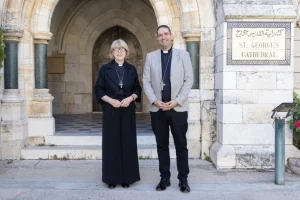
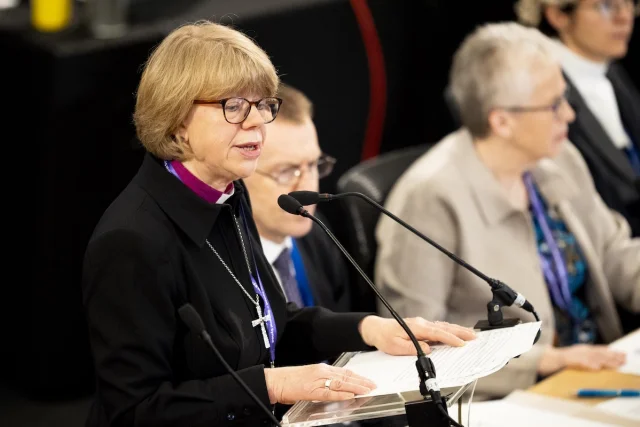
The vote follows the recent five-day visit of Archbishop Sarah Mullally at the invitation of the Anglican Archbishop in Jerusalem, the Most Revd Hosam Naoum, last month.
In a joint letter from “Love Never Fails” representing 25 organizations, the Archbishop’s bias towards Palestinian Christians over believers in Israel was challenged, as Christ Church, an Anglican church with services conducted in Hebrew, Arabic and English, was not included in her trip. While acknowledging the priority of visiting Palestinian Christians after being invited by Revd Naoum, they wrote,
“Following the example of the father in our Lord’s parable of the prodigal son, surely both the younger and older sons should hold a place in your affection?”
The letter brought several points of correction and added important historical context, including the reality of Muslim persecution of Palestinian Christians.
The UK’s Chief Rabbi Ephraim Mirvis also spoke out regarding the language of KPII and its rejection of the Abraham Accords saying:
“While it is important to recognize the suffering of Palestinian Christians, this document does so in a way which can only harm the cause of peace.”
“It is truly shocking that a document which purports to speak in the name of truth contains so much falsehood,” he added, saying the document used “extreme rhetoric to challenge the very concept of a Jewish state, and to oppose existing peace agreements in the region.”
The Archbishop of Canterbury sought to reassure detractors, saying,
“To hear the heartfelt expression of the lived experience of Palestinian Christians does not mean we agree with everything in these documents.”
However, she expressed her concern that the “state of Palestine,” which the British government recognized last year, was “disappearing.”
Rabbi Mirvis described the outcome of Monday’s vote as “shameful,” and slammed KPII as an “egregious barrier to understanding.”
“Reducing one of the world's most complex conflicts to a single, warped narrative that can only harm the cause of peace. This is a sad day for Jewish-Christian relations," he said.
Rev. Fletcher also expressed his concerns about the impact on the Jewish community in the UK:
“I find it deeply troubling that our General Synod has endorsed a report that includes the false accusations of Israel committing genocide, ethnic cleansing and apartheid,” he said. “Israel has always been the victim of distorted news reporting, and never has this been more true than since the horrific Oct 7th attacks.”
“It is so sad that our national church’s governing body hasn’t been able to put aside numerous blatant untruths and to speak lovingly and truthfully into a desperately sad and complex situation,” he added.
In response, a “declaration against Kairos II” was issued on Tuesday by a coalition of Christian leaders, theologians, pastors and lay representatives, inviting Christians to add their name to the statement denouncing KPII, and to stand in support of Israel.
Please take a moment to join believers worldwide praying for Israel right now. Add your light to the live prayer map—and show the world one more watchman praying for the peace of Jerusalem.

You might also like to read this: