Hamas' supposed gov't ‘dissolution’ hasn't changed Gaza situation, as first int'l troops arrive
Failure to hand over weapons, violence against Gazans, proves terror group still holds power







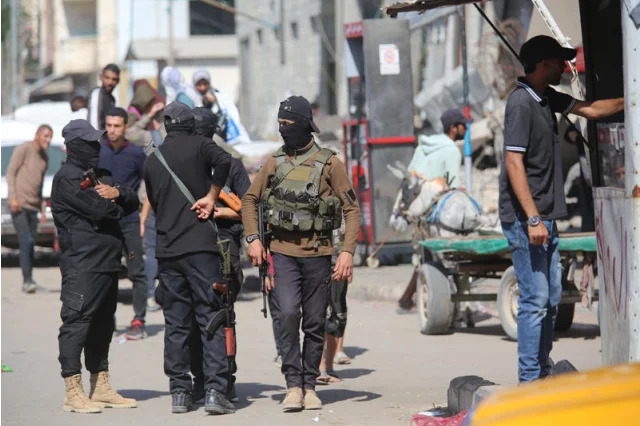
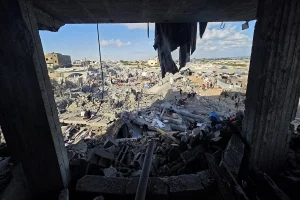
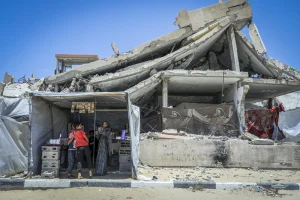
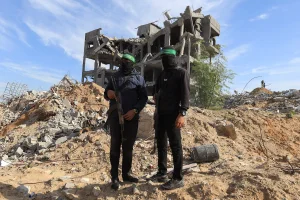
A week after Hamas announced it was dissolving its government to allow for the transfer of authority to the technocratic National Committee for the Administration of Gaza (NCAG), that body remains in Egypt, and Hamas remains in power in the Strip, despite the arrival of the first contingents of the international force meant to provide security instead of the terror group.
Hamas has governed the Gaza Strip for nearly two decades, following the bloody civil war it fought with the Palestinian Authority-linked Fatah in 2007.
Since then, the terror organization turned the Strip into a terror enclave, building an enormous underground terror tunnel network for the purpose of protecting its leaders and fighters against superior Israeli military forces.
Various analysts and experts warned that Hamas’ announcement was nothing more than a political stunt, designed to relinquish responsibility for governing the Strip, without handing over its weapons.
“The intention is obviously mostly public, to pretend as though they have no interest in the current government,” Dr. Moshe Elad, a Palestinian affairs expert from the Western Galilee Academic College, told Radio 103FM.
Elad said the NCAG has no real authority in Gaza and no power to enforce any decisions.
“What is this international council worth that will allegedly replace them [Hamas]?” Dr. Elad asked. “It has no real power, no authority to issue decrees, and no power to enforce anything, like the collection of weapons.”
Elad said that Hamas “is currently boosting its forces and recruiting people. True, it is recruiting people without experience or capability, but it is showing that it still has strength. It is holding onto the main positions of power.”
Analysts have noted that without surrendering its weapons, Hamas is not surrendering its de facto control over the Strip.
“While Hamas has publicly expressed its willingness to surrender administrative responsibilities, it has remained equally consistent in rejecting demands that it disarm or surrender control of its military infrastructure,” analyst Eric Schorr said.
“Hamas appears willing to step away from governing Gaza if doing so eases international pressure and facilitates reconstruction, but it has shown little indication that it intends to abandon the military capabilities that ultimately guarantee its true influence and control over the territory,” Schorr continued.
The recent seizure of humanitarian aid from a World Food Pantry warehouse by Hamas operatives appears to demonstrate that the terror group’s relinquishing of political authority is not connected to a change in its practices.
That incident even led UN Deputy Special Coordinator (UNSCO) for the Middle East Peace Process Ramiz Alakbarov to condemn the group, although without mentioning Hamas by name.
EVEN THE U.N. NOW ADMITS: Armed Hamas terrorists have repeatedly and violently hijacked humanitarian aid in Gaza. pic.twitter.com/VSJRfIHbHf
— UN Watch (@UNWatch) July 13, 2026
In a statement, Alakbarov said, “I strongly condemn the recent obstruction of humanitarian operations in Gaza by the de facto authorities, which endangered humanitarian personnel, intimidated workers delivering lifesaving food assistance and disrupted life-saving humanitarian operations.”
Palestinian activist and analyst Ahmed Fouad Alkhatib wrote on 𝕏 that since that announcement, Hamas “has intensified its thuggery, violence, and extortion of Gaza’s population. Its security and intelligence services have summoned hundreds of Gazans, including people I know, for interrogation, some at Nasser Hospital in Khan Younis.”
A week after Hamas “gave up control of Gaza”: Despite Hamas’s deceptive claim that it “dissolved” its government in Gaza, the opposite has unfolded. Since that announcement, amplified endlessly by Al Jazeera and other “pro‑Palestine” platforms, the group has intensified its… pic.twitter.com/hoVqQhljBN
— Ahmed Fouad Alkhatib (@afalkhatib) July 13, 2026
“Hamas did not ‘dissolve’ its government,” Alkhatib concluded. “It is tightening its grip, escalating its violence, and entrenching its fascistic control over Gaza more aggressively than ever.”
At the same time, the Gaza International Stabilization Force, envisioned by U.S. President Donald Trump’s Gaza Peace Plan, has failed to materialize, with few nations willing to commit troops to a war zone in which Hamas continues to retain its weapons and recruit additional fighters.
The #ISF welcomes the newest members of the Kosovo Security Force to the team. They will support the Gaza security effort in areas such as logistics and civil affairs.#StabilityStartsHere pic.twitter.com/Pv0xWif4Gz
— Board of Peace (@BoardOfPeace) July 12, 2026
On Sunday, the Gaza Board of Peace announced that a contingent of Kosovo soldiers had arrived in Israel to join the ISF, joining a group of around 20 Moroccan soldiers who arrived last month.
The soldiers arrived about one and a half months after two liaison officers from the Kosovo military.
Additionally, Uganda's UPDF set to deploy troops to Gaza as part of the ISF, joining Morocco, Kosovo, Albania, and Kazakhstan, Ugandan newspaper The New Vision reported Monday.
A recent report in The Middle East Eye indicates that the Board of Peace could soon start a pilot zone in the Israeli-controlled territory of Rafah, allowing reconstruction and the entry of a limited number of Gazans to the territory.
#UPDATE.
— Numbers Uganda (@Numbersuganda) July 13, 2026
According to reports, UPDF commandos are set to be deployed in Gaza as part of the International Stabilisation Force (ISF).
Statehouse spurces say President Museveni has reportedly given the go-ahead following a request from President Trump, pic.twitter.com/NUh2Ij8iNJ
According to that report, the ISF would take responsibility for security in the pilot zone, with the NCAG overseeing day-to-day governance. The NCAG and the ISF would carry out screening and access control to the pilot territory.
The establishment of such a pilot would be dependent on Israeli agreement to the program, including the withdrawal of IDF troops from the area. The feasibility of such a move by the current government is not clear.
However, both the U.S. and Europe are eager to move forward with rebuilding in Gaza, despite the failure to establish all the terms of the Gaza Peace Plan. On Monday, European donors pledged $1 billion to Gaza reconstruction efforts.
“We now need the conditions on the ground that will allow the support to reach the people in Gaza,” Dubravka Suica, European Commissioner for the Mediterranean, said.
You might also like to read this: