Hamas crushes rare Gaza protests with death threats, kidnappings & arrests





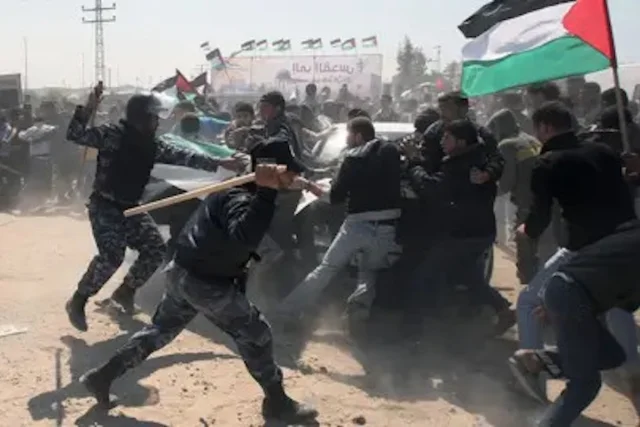
Hamas violently suppressed planned anti-government protests across Gaza this week, using threats, kidnappings and arrests to prevent demonstrators from taking to the streets, according to a Gaza resident who spoke with The Algemeiner on condition of anonymity.
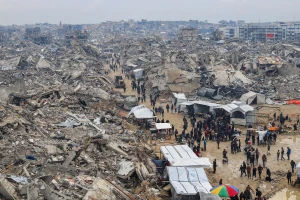
The crackdown targeted organizers of the "June 26 Peaceful Revolution," a planned wave of demonstrations against Hamas' rule. The protests reflected growing frustration among many Gazans, who blame the terrorist group for the devastation caused by the war that followed Hamas' Oct. 7, 2023, attack on Israel.
Last month, a Gazan dissident group urged residents to join a "revolution of rage" while carefully avoiding naming Hamas directly. Instead, the organizers denounced "the arrogance" of "a government that has separated itself from its people, usurped their right to participate or even ask questions, and monopolizes all national decision-making."
Although Israeli forces currently control roughly 70% of Gaza, most of the population remains in the 30% of the territory still controlled by Hamas.
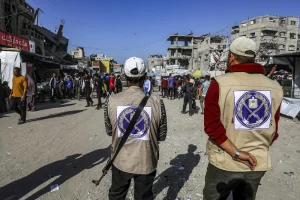
Protest organizers planned demonstrations at dozens of locations, including Al-Shifa Hospital in Gaza City and Nasser Hospital in Khan Younis. Instead, armed Hamas operatives reportedly rounded up suspected protesters at hospitals and in the streets, leaving many planned gathering sites largely deserted.
“The situation in Gaza is very difficult. They are kidnapping people and threatening people. The level of terror is high,” the Gaza resident said.
He added that Hamas had sought to discourage participation through religious intimidation as well as arrests.
“There are fatwas calling for killing and fatwas declaring people infidels in the mosques, and calls saying the protest movement has been postponed,” he said. “Things are very difficult. Since the morning, they’ve been arresting people and kidnapping people from the streets. Things are very bad.”
The Association of Palestinian Scholars, a powerful pro-Hamas religious organization, denounced the protesters as “a criminal movement,” according to a report by the Telegraph.
The group accused the anti-Hamas demonstrators of assisting “the occupier,” a reference to Israel, and warned they could be labeled “collaborators,” a term Hamas uses for individuals accused of cooperating with Israel.
Under Hamas rule, alleged collaboration with Israel is punishable by death.
Hamas reportedly moved quickly to crush the protests out of concern they could spread across Gaza and create an opening for rival armed groups to expand their influence. On Friday, the terrorist group published images of empty protest sites and declared the “Failure of the June 26 Revolution.”
Ahmed Fouad Alkhatib, a Gazan human rights activist living in the United States, warned on Thursday that Hamas had launched an “industrial-scale campaign of terror, intimidation, interrogation, and blackmail against thousands of Gazans.”
He also alleged that Hamas had converted hospitals into “makeshift police stations, interrogation sites, and torture centers.”
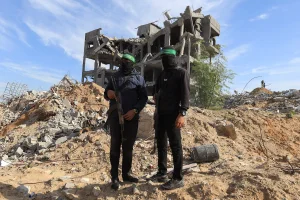
Alkhatib alleged that Hamas had escalated its campaign against dissent by threatening families, placing residents under house arrest and deploying its al-Qassam Brigades to reinforce security forces.
“Families are being threatened, people placed under house arrest, and Hamas’s al-Qassam brigades [the same forces responsible for October 7] have been fully mobilized to reinforce police and intelligence units with an explicit shoot-to-kill order,” he wrote.
Ahed al-Hendi, a senior fellow at the Center for Peace Communications, argued that organizers inadvertently gave Hamas time to dismantle the demonstrations before they could gain momentum.
“The fact that organizers announced the protest weeks in advance made it easier for Hamas to prepare, intimidate people, pressure families, and silence the movement before it reached the streets,” he said.
Al-Hendi added that previous protest movements had been more successful when organized quietly and appearing without warning.
Alkhatib also criticized what he described as the lack of international attention to the crackdown. “Apparently, because Israel is not involved – so no Jews, no news,” he wrote, adding, “This is what the abandonment of Palestinians in Gaza looks like. Shame on all who stay silent in the face of jihadi, ISIS-like violence against the very people they claim to champion.”
Hadeel Oueis, editor-in-chief of Jusoor News, said Hamas had also targeted journalists and anti-Hamas activists in an effort to prevent demonstrations.
“For the past several days, our reporters and several of Gaza’s most prominent anti-Hamas activists have been subjected to an intense campaign of surveillance and intimidation by Hamas,” Oueis said.
She added that activists had been “effectively placed under house arrest by Hamas,” arguing that “They’ve made it clear their number one goal is to prevent any anti-Hamas demonstrations from taking place in Gaza.”
In February, the U.S. State Department similarly condemned Hamas after videos circulated on social media showing masked Hamas operatives threatening and extorting Gazan civilians.
You might also like to read this: