Iranian president says country 'at total war with US, Israel, and Europe,' threatens 'decisive response' if threatened again
Israeli officials assess that Iran is rehabilitating its ballistic missile production




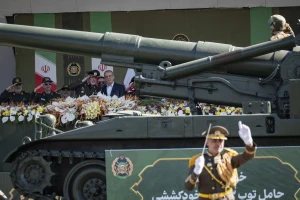
Iranian President Masoud Pezeshkian said on Saturday that his country is facing an "all-out war" waged by the United States, Israel, and Europe, six months after the surprise Israeli strikes which started the 12-day war, called Operation Rising Lion by the Israeli government.
“In my opinion, we are in an all-out war with the United States, Israel, and Europe. They don’t want our country to remain stable,” he said in remarks to Iranian state media published on the website of Iranian Supreme Leader Ali Khamenei.
Pezeshkian also stated his opinion that the war against the U.S., Israel, and Europe is worse than the 8-year Iran-Iraq war.
“This war is worse than the one Iraq waged against us. Upon closer examination, it becomes clear that it is much more complex and difficult," he added, referring to the military conflict between the Iran and Iraq between 1980 and 1988 that resulted in hundreds of thousands of deaths.
“During the war with Iraq, the situation was clear: they fired missiles, and we knew exactly where we were responding. But now, we are being surrounded from every angle,” Pezeshkian said.
The Iranian president also warned that the military has recuperated from the 12-day Israel-Iran War.
“Our beloved military forces are doing their jobs with strength and now, in terms of equipment and manpower, despite all the problems we have, they are stronger than when they (Israel and USA) attacked. So if they want to attack, they will naturally face a more decisive response.”
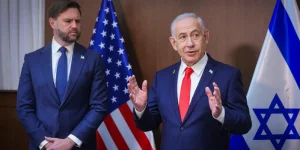
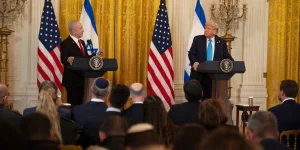
Pezeshkian’s remarks come as Prime Minister Benjamin Netanyahu is set to meet with U.S. President Donald Trump on Monday, with Iran expected to be a key topic of discussion.
During his visit to the U.S. this week, Netanyahu is expected to present Trump with proof that Iran is successfully restoring its ballistic missile program.
According to a Wall Street Journal report last Tuesday, Israel reports an acceleration in Iran's efforts to rehabilitate its ballistic missile production. According to estimates based on recent analysis and quoted in the report, if Iran succeeds in restoring its production facilities to full operation, it could hit a production capacity of hundreds of missiles per month.
A significant difference in Pezeshkian's statement, compared to earlier ones, comes in relation to the European powers. Until recently, European nations, such as France and Germany, were a key part of Iran's diplomatic efforts to reach a new nuclear deal with the U.S. under President Trump. After the re-imposition of UN sanctions via the snapback mechanism by the E3 – France, Britain, and Germany – Tehran's attitude towards achieving a negotiated deal also changed.
Led by the E3, the United Nations reinstated “snapback” sanctions against Iran on Sept. 28 over its failure to allow the International Atomic Energy Agency to monitor its nuclear program, and following the failure of negotiations to reach a settlement.
Pezeshkian has reportedly favored making a nuclear deal with the U.S., but Supreme Leader Ali Khamenei effectively shut down this possibility following the U.S. military strike on Iran's nuclear facilities in June. Despite Pezeshkian's desire for an agreement that would ease the sanctions burden and the economic crisis, the prevailing attitude among the Iranian leadership appears to be that the U.S. cannot be trusted and should not be negotiated with.
The U.S. and other Western powers accuse Iran of seeking to acquire nuclear weapons, an accusation which Tehran consistently denies.
On June 13, Israel launched a surprise strike on Iranian military and nuclear sites, which led to a 12-day war between the two countries. The decision by the U.S. to enter the conflict with Operation Midnight Hammer halted negotiations that had begun in April with Iran regarding its nuclear program.
Since returning to the White House in January, President Trump has revived his previous "maximum pressure" policy from his first term.
This policy has involved imposing crippling sanctions aimed at degrading the Islamic Republic's economy and preventing oil revenues from illicit sales.
Since the 12-day Israel-Iran War, the Islamic Republic has faced significant challenges, including a dramatic water shortage, which threatens to lead to the abandonment of the capital city, and has led to increasing internal pressure on the regime.
You might also like to read this: