Israeli study finds cancer tumors may improve heart function




Scientists at the Technion–Israel Institute of Technology in Haifa conducted a surprising study revealing that cancerous serum in mice reduced fibrosis in the heart muscle.
“The failing heart can beat much better in the presence of cancer cells or a tumor,” Professor Ami Aronheim, dean of the Technion’s Ruth and Bruce Rappaport Faculty of Medicine, said in an interview with The Times of Israel.
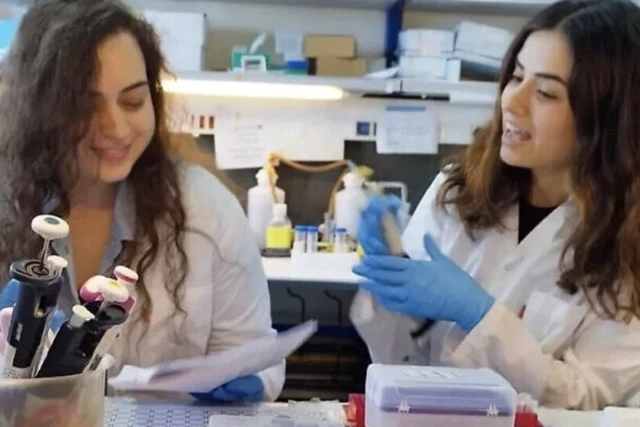
The study, led by PhD students Lama Awwad and Laris Achlaug, was published in JACC: CardioOncology, a peer-reviewed journal of the American College of Cardiology.
Like in many other advanced countries, cancer and heart diseases are among the most common causes of death in Israel, according to the Israeli Ministry of Health.
“These are two diseases that are all around us, and that people we know suffer from,” Awwad said. There is also a connection between the two diseases.
“When we first looked at how heart failure affects cancer, we showed that a damaged heart can make the cancer more aggressive and more metastatic.”
“This led us to start to think about studying the other direction, how cancer affects heart failure,” Awwad added.
The scientists decided to implant cancer cells in mice with heart failure.
“We were surprised to find an improvement not only in the ability of the mice’s hearts to pump blood but also an improvement in the muscular system,” Achlaug explained.
“This was a breakthrough for us,” she explained. “Of course, it was clear to us that it’s not a possible treatment to use another disease for the sake of repairing heart dysfunction. So we had to study the mechanism.”
Itzhak Kehat, head of the Department of Physiology, Biophysics and Systems Biology at the Technion’s Faculty of Medicine, believes the groundbreaking study could improve scientists' understanding of the connection between cancer and heart diseases.
“Tumors can release signals that affect the whole body’s repair and immune response,” Kehat explained. “And some of these signals can be harnessed to improve heart disease.”
Awwad, who lives in the Arab Israeli town of Tamra, and Achlaug, a member of Israel’s small Circassian community, spoke about the challenges women from minority communities face when pursuing scientific careers. Both praised their engineer husbands for their support, noting that they are sometimes able to work from home during the week.
Awwad also shared how people at international scientific conferences often ask about the lives of the Arab minority in the Jewish state.
“People ask me a lot of questions about ‘what’s really happening,'” Awwad said. “It’s good because I like to calm them down,” she added.
While they have so far not experienced hostility at the international conferences, Achlaug acknowledged that she was “a little nervous” to present her paper to a group of Lebanese scientists.
“But there’s a sense of honor among researchers to focus on science,” she said, adding that, afterwards, they can have their opinions.
You might also like to read this: