Is Hamas trying to rewrite Oct 7 before Washington decides Gaza’s future?
.jpg "Maayan Hoffman")



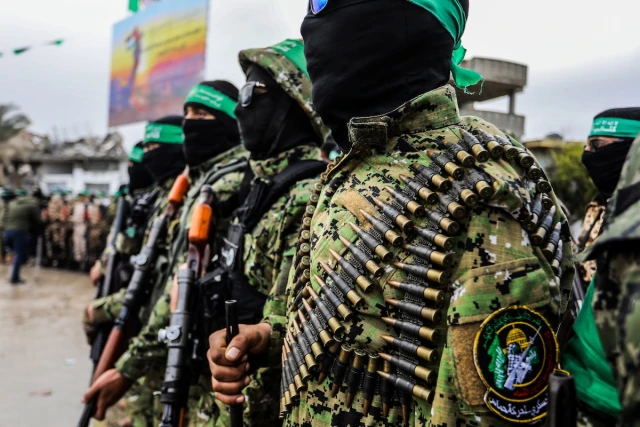
The Hamas terrorist organization’s publication of its latest white paper, “Our Narrative… Al-Aqsa Flood: Two Years of Steadfastness and the Will for Liberation,” is not just another propaganda exercise. It is a calculated attempt to shape the future, to redefine Hamas’ role in Gaza, and to secure its political and military survival.
Hamas has succeeded before at steamrolling false narratives over governments, supporters, and the uninformed. Israel must recognize that this effort, if left unchecked, could succeed again.
The timing of the document is no coincidence.
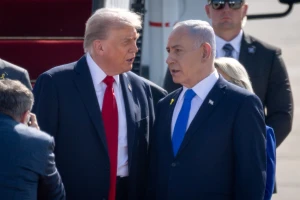
Prime Minister Benjamin Netanyahu is heading to United States this week to meet with President Donald Trump, where a central issue on the agenda will be whether and how Hamas should be disarmed and removed from power. Hamas understands this moment and understands the stakes.
Publishing the paper now, and doing so in English, appears designed to preempt that conversation. It is a bid to influence policymakers, international opinion, and the terms of any postwar arrangement in Gaza.
In short, Hamas is attempting to write itself back into Gaza’s future.
Only careful and resolute action by Israel can prevent that outcome. Yet Israel’s track record shows repeated weakness when it comes to its own hasbara (Hebrew for "explanation," refers to strategic public communication).
According to Professor Gabriel Weimann from the School of Government at Reichman University and also a senior researcher at the International Institute for Counter-Terrorism, Hamas published the paper on Wednesday to reestablish its narrative among the American public. The goal, he said, is to argue that if stage two of Trump’s 20-point plan is meant to bring freedom to Gaza, then Hamas must remain part of that future.
The underlying message of the paper, Weimann explained, is that Hamas presents itself as the legitimate representative of the Palestinians in Gaza.
“They speak about our Palestinian people, forging a war to get freedom, to liberate themselves,” Weimann noted. “It’s not a terrorist organization challenging the state. It’s one people against the other, victims against the oppressors. Hamas is the legitimate representative, and this is why in the future it should not be disarmed and should not be removed from Gaza.”
The final paragraph of the 42-page paper makes that argument explicit. It reads, “Palestine does not ask for the world’s pity, but respect for its people’s right to life and freedom. The independent Palestinian state, with Jerusalem as its capital, and the return of refugees to their land are not a dream, but a historical and political entitlement demanded by a people who withstood genocide and did not break. This is our narrative... remaining as long as a heart from this people beats for freedom.”
This latest paper is not Hamas’ first attempt to frame the Oct. 7 attacks in this way. In the weeks following the massacre, Hamas published a similar document titled “Our Narrative… Al-Aqsa Flood,” which closely mirrors the themes of the new publication.
In that earlier paper and in this new one, the massacre was portrayed not as a single event but as part of a long struggle by the Palestinian people, not by Hamas itself. As Weimann explained, the violence was also presented as legitimate because it was framed as an effort to free Palestinians from what Hamas described as a cruel occupation.
“The attempt was to portray the 7th of October as a direct attack on Israeli occupation forces, only the army,” Weimann said. “They claimed already then and repeated, of course, now, that on the 7th of October, there were no attempts to kill civilians. There were no killings of women. There was no killing of innocent families. It’s all Israeli lies. It’s all part of a long-term campaign that the Israelis are launching against Hamas and the Palestinians in the world.”
Weimann said Hamas consistently tried to present Oct. 7 as one army fighting another.
The new paper repeats that narrative in even stronger terms.
“October 7, 2023, was no sudden event; it was another chapter in the ongoing struggle with the Israeli occupation,” the document states. “The Israeli entity promoted a series of lies and fallacies about killing children and raping women, paving the way to proceed with an all-out genocide project that was pre-planned and aimed to erase Gaza from existence.”
The paper continues, “Because the Israeli entity’s leaders continue to brazenly repeat their lies, we affirm the following: Killing civilians is not part of our religion, morality, or education; and we avoid it whenever we can. Killing civilians, committing brutal massacres, and ethnic cleansing are original Zionist behaviors since this entity’s establishment, and there are thousands of conclusive pieces of evidence that prove this, leaving no room for doubt or debate.”
It also claims that “during the Al-Aqsa Flood operation on October 7, the resistance did not target any hospital, school, or house of worship; it did not kill a single journalist or any member of ambulance crews. We challenge the entity to prove otherwise.”
Every one of these statements can be easily debunked using Hamas’ own footage, captured on GoPro cameras and shared on social media that very day. Of the more than 1,200 people killed on Oct. 7, the names of over 800 civilians who were murdered in their homes, towns, and communities have been confirmed.
Already last year, the United Nations acknowledged that there were “reasonable grounds to believe that conflict-related sexual violence, including rape and gang rape, occurred across multiple locations in Israel and the Gaza periphery during the attacks on 7 October 2023.”
The first paper, Weimann noted, was effective. As he put it, “nothing succeeds like success,” which explains the decision to publish a second paper at this pivotal moment.
Within weeks of the massacre, Hamas managed to shift public opinion against Israel. That change was not driven solely by the publication itself or by Hamas alone. Other factors, including antisemitic attitudes and widespread ignorance, also played a role. Still, Hamas was a central actor in shaping the narrative.
The terrorist organization is one of the most experienced and media-savvy organizations in the world, Weimann said. Its expertise spans media strategy, public relations, psychological warfare, new media, and online platforms.
“There are few organizations in the world that have so much experience, so much know-how in using media,” Weimann told ALL ISRAEL NEWS, noting that these efforts began long before Oct. 7, 2023.
For many years, Hamas has operated a highly sophisticated media system built across multiple platforms.
“Hamas established a media empire,” he said, which includes television stations, radio, newspapers, websites, and social media. According to Weimann, the organization targets four distinct audiences in different languages: Israelis in Hebrew, Palestinians and other Arab states in Arabic, and the West in English.
Last year, Weimann and his colleague, Dana Weimann-Saks, published a paper examining how “Hamas planned its psychological operations,” including its use of disinformation campaigns and new tools such as bots and artificial intelligence to amplify its messaging.
One example cited in the paper describes how, at one stage, Hamas activated a network of bots on Telegram and 𝕏 to spread a false message claiming, “Hamas published videos proving the bombing of more than 640 Merkava tanks and personnel carriers, which means that the number of dead and wounded soldiers reached thousands. Why is the spokesman of the army lying?”
According to Weimann’s research, visual manipulation has played a compelling role.
“Images from the war have vividly and painfully illustrated the potential of Artificial Intelligence (AI) as a psychological propaganda tool, used to create lifelike images of carnage, destruction and victimization,” he wrote.
Digitally altered pictures and videos were viewed millions of times online since the start of the war, only to be debunked later, often after they had already shaped public perception.
“During one week of the war, CBS News staff in New York scanned through 1,000 videos submitted to them and related to the war. Only 10% of the submissions were found to be trustworthy,” Weimann wrote.
If Hamas can do this, does that call all truth into question?
In many ways, Weimann said, the answer is yes.
“If I had to be an advocate for truth today, it would be a harder job than it was in the past,” he told AIN. “Truth today is victimized by many processes, including terrorist organizations that can manipulate the truth. Much of the information today is open to misinformation.”
Many young people now rely on social media as their primary source of information, rather than traditional television, radio, or newspapers. These social media platforms remain largely uncensored and unregulated.
Telegram and TikTok, in particular, have almost no gatekeepers, editors, or fact-checkers. That reality allows anyone to post whatever they want. It is on these platforms that Hamas distributes much of its fake imagery. While some of that content is eventually exposed, it does not prevent the organization from repeating the tactic again and again.
Israel, Weimann argued, must respond using the same tools.
He stressed that even though Israel knows the claims in Hamas’ latest paper are false, allowing the message to sit unanswered carries consequences. If it goes unchallenged, there is a price to pay.
“We need to challenge, and we need to fight back over public opinion, especially since we are discussing the next stage, and it may involve foreign forces,” Weimann said.
Stage two of Trump’s plan calls for establishing an international stabilization force, known as the ISF. How that force ultimately acts against Hamas in Gaza, and what compromises may be considered, even in Washington, to move forward with stage two, could be influenced by messaging and public perception.
If Israel allows this paper to go unanswered or answered weakly, as it has in the past, it risks losing ground. The country does not need Hamas to determine the narrative. Israel has its own narrative, and it must present it clearly and consistently.
“It’s a cynical war of narratives,” Weimann stressed. “We should not let the lies that Hamas spreads be the dominant frame of the events on the 7th of October and afterwards.”
If the country has learned anything over the past two years, it is that surrendering the narrative comes with consequences Israel and the Jewish people can no longer afford.
Want to help more people find our reporting from Israel? Leave a quick Google review of our website HERE .
You might also like to read this: