‘Ignoring gaps could lead to new Oct 7’: Recent terror highlights dangerous lack of border enforcement in Judea & Samaria
High number of breaches in border fence, manpower shortage lead to security risks




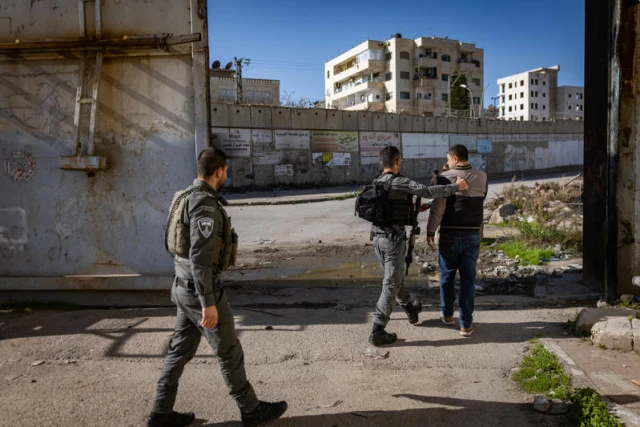
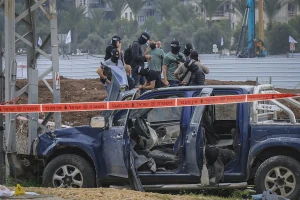
The terror attack on Friday, in which two people were killed by a terrorist who had entered Israel illegally, again highlighted the serious problem with the security barrier between Israel and the Palestinian Territories in Judea and Samaria, which thousands of Palestinians regularly cross to seek employment.
The IDF recently completed a major operation in Qabatiya, the town where the terrorist, Ahmad Abu al-Rub, was from. The purpose of the operation was not to aid the investigation, but to prevent any attempts to carry out a “copycat” attack.
After his arrest, Israeli security forces discovered that Abu al-Rub was an illegal Palestinian worker who did not have an entry permit. After interrogation, it was discovered that two of his brothers were also inside Israel, working illegally.
The investigation highlighted a phenomenon of growing concern in Israel – the ease of entry by illegal workers, often exploiting gaps in the security barrier.
פלסטינים עוברים את גדר ההפרדה בקלות ובאור יום.
— Naftali Bennett נפתלי בנט (@naftalibennett) December 28, 2025
מחר אגיע ליישובי הגדר כדי ללמוד מקרוב על המחדל ועל התיקונים שצריך לעשות.
לעם ישראל מגיע ביטחון.
בקרוב נתקן. pic.twitter.com/ejLI3Tlvwq
MK Oded Forer, chairman of the Committee for the Strengthening and Development of the Negev and the Galilee, in a recent interview on Radio Zafon 104.5FM about the security situation in Israel, highlighted the risks of ignoring security on the “seam line” – the security barrier between the Palestinian territories and the main country.
Forer, of the right-wing opposition party Yisrael Beiteinu, linked the growing problem of criminal violence with the terror attack which happened on Friday, warning, “The writing is on the wall. Ignoring the gaps in the seam line could lead to another Oct. 7, this time in the Central Mountains.”
“You look at the seam line, you see the IDF [knows about] obvious routes, and these are routes known to the security establishment,” Forer said.
“The security establishment does not have enough forces to seal these routes, and because there are not enough forces, the security establishment and the IDF are stretched to the limit, among other things, because soldiers are not being recruited for the IDF. We are 15,000 soldiers short in the IDF.”
Forer harshly attacked the coalition government for failing to pass a draft law that would lead to increased recruitment from the ultra-Orthodox community.
“Instead of dealing with terror attacks and closing breaches in the fence, the Foreign Affairs and Defense Committee convenes to talk about exemptions from conscription,” Forer accused. “This is a government that has lost its direction.”
Dr. Moshe Elad, former head of the security coordination apparatus between Israel and the Palestinian Authority, also spoke with 104.5FM, warning of the limitations of security cooperation with the Palestinian Authority, the strengthening of independent terrorist cells in Judea and Samaria, and the expansion of security threats.
Dr. Elad explained that security cooperation with the PA is limited and does not provide a sufficient response to threats against Israel.
“The problem is that they [the PA] generally provide information when it concerns them,” Dr. Elad claimed. “If it is an attack aimed at their targets, they will be arrested. If it is our concern within Israel, they rarely act. That is how it works, unfortunately.”
Dr. Elad said the Oct. 7 attacks should serve as a warning sign for what could happen in Judea and Samaria and the surrounding communities.
“October 7 is a model that should be feared,” he explained. “We must not again reach a situation that we did not know [about] in advance. We need to assume that it will happen and everyone needs to be monitored in their own sector.”
Dr. Elad also warned of the strengthening of independent terrorist cells, influenced by Iran, in Judea and Samaria.
“Cells have been formed in the West Bank that are not identified with Fatah or Hamas,” Dr. Elad noted. “Their common camp is Iran. Iran is taking advantage of the situation of very high unemployment; there is no way to go to work in Israel, so it recruits every young man, gives him a good amount to live on, and this is the story that is gaining momentum in the cities of the Seam.”
Dr. Eldad referred to the increasing use of drones to smuggle contraband into the Palestinian territories, often via Jordan, and warned about the breaches in the fence and the presence of illegal Palestinian workers, like the terrorist who carried out Friday’s terror attack.
“The story of the fence – in 2000, it was good. Today, if someone wants to cross, they will cross,” he said. “Those who have no choice and want to make a profit will find a way to get in. The majority are not caught.”
“There are between 40,000 and 50,000 illegal [Palestinian] residents who are in Israel at a given point in time,” Dr. Elad noted. “This needs to be dealt with through the people who let them in.”
In recent years, the government has been lax in enforcing the security barrier, believing that the majority of those entering illegally are doing so to provide income to their families. Obtaining an entry permit for work is difficult and usually requires an invitation from an Israeli business.
A Central Command officer in the IDF told Ynet News, “Any fence or wall can be bypassed, especially when the goal is to put food on the table.”
He admitted that both a manpower shortage and a sense of pragmatism were guiding the decision not to enforce border security more thoroughly.
“There are currently 23 battalions in the West Bank, dedicated forces along the seam line and reinforced Border Police for this mission, but in the end, you can’t place a company at every breach,” he noted.
“There is a standing decision to continue with the current situation for two reasons: industrial peace thanks to the income tens of thousands of illegal workers bring home instead of engaging in terrorism, and the Israeli economy’s dependence on them.”
While the government has been slowly upgrading the security fence to help prevent illegal crossings, security experts warn that thousands of workers still cross illegally every week. They warn that after Oct. 7, Israel can no longer afford to turn a blind eye to the situation.
You might also like to read this: