Iran threatens to cancel ceasefire if Israeli strikes against Hezbollah continue, amid general confusion over truce deal's terms
US denies Iranian 10-point proposal is the basis for ceasefire negotiations





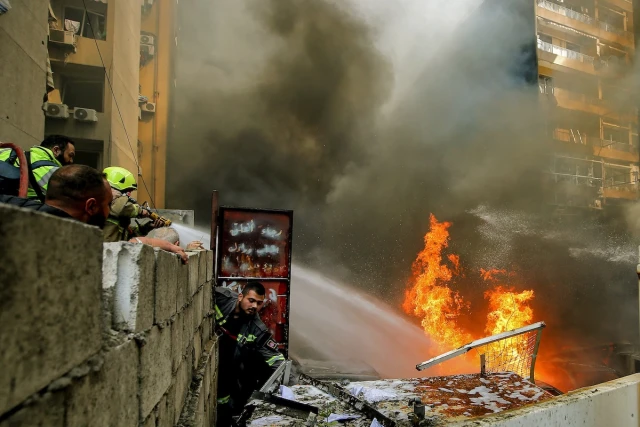
Less than 24 hours after agreeing to a ceasefire deal with the United States, Iranian officials threatened to cancel the agreement on Wednesday afternoon, blaming escalating Israeli strikes on Hezbollah targets across Lebanon.
Just hours earlier, U.S. President Donald Trump clarified the terms of the ceasefire agreement with the Iranian regime, following contradictory reports in Iranian media about the conditions of the deal.
The U.S. and Iran had agreed to halt hostilities for a two-week truce period, with Trump noting in overnight posts on Truth Social that Iran agreed to “the COMPLETE, IMMEDIATE, and SAFE OPENING of the Strait of Hormuz,” and that a final agreement would be made based on a “10 point proposal from Iran” that he called “a workable basis.”
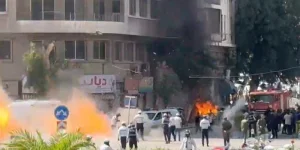
However, Israel has stated that the ceasefire does not apply to the Lebanese arena, where ground operations are ongoing and the IDF has launched a new operation, “Eternal Night,” accompanied by extensive airstrikes across the country. This comes despite claims by Pakistani mediators that the agreement required Israel to halt attacks on Hezbollah.
As long as Hezbollah continues to threaten our civilians, we will continue to operate against them. pic.twitter.com/TD5VOGLcNO
— Israel Defense Forces (@IDF) April 8, 2026
On Wednesday evening, Iranian officials told regional mediators that Tehran would not participate in the planned talks in Islamabad, Pakistan, and could even close the Strait of Hormuz once again unless Israel stops its attacks.
They also warned that Iran could continue carrying out strikes against Israel and other regional countries.
Trump clarified some terms of the agreement in an interview with the Public Broadcasting Service (PBS), noting that the Hezbollah terror group in Lebanon, which is significant for Israel, is not included in the deal with Tehran.
Asked about the massive Israeli strikes in Lebanon on Wednesday, Trump said, “Yeah, they were not included in the deal… because of Hezbollah.” The president added that the Iranian proxy militia would “get taken care of, too,” and “that’s a separate skirmish.”
You started the war, but Iran will set the conditions for its end.
— Iran in India (@Iran_in_India) April 8, 2026
Iran's 10-point conditions that the US has accepted as "workable":
The US is fundamentally committed to:
🔹 Non-aggression
🔹 Continuation of Iran's control over the Strait of Hormuz
🔹 Acceptance of enrichment…
Israel’s Channel 12 also reported that Trump told Prime Minister Benjamin Netanyahu in an overnight phone call that Lebanon was not included in the agreement, and indicated that he would not oppose continued IDF operations there.
With the future of the Lebanese front unclear, Trump’s comments about the other parts of the agreement did not shed much more light.
In another post on Truth Social on Wednesday night, the U.S. president wrote, “Agreements, Lists, and Letters” were being circulated by “total Fraudsters, Charlatans, and WORSE” who aren’t connected to the talks.
"There is only one group of meaningful 'POINTS' that are acceptable to the United States, and we will be discussing them behind closed doors during these Negotiations..." - President Donald J. Trump pic.twitter.com/PP4jlW8LAJ
— The White House (@WhiteHouse) April 8, 2026
“There is only one group of meaningful 'POINTS' that are acceptable to the United States, and we will be discussing them behind closed doors during these Negotiations. These are the POINTS that are the basis on which we agreed to a CEASEFIRE. It is something that is reasonable, and can easily be dispensed with,” Trump wrote.
A senior U.S. official also told Agence France-Presse (AFP) that the 10-point proposal submitted by Iran as the basis for the negotiations, which will be unacceptable to Israel and the Gulf states, had not been approved by the United States: “The document being reported by media outlets is not the working framework.”
But the president himself fueled confusion over the negotiation’s terms by writing that the talks would be based on the 15-point U.S. proposal, rather than the 10-point Iranian plan, which he had himself called a “workable basis on which to negotiate” in his post announcing the ceasefire.
President Trump set out clear, obtainable military objectives for Operation Epic Fury. Thanks to the brilliance of the United States military forces, this operation was a massive success, crushing the Iranian military apparatus. pic.twitter.com/m66TKbIASu
— The White House (@WhiteHouse) April 8, 2026
Earlier on Wednesday, Trump responded to a question about Iranian claims that the agreement stipulates that ships transiting the Strait of Hormuz would pay a toll to Iran. Trump replied that he is thinking about whether the U.S. could impose tolls on passage through the strategic waterway, which he said might ensure the fair flow of maritime traffic and safeguard U.S. interests.
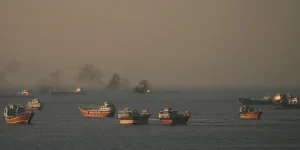
Shipping sources told AFP that, despite reports that two ships transited the Strait this morning, the Iranian regime continued to threaten to attack ships attempting to cross without its permission.
A senior Iranian official told Reuters that the regime could open the Strait in a limited and controlled way on Thursday or Friday “if an understanding on a framework for talks is reached.”
“Coordinating with the Iranian military will be mandatory for all ships,” he said.
Allowing Iran to control the strategic Strait of Hormuz and potentially impose tolls on transiting ships is likely to anger Trump’s Gulf allies, who had reportedly urged the president to pursue a strategy aimed at decisively weakening the Iranian regime rather than entering negotiations.
A big day for World Peace! pic.twitter.com/HsqbANM0k4
— The White House (@WhiteHouse) April 8, 2026
Israel’s Channel 12 quoted a source in the Saudi royal family as saying, “The entire world has witnessed the danger Iran poses to the region and the world… If this regime is not toppled as Saddam's regime was toppled – what is the point of the war? The clerics in Iran will go back to developing the nuclear program they have been working on for 20 years and will continue to develop missile capabilities.”
However, Trump reiterated his stance that the regime had undergone “what will be a very productive Regime Change,” and vowed to work “closely” with the new leadership in another post.
The U.S. president also reiterated that Iran wouldn’t be allowed to continue enriching uranium, adding that the U.S. would be, “working with Iran, (to) dig up and remove all of the deeply buried (by B-2 Bombers) Nuclear ‘Dust.’ It is now, and has been, under very exacting Satellite Surveillance (Space Force!). Nothing has been touched from the date of attack.”
"We untied just a fraction of our strength. And Iran suffered a devastating military defeat." 🇺🇸@SecWar Pete Hegseth briefs members of the media at the Pentagon for the first time since Tuesday evening's ceasefire announcement. pic.twitter.com/iKJFPpkCOW
— The White House (@WhiteHouse) April 8, 2026
U.S. Secretary of Defense Pete Hegseth addressed the issue of enriched uranium at a Pentagon news conference on Wednesday. “We know exactly what they have.” He added, “They will either give it to us, or we’ll take it out.”
Tariffs and sanctions relief will reportedly be addressed during the talks. In a follow-up post, Trump stressed that any country “supplying Military Weapons to Iran will be immediately tariffed, on any and all goods sold to the United States of America, 50%, effective immediately.”
You might also like to read this: