PM Netanyahu: Israel accepts Iran ceasefire if regime opens Hormuz Strait & stops attacks; fighting against Hezbollah continues
Last missile attack on Israel ends around 2:40 am local time; Iran strike Bahrain hours later








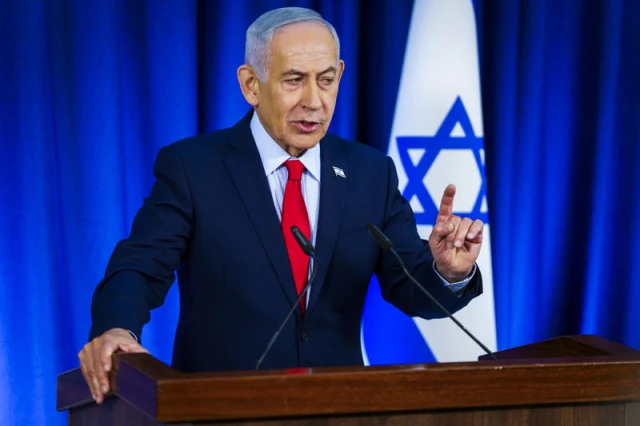
Following U.S. President Donald Trump’s dramatic overnight announcement of a two-week ceasefire, made just hours before his deadline expired, Israel said it supports the arrangement while clarifying that the ceasefire will not apply to Lebanon, where the IDF continues striking Hezbollah targets.
Early on Wednesday morning, the office of Prime Minister Benjamin Netanyahu (PMO) stated, “Israel supports President Trump's decision to suspend strikes against Iran for two weeks subject to Iran immediately opening the straits and stopping all attacks on the US, Israel and countries in the region.”
“Israel also supports the US effort to ensure that Iran no longer poses a nuclear, missile and terror threat to America, Israel, Iran's Arab neighbors and the world. The United States has told Israel that it is committed to achieving these goals, shared by the US, Israel and Israel's regional allies, in the upcoming negotiations.”
Prime Minister’s Office:
— Prime Minister of Israel (@IsraeliPM) April 8, 2026
Israel supports President Trump's decision to suspend strikes against Iran for two weeks subject to Iran immediately opening the straits and stopping all attacks on the US, Israel and countries in the region.
Crucially, the statement concluded, “The two-weeks ceasefire does not include Lebanon.”
Shortly afterwards, IDF Arabic Spokesman Col. Avichay Adraee published an evacuation notice for a Hezbollah target in the city of Tyre. He urged civilians, “To ensure your safety, evacuate your homes immediately and move north of the Zahrani River.”
Earlier statements by the U.S. did not explicitly state whether the truce was relevant for the Lebanese arena as well, where five divisions of the IDF recently captured a line of hills some 8-10 km (5-6 miles) within Lebanese territory and are clearing the area of Hezbollah's infrastructure.
Pakistani Prime Minister Shehbaz Sharif, who was reportedly involved in mediation efforts, declared that Washington and Tehran “have agreed to an immediate ceasefire everywhere including Lebanon and elsewhere, EFFECTIVE IMMEDIATELY.”
#عاجل ‼️ انذار عاجل ومتكرر لسكان مدينة صور وتحديدًا في شبريحا (العباسية)
— افيخاي ادرعي (@AvichayAdraee) April 8, 2026
⭕️نشاطات حزب الله الإرهابي تجبر جيش الدفاع على العمل ضده وبقوة. جيش الدفاع لا ينوي المساس بكم.
⭕️حرصًا على سلامتكم عليكم اخلاء منازلكم فورًا.
⭕لضمان سلامتكم أخلوا منازلكم فوراً وانتقلوا إلى شمال نهر… pic.twitter.com/GfqsHWQ0Oe
Sources close to Hezbollah also told Reuters on Wednesday morning that Hezbollah remains committed to the ceasefire despite the continuation of Israeli strikes and would later clarify its stance in an official statement.
Nevertheless, the IDF published an official statement in the late morning confirming, “In accordance with the directives of the political echelon, the IDF has ceased fire in the campaign against Iran and is on high alert in defense and ready to respond to any violation.”
“At the same time, in Lebanon, the IDF continues fighting and ground operations against the terrorist organization Hezbollah.”
With the greatest humility, I am pleased to announce that the Islamic Republic of Iran and the United States of America, along with their allies, have agreed to an immediate ceasefire everywhere including Lebanon and elsewhere, EFFECTIVE IMMEDIATELY.
— Shehbaz Sharif (@CMShehbaz) April 7, 2026
I warmly welcome the…
Iran initially continued launching missile barrages at Israel even after Trump’s announcement. Later that night, Iran's Tasnim News claimed that the ceasefire went into effect at 3:30 a.m. Iran time, meaning 03:00 Israel time.
Other state media also reported that the new Supreme Leader, Mojtaba Khamenei, had ordered all units to cease fire. The last missile attack on Israel ended around 02:40 a.m. local time, though the Bahraini Interior Ministry reported two people wounded in an Iranian drone attack in the area of Sitra just hours later.
A “senior political source,” a phrase often indicating a semi-official briefing to media outlets by high-ranking government representatives, assured Israeli media outlets that Washington had cleared the temporary ceasefire with Israel in advance.
“This is a move in which Iran opens the Strait of Hormuz without receiving in advance any of its demands, such as a commitment to a final end to the war, receiving compensation, the cancellation of the heavy sanctions against it, and more,” the source said.
He added that Trump administration officials had assured Israel that the U.S. would “firmly insist” on the removal of remaining nuclear material, a halt to enrichment, an end to the ballistic missile threat, and other Israeli demands.
“These are shared objectives of Israel and the United States,” the source said, claiming, “Iran retreated from its demands and yielded to the demand to open the straits under the massive pounding of the regime’s infrastructure since the outbreak of the war, and even more so in recent days.”
The Iranian regime, however, claimed victory and alleged that the U.S. had agreed to its 10-point list of demands, including acceptance of its uranium enrichment program, the lifting of all sanctions, and, crucially, expanded Iranian control over the Strait of Hormuz.
Other demands include a U.S. military withdrawal from the Middle East, an end to attacks on Iran and its proxies, and other conditions that are unacceptable for Israel.
Iran's National Security Council announced that Khamenei had approved the two-week ceasefire, adding that negotiations would be held in Islamabad, the capital of Pakistan, in an effort “to finalize the details within a maximum period of 15 days.”
Iran’s delegation is reportedly expected to be led by the speaker of the Iranian Parliament, Mohammad-Bagher Ghalibaf, while U.S. Vice President JD Vance is set to head the American delegation.
You might also like to read this: