Trump says he's 'very upset' guns for Iranian protesters were diverted, Kurdish groups deny receiving weapons
Weapons reportedly sent to region during the anti-regime protests, never reached dissidents



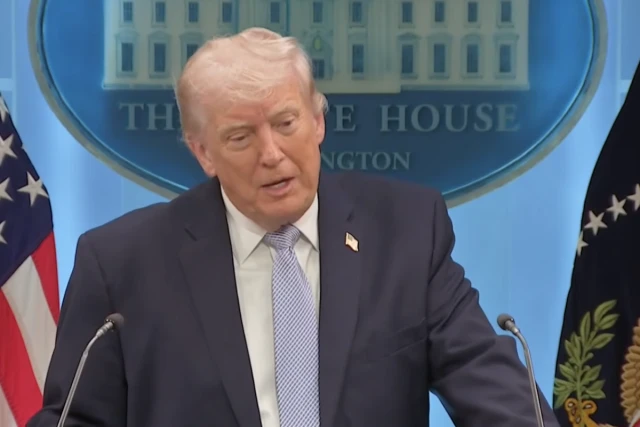
U.S. President Donald Trump told reporters on Monday that the United States attempted to arm Iranian dissidents, but that the weapons were diverted and held by the group meant to transfer them.
While the president didn’t name the group involved, he had previously said the U.S. sent weapons to the Kurds.
“We sent guns, a lot of guns, they were supposed to go to the people so they could fight back against these thugs,” Trump told reporters at a White House Easter egg event on Monday. “You know what happened? The people that they sent them to kept them.”
Trump on Iran: We sent to some guns. They were supposed to go to the people so they could fight back against these thugs. The people we sent them to kept them. I am upset with a certain group of people and they will pay a big price pic.twitter.com/q5JCqpFfHx
— Open Source Intel (@Osint613) April 6, 2026
“They said, ‘What a beautiful gun. I think I’ll keep it,'” Trump claimed. “So I’m very upset with a certain group of people, and they’re going to pay a big price for that.”
On Sunday, Fox News reporter Trey Yingst quoted President Trump as saying that the weapons were sent to the Kurds, and that he believes the Kurds kept them.
President Trump reportedly told Yingst that the U.S. was directly involved in efforts to destabilize and overthrow the Iranian government during the widespread protests, and weeks before strikes were launched across Iran by the U.S. and Israel.
🚨WATCH: Trump: "We sent guns to the protesters, a lot of them," President Trump told me. "And I think the Kurds took the guns." pic.twitter.com/rioRZyWpo4
— Raylan Givens (@JewishWarrior13) April 5, 2026
While Trump didn’t specifically blame the Kurds in his remarks on Monday, he did pan any involvement of Kurdish resistance groups in the war effort in Iran.
Asked if he would like the Kurds to become involved in the war effort in Iran, Trump said, “I’d rather have them stay away because I think they bring with them some problems and some difficulty.”
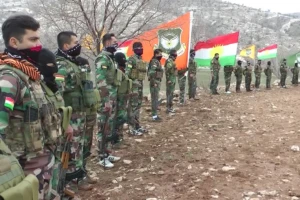
However, following President Trump’s comments, several Kurdish groups in northern Iraq denied receiving any weapons.
Mohammed Nazif Qaderi, a senior official from the opposition Kurdistan Democratic Party of Iran (KDPI), said, “We haven't received any weapons. The weapons we have are from 47 years ago, and we obtained them on the Islamic Republic's battlefield, and we bought some from the market.”
Additionally, Amjad Hussein Panahi, head of communications for Komala of the Workers of Kurdistan, said, “We assure you we haven't received a single bullet or weapon from any country or place, and we're not aware of the existence of such a thing; what we have is our own.”
Siamand Moeini, a senior figure in the armed Kurdistan Free Life Party (PJAK), also denied receiving any weapons, saying, “We as PJAK, as I know, have not received anything. As for others, I cannot answer.”
The Kurdistan Freedom Party (PAK), also denied receiving weapons in a statement, saying, “We have received no single weapon from the US at this time.”
Several of these groups also denied having any discussions with U.S. officials regarding operations in Iran, or support for the war effort there.
However, some Kurdish groups suggested that the U.S. may have sent the weapons to a Kurdish group allied with Shi’a militias in Iraq, noting that the U.S. Ambassador to Turkey Tom Barrack has met several times with Bafel Talabani, an Iraqi Kurdish politician who has often cooperated with the Iranian regime, and has spoken out against regime change, or any Kurdish involvement in the war.
Reports in early March said that Washington was considering arming Kurdish resistance groups in a bid to spur a rebellion which could lead to the collapse of the Islamic regime. However, following a series of leaks regarding details of the plan, along with reticence by the Kurdish groups, who were distrustful after the U.S. pulled support from Syrian Kurds, the plan fell through.
Iranian Kurdish resistance fighters have lived in a semi-autonomous region of Iraq, near the border of Iran, since the Islamic Revolution in 1979.
If the attempted weapons transfer took place in early January, as Yingst’s report implies, it could provide some further explanation for President Trump’s promise to Iranian protesters that “help is on the way.”
Around the same time that Trump made that promise, the Iranian regime began crackdowns which killed thousands of protesters. Trey Yingst said that Trump told him the regime may have killed as many as 40,000 people during the protest crackdowns.
You might also like to read this: