What are Israel’s goals in southern Lebanon? Politicians and military send conflicting signals
DM Katz: No return for Lebanese residents until security of northern Israeli residents is guaranteed





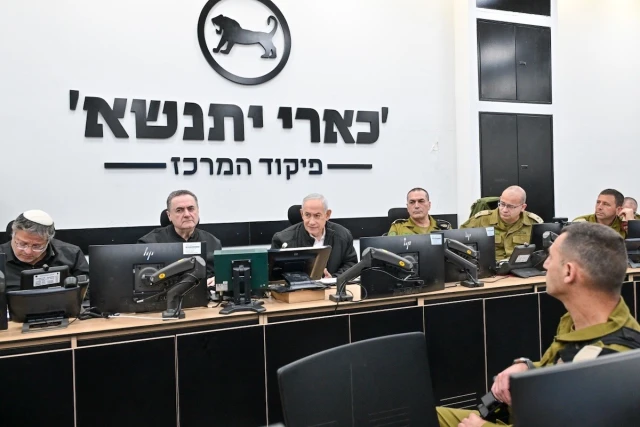
Defense Minister Israel Katz on Tuesday vowed that Israel would create a security zone in southern Lebanon and demolish all homes near the border, creating further confusion about the exact objectives of the IDF's ground operation in Lebanon, as the Israeli military has signaled differing goals.
In a statement, Katz said, “At the end of the operation, the Israel Defense Forces will position itself in a security zone inside Lebanon – along a defensive line against anti-tank missiles – and will maintain security control over the entire area up to the Litani River.”
He used the Hebrew term retzu’at bitachon, meaning “security zone,” which for many Israelis evokes memories from the 18-year occupation of large parts of southern Lebanon, widely viewed today as costly in both lives and resources, and largely unsuccessful.
Katz added that the “return south of the Litani [River] of more than 600,000 residents of southern Lebanon who evacuated northward will be completely prohibited until the safety and security of northern Israeli residents is guaranteed. All houses in villages near the border in Lebanon will be destroyed – according to the model of Rafah and Beit Hanoun in Gaza – in order to remove once and for all the threats near the border to residents of the north.”
This is the first time that an Israeli politician has suggested that the residents of southern Lebanon would not be allowed to return until further notice. Presumably, Hezbollah would need to be dismantled to “guarantee” the safety of northern Israel’s residents.
The defense minister also addressed concerns that the Iranian regime may seek to include a ceasefire in the Lebanese arena in a deal with the United States to end the war in Iran, a move that could ostensibly prevent the destruction of Hezbollah.
“We are determined to separate Lebanon from the Iranian arena – to pull the snake’s teeth and remove Hezbollah’s ability to threaten – and to fundamentally change the situation in Lebanon through a security presence of the IDF in the necessary locations, with strict enforcement and absolute deterrence – just as in Syria and Gaza,” Katz vowed.
Local commentators have noted that the Israeli leadership currently appears to be pursuing the creation of “buffer zones” along several borders. In Gaza, large parts of the border area along the “Yellow Line” have been destroyed, many as part of the process of dismantling Hamas tunnels and other infrastructure.
In Syria, the IDF has created a buffer zone, but without conducting large-scale demolitions.
This leaves the Lebanese border, where the exact parameters of a “buffer” or “security” zone are still unknown.
Katz’s statement on Tuesday was the first to suggest broad, systematic demolitions of civilian homes in the border villages, many of which were used as bases by Hezbollah to devastate Israeli towns through direct artillery fire in 2023-24.
In 2024, the IDF captured most of the first line of villages and ridges on the Lebanese side and cleared them of Hezbollah infrastructure before withdrawing from most of the area, except for five strategic hills overlooking parts of the border.
On Sunday, Prime Minister Benjamin Netanyahu said he ordered the IDF to “further expand the existing security zone,” without specifying what that meant.
On Monday, Israeli media also reported that troops had reached the Litani River in some areas.
Following Katz’s comments, IDF sources briefed Israeli media outlets to contradict him, noting that the overall goal of the operation is to capture all areas that enable direct-line fire at Israeli towns, mostly through anti-tank missiles.
In the rest of southern Lebanon, up to the Litani River, the military will rely on precise intelligence strikes on Hezbollah targets in the now-depopulated villages.
This indicates that the IDF is not planning to capture all of southern Lebanon up to the Litani, as Katz’s comments seemed to imply.
In addition, the sparse updates released by the IDF and additional information from open-source intelligence accounts on social media appear to confirm that the IDF is not planning to capture the entire region south of the Litani.
For example, most incidents where Israeli soldiers were killed or wounded occurred in areas relatively close to the border. The IDF said the incident in which four IDF soldiers were killed on Monday took place across the border from the Israeli communities of Zar’it and Shtula, where troops are working to secure the entire ridge from which many rockets were launched toward Israel.
🧵Lebanon Update: Significant advances have been reported along four axes over the past 2 days.
— Theti Mapping (@ThetiMapping) March 30, 2026
> The 226th Reserve Paratroopers Brigade of the 146th Division deepened its advances along the Tyre coastal road, securing the entirety of al-Bayada. At the very least, the Black… pic.twitter.com/RG8VlUYI52
According to open source analysts, IDF troops have not advanced in a straight line but have pushed into Lebanese territory along several corridors.
Along the coast, troops reached the town of al-Bayada, about 7 km (4.3 miles) from the border. In the eastern sector, a corridor extends from Metula toward the town of Qantara, stretching about 10 km (6 miles) from the border.
Hezbollah has also announced locations where its operatives have attacked Israeli troops, with most located relatively close to the border as well.
Israeli troops reached the Litani River near Metula, where the river valley comes within roughly 3 km (1.8 miles) of the border.
Speaking to Ynet News, military sources stressed that Israel does not intend to establish a ground presence up to the Litani River, but rather focus on aerial control to prevent civilians from returning south of the river and to quickly identify terrorist activity.
“From our perspective, anyone who crosses is a militant,” the officials said.
You might also like to read this: