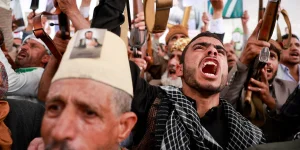
'Transparency deficit' identified in new report on funding behind UK anti-Israel protests


NGO Monitor released a new report criticizing current UK regulations as “inadequate,” expressing concern about funding transparency and links to extremist groups.
The “Imported Influence” report conducted by NGO Monitor (NGOM) highlights the political implications of anti-Israel campaigns, saying they are destabilizing British society.
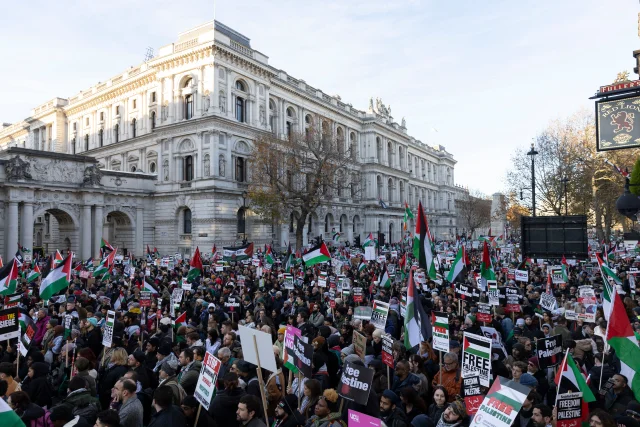
The report stated that although the weekly protests against Israel in recent years have been widely portrayed in the media as grassroots and spontaneous, they have in fact been organized by professionals and are “part of a well-funded, coordinated global advocacy network.”
As a project of the Institute for NGO Research, NGOM publishes research and independent analysis about non-governmental organizations, their funders and stakeholders and has had Special Consultative Status with the United Nations Economic and Social Council since 2013.
The report presents the results of mapping 40 major post-Oct. 7 protests and campaigns in the UK, identifying the main “recurring actors” responsible for coordination, advocacy, funding and related activity.
According to their findings, at least 11 of the 40 organizations they investigated either had links to extremist organizations and/or have officials who have met with or cooperated with extremist actors, such as the Iranian regime and its Revolutionary Guard Corps (IRGC), Hamas, Hezbollah, the Popular Front for the Liberation of Palestine (PFLP) and the Muslim Brotherhood.
The group traced millions of pounds “flowing” into what it called the “protest network” through memberships, donations, and funding from overseas. Transparency issues were also identified as some groups were raising money via cryptocurrency, providing untraceable funding for organizations such as Palestine Action, a proscribed terror group.
Despite some having dubious claims to charitable status, 19 of the 40 organizations in the study receive government funding either via the FCDO or by Gift Aid, while 11 are receiving taxpayer funding from countries such as the United States, Belgium, the European Commission, Ireland, Norway, Scotland, Sweden and Switzerland.
Radical groups both from within the UK and from other countries were found to be targeting British youth as a “core activity.”
The report cited Amnesty’s anti-Israel activism program, which trains hundreds of UK youth in protest rights, media engagement, and campaign strategy, and the Friends of Al-Aqsa group, which has been encouraging young people in particular to ‘get active for Palestine.’
Similar issues have been identified in research carried out in the US by Dr. Charles Asher Small, director of the Institute for the Study of Global Antisemitism and Policy (ISGAP).
“We found over $100 billion…coming from the Muslim brotherhood into American higher education, not declared,” he reported, breaking down the astronomical amounts of money being funneled into U.S. universities and supporting the protests on campuses after Oct. 7.
The strategy of targeting youth was also found, after an entire school curriculum from kindergarten to twelfth grade was discovered in which Israel was purged off the map, along with all evidence of Jewish and Christian heritage in the Middle East.
“The insidious nature of changing our students and scholars is serious,” he warned.
However, he reported that Texas A&M College had the “morality and ethics” to withdraw their campus from the billion-dollar funding from Qatar, calling it a “minor victory.”
Looking at the situation in the UK, the NGOM report suggested that the government should “take a closer look at foreign funding to domestic advocacy networks” and asked whether the current mechanisms, such as FCDO oversight regulations and the Foreign Influence Registration Scheme, are able to address the “gaps in transparency.”
“Key questions include whether existing Charity Commission and Companies House disclosure regimes are sufficient,” the report advised, asking whether a new approach should be required for organizations that are connected with extremist networks or receiving public funding for activities without any formal accountability structure.
The recommendations in the report included a strengthening of transparency and disclosure requirements, better oversight and accountability, especially when it came to foreign funding and cryptocurrency, and readiness to identify and proscribe extremist groups. The report also suggested clearer guidance on charitable status and political campaigning.
“The extensive protests that began on 7 October 2023 have had significant destabilising effects in the UK. They have exacerbated political and societal polarisation, leading to exponential increases in acts of incitement, discrimination and violence,” the report stated. “Much of this hate has been directed at the UK’s Jewish community.”
NGOM is an independent body founded in 2002 and is a globally recognized research institute committed to accountability, transparency and universal human rights.
You might also like to read this: