What a Soviet memorial in Latvia teaches us about modern antisemitism





This past summer, while driving through a Latvian forest near Lake Valguma on vacation, I noticed a solemn-looking memorial flash past us. We were in a hurry and couldn’t stop, so I did something that would have been impossible a few decades ago: I found it on Google Maps and asked ChatGPT what it was.
As it turns out, the plaque we drove by says in Latvian and Russian, “During the Great Patriotic War, the fascist occupiers murdered several thousand peaceful Soviet citizens in this forest during 1941–1942.”
Soviet citizens.
It was a Soviet-era memorial. The text sounds solemn and respectful until you realize what it’s leaving out. Among those murdered there were hundreds of Jews from nearby Tukums, alongside other victims, but none of those identities appeared on the inscriptions. Holocaust victims were just “peaceful Soviet citizens.”
This was a deliberate erasure of identity.
I was only 9 years old when the Soviet Union collapsed, and yet… I felt like I recognized this erasure of antisemitism. This attempt to not deny, but trivialize antisemitism by folding it into “all types of racism” was strangely familiar. But more on that later.
As I looked into this more, I realized that the memorial I encountered was not unique. At Babi Yar, near Kyiv, where almost 34,000 Jews were murdered in two days, the Soviet monument erected in 1976 commemorated “Soviet citizens and prisoners of war” without identifying the Jewish victims.
The famous Russian poet Yevgeni Yevtushenko wrote in 1961: “No monument stands over Babi Yar,” causing a national debate. His opponents accused him of singling out Jewish suffering and dividing the Soviet people rather than stressing their common struggle against fascism.
Does that sound familiar?
This was a kind of “asymmetric universalism,” as some scholars call it. On paper, everyone was equal, but that equality came with a cost. Any kind of Jewish particularity, whether in religion, unique history, or identifying with Jews of other countries, was seen as suspicious.
Given this, you would expect the Soviets to resist any type of Zionism, and generally, they did. But in 1947-48, the opposite occurred for a brief moment. The Soviet Union actually helped create Israel. They not only openly supported the 1947 UN partition plan, they even helped arm Israel after May 1948, despite the American embargo and UN restrictions on arms shipments. With Stalin’s direct approval, communist Czechoslovakia shipped much-needed weapons and fighter planes to Israel right in the crucial moments of 1948, enabling Israel to prevail in its war of independence despite the American embargo.
Why did Stalin do this? Pure geopolitics. Stalin wanted the Brits out of the Middle East, and the kibbutz movement made him think Israel might become a socialist ally of Moscow. He was wrong.
When the first Israeli ambassador to Moscow, Golda Meir, attended a Moscow synagogue in the fall of 1948, tens of thousands of Soviet Jews spontaneously flooded the street, weeping, reaching out to touch her clothes, singing and shouting “Am Israel Chai” (the nation of Israel lives). Those crowds revealed something deeply unsettling to the Soviet regime: decades of Communist assimilation had not extinguished Jewish collective identity, and the creation of Israel had awakened something within them. They had an alternative emotional homeland. Stalin did not like that.
Ben Gurion was a socialist, but he was a social democrat. He publicly sided with the West at the outbreak of the Korean War in 1950, and by then, the USSR was already done with Zionism. In early 1949, Stalin had moved into a deliberate campaign to get rid of the Jews from universities, government ministries, hospitals, and places of influence. Only, instead of “Jews,” he used the code word “rootless cosmopolitan.” Pretending that the purge was not targeting Jews, but “bourgeois Western influences.” Of course it disproportionately targeted Jews, branding any kind of sympathy for Israel as them being foreign agents or threats.
As Soviet alignment shifted more and more toward Arab states while Israel gravitated westward, and the Middle East became one of many stages for the Cold War, this suspicion against Jews intensified. And then it erupted in 1967 when the Soviet-armed nations suffered a humiliating defeat. In just six days, Israel destroyed billions of dollars’ worth of Soviet weaponry and equipment in Egypt and Syria. The USSR was furious and broke all diplomatic relations with Israel. And this rage also turned inwards against the Jews who lived within the communist bloc.
How did they explain the defeat? Partly by using classic “the Jews control the world” rhetoric. But since they were anti-racists, they had to mask it again. The “evil Jew” was no longer Jewish by religion or race, but by ideology. After 1967, ‘Zionism’ became an increasingly elastic political slur and the term was redefined. (For the actual definition of Zionism, as a real specific political ideology regarding Jewish self-determination, read my article from 2024).
The USSR propaganda worked overtime to convince the world that “Zionism” equals capitalism, racism, colonialism, imperialism, fascism, and aggression. “Zionism” became a floating signifier for literally anything they wanted to delegitimize. Just as the Nazis had accused the Jews of everything that went wrong, the Soviets now blamed the “Zionists” for everything.
In 1968, thousands of Polish Jews were accused of being “secret Zionists” and purged from the universities, the military, the press, and the communist party itself. Many left Poland. Most of these were not Zionists nor religious. They were highly assimilated, lifelong loyal Polish communists who happened to have Jewish heritage. Their only crime was that they weren’t ready to condemn “Israeli aggression” or “international Zionism” harshly enough, and thus were labeled “Zionist sympathizers.”
In the USSR, this “Zionist” paranoia created its own pseudo-science: Zionology. This wasn’t just a scholarly critique of Israeli border policy. It was a massive propaganda machine intended from the start to also be exported. Pamphlets, books, lectures, broadcasts, “scholarly” papers, millions of cartoons, and an aggressive export and translation of these ideas throughout the world. Some of it was incredibly crude, accusing “global Zionism” of controlling the banks and the media, basically just recycling the same accusations as the Nazis or the Protocols of the Elders of Zion, completely blurring the line between critique against Israel and pure, crude, blatant antisemitism.
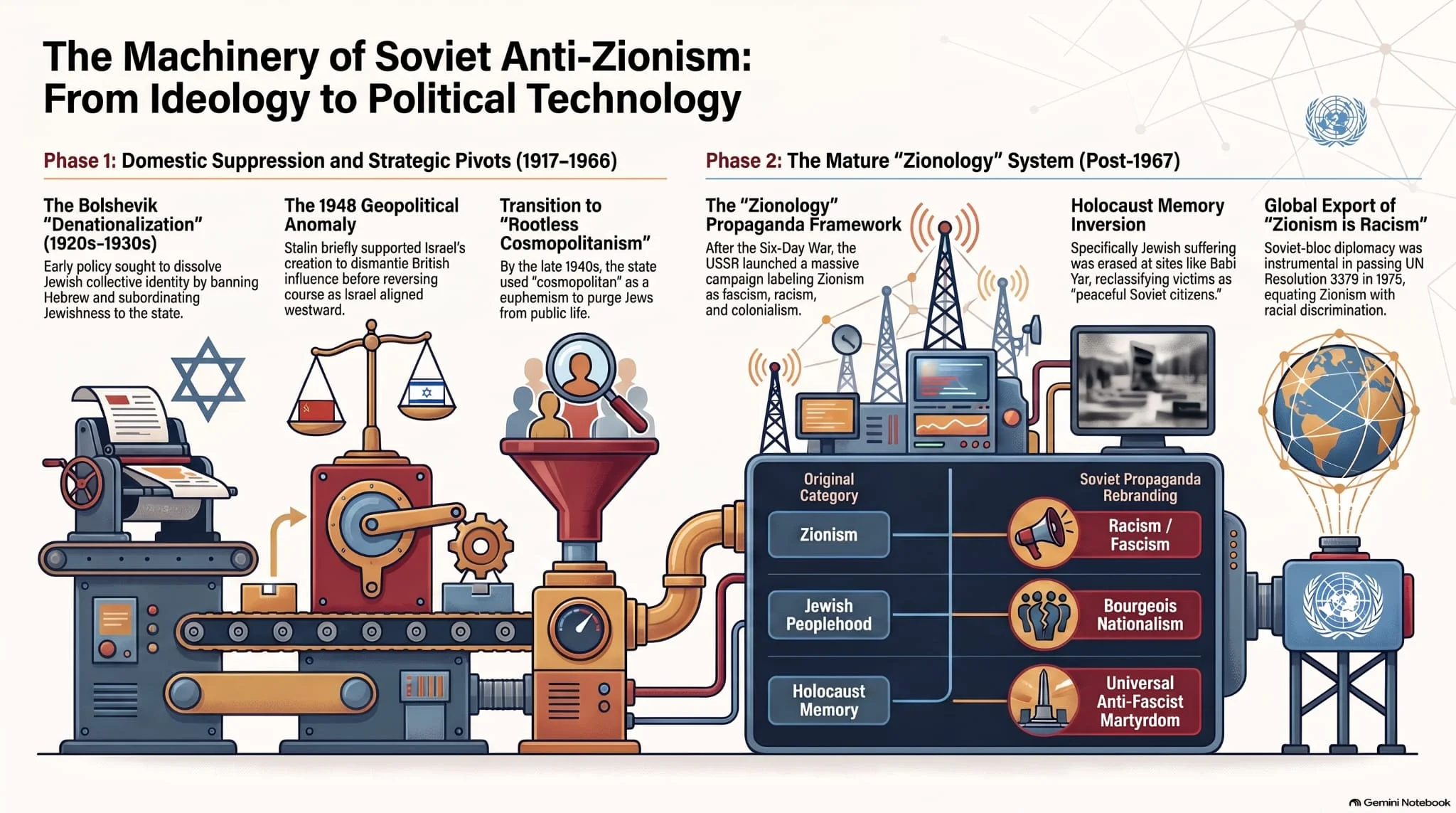
Since they had already downplayed the specific anti-Jewish aspect of the Holocaust, it was easy for them to do what scholars call “Holocaust inversion” – accusing Zionism of being the ideological heir of Nazism. They routinely accused the Zionist movement of having actively collaborated with Nazi Germany.
When exporting this idea to communist and socialist parties on the other side of the Iron Curtain, Zionism was branded as “a tool of globalist capitalism and finance.” When speaking to the Middle East and the Third World, they would frame Israel as “a white European colonial outpost designed to oppress indigenous people.”
The crowning achievement of this antisemitic propaganda was when the Soviets, together with the East Bloc and Third World countries, were able to push through the 1975 UN resolution that claimed that “Zionism is a form of racism.”
It was in this environment that Mahmoud Abbas – currently the president of the Palestinian Authority – wrote his dissertation on “Connections Between Zionism and Nazism (1933-1945).” He defended it in 1982 at the very Institute of Oriental Studies in Moscow that had been tasked with giving Soviet anti-Zionism scholarly legitimacy. Its arguments and vocabulary closely followed the Zionology literature of the preceding decade.
The key mechanism in this system was the closed loop of Zionology. Antisemitism was racism, and the USSR had abolished racism. Therefore, the Soviet state cannot possibly be antisemitic. Zionism, however, was defined as racist and imperialist, and therefore state hostility towards Zionism and Zionists was anti-racism per definition. And if Jews objected to these definitions, their objections were dismissed as deceptive Zionist propaganda. It was a self-sealing system.
This particular way of talking about Zionism was so successful, and gained so much traction, that it survived the USSR itself.
Soviet Jews at this time who wished to emigrate to Israel were often either imprisoned (prisoners of Zion) or denied permission to leave, but also fired from their jobs and put in a legal perpetual limbo (refuseniks). Soviet Jews got caught in an existential limbo known as “involuntary ethnicity.” On the one hand, being Jewish was written in their internal passport, making them a target for discrimination and suspicion of Zionist sympathies. On the other hand, they were not allowed to express anything distinctly Jewish. The USSR had systematically closed many Jewish schools and synagogues, and banned Hebrew, to force assimilation. Soviet Jews were legally marked as different, but were denied the cultural tools to understand or sustain that difference. It ruined thousands of lives.
How much of this is left in today’s world? Surprisingly much.
Let me introduce you to the contemporary scholar Adam Louis Klein. He argues that antisemitism and anti-Zionism are two different forms of Jew-hatred. Classic far-right antisemitism marks Jews as non-European, foreign, and not belonging. Anti-Zionism flips the script and marks Jews as white European colonizers. The only way for them to redeem themselves in progressive spaces is to publicly disavow their collective national identity – the exact same demand the Soviet Union imposed on its Jews.
Can one still criticize Israel without being an anti-Jewish bigot? Of course. But it becomes bigotry when the critique totalizes, when it demands complete dismantling of the Jewish collective identity, and when it treats Jewish national self-definition as uniquely fraudulent and malicious compared to every other national movement on earth. It is bigotry when it relies on conspiratorial tropes about hidden power to explain global events. And it specifically becomes bigotry when it holds Jewish individuals collectively accountable for the actions of another country. A survey in the EU from 2023 (before October 7th) found that 75% of Jews across 13 European Union countries reported that people in their country regularly held them personally responsible for the actions of the Israeli government, just because they were Jewish.
So I am not claiming that every contemporary critic of Israel is a Soviet agent, or that every accusation of colonialism necessarily descend directly from Moscow, but I do claim that many structures of thought persisted and traveled. Scholars like Jeffrey Herf have proved that there is robust archived evidence of these ideas being actively funded and exported directly from Moscow through the Stasi in East Germany and to Palestinian terror groups and the West German radical left.
This does not mean that “the left is the new home of antisemitism” as some claim. Daniel Staetsky did a statistical survey, noting that the classic antisemitic conspiracy tropes of Jews are still mostly prevalent on the right. However, the left is a lot more anti-Israel than the right is, and the more radically anti-Israeli a left-winger was, the more inclined he was to also believe the classic antisemitic tropes. This shows that the prejudice against Jews is not confined to just one side, but it adapts its vocabulary to fit the host ideology.
And on the left, that host ideology is anti-racism, just as in the USSR – and they deploy the same tactics to mask it.
This is why it’s a problem when antisemitism is treated as just one racism among many. If the Jews are “treated equally” by being culturally erased or forced to be invisible, you’re employing a Soviet-style bigotry.
In the past, every time I heard a (usually left-wing) politician speaking on Holocaust Memorial Day about “antisemitism and Islamophobia,” tying them together, I instinctively felt something was wrong. And then I’d feel bad about wanting to protest, because I do agree that all types of racism are bad. Was I being selfish wanting it to be just about the Jews?
This is the deceptiveness of the anti-Zionism hate movement, making us question our own sanity, and using universal anti-racism to erase our specific Jewish concerns.
There are, of course, legitimate reasons to study antisemitism and Islamophobia together for various reasons in academia. But the problem is this rhetorical shield of universalism. When a Jewish community says they’re seeing a spike in antisemitic conspiracy theories or prejudice, and the reply they get is “we are committed to fight all forms of racism,” the institution is deflecting. They’re using universalism to avoid addressing the unique nature of antisemitism. That’s the same tactic I saw on the Soviet memorial plaque in Latvia. What they are really saying is “Your particular pain is an inconvenience to our universal narrative, so we will erase your specific concerns in the name of equality.”
Soviet Zionology ruined thousands of lives, and today everyone agrees it was a vehemently antisemitic movement with a thin veneer of “anti-racist” language. Is today’s anti-Zionism a direct continuation of the same hate movement? The scholar Izabella Tabarovsky claims that the answer is yes. Not necessarily always, not necessarily every anti-Israel accusation, but when they include a cluster of the exact same ideas from Soviet Zionology, it bears clear traces of Moscow influence.
What is that cluster of ideas?
· Zionism as racism and colonialism.
· Framing Israel not just as a state with flawed policies, but as a uniquely malevolent Nazi-like entity.
· The conspiracy of global Zionist influence on media and finance.
· Denial of Jewish collective legitimacy.
· Holocaust inversion, accusing “the Zionists” of being the ideological heirs of the Nazis.
· Shielding bigotry behind anti-racist language.
· Universalizing racism.
· The idea that Jewish claims of antisemitism are themselves deceptive Zionist tactics.
When you see that cluster working together – the Soviet structure is impossible to ignore. These formulations didn’t emerge organically, Tabarovsky claims. They were systematically seeded by the Soviets during the Cold War, and became embedded in certain academic and political subcultures.
A few days after we had seen that plaque, my wife and I took a short hike in the Latvian forest around Lake Usma. In Sweden, Israel, or even the US, the forest is just a forest. There in Latvia, the forest felt different. Any spot in that forest could be a place where thousands of Jews were murdered. The memorial plaque wasn’t wrong. The people really were Soviet citizens. But it missed something important.
When I hear today’s anti-Zionists speak, I don’t worry too much about Israel or my own well-being. We’ll be fine. I do worry for the Jews living in these countries. I worry that what we are seeing is the first step toward trivializing the Jewish experience, downplaying the severity of antisemitism, which in turn prepares the way for new types of antisemitism, anti-Jewish purges, and loyalty tests. It’s what we saw in the USSR, and I feel I’m seeing the first signs of it in the rest of Europe and the United States.
I hope I’m wrong.
You might also like to read this: