96 years of running toward danger: Inside Israel's Magen David Adom
Long before there was a State of Israel, there was Magen David Adom



In 1930, six founding fathers gathered in what was then a young, 20-year-old city called Tel Aviv. A year earlier, riots between Jewish residents and their neighbors in Jaffa had left Jews injured and killed. A simple question was then asked: what could get an injured person to a doctor quickly enough to save their life? The answer was an ambulance – and with that, Magen David Adom (MDA) was born.
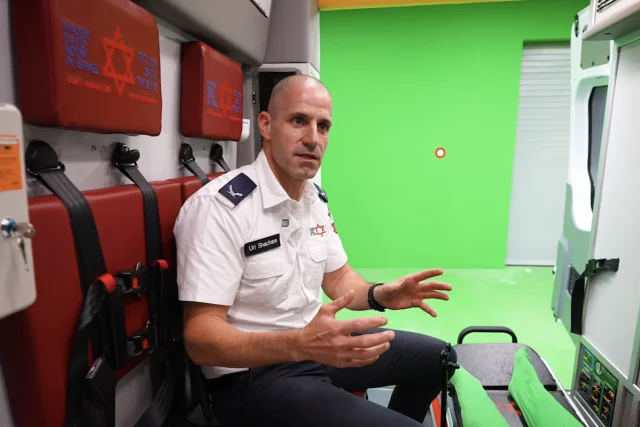
ALL ISRAEL NEWS correspondent Kayla Sprague had the opportunity to visit MDA training facilities in Ramleh. “Since 1930, Magen David Adom has been operating ambulances,” said Uri Shacham, the organization’s chief of staff and head of technological innovation.
By 1936, Jewish communities in the United States were already raising money to send ambulances – 12 years before Israel became a sovereign state. Through the Holocaust and Israel’s War of Independence, MDA sent aid to Jews liberated from the camps and trained members of the Haganah, ordinary people who worked by day and fought by night to secure a homeland.
“When the State of Israel was established, it already had an ambulance service and a blood service,” Shacham said. “The state didn’t have a lot of money, didn’t have the army as we know the IDF now. But it had Magen David Adom.”
Oct. 7: When the uniform became a target
For decades, the red Star of David on an MDA uniform has functioned as an unspoken truce. “It is like an unseen shield that says, I’m here to help others. I’m above any dispute. I’m protected,” Shacham explained.
That shield came under attack on Oct. 7. Just 30 minutes into the Hamas attack on southern Israel, terrorists deliberately targeted MDA crews, firing a rocket-propelled grenade at an ambulance in one community bordering Gaza, disabling it and cutting off a lifeline for the wounded.
“Learning that those uniforms are not protecting – that Magen David Adom people had become a target – this is one of the biggest shocks that we had,” Shacham said.
And yet paramedics who might have been expected to run and save their own lives instead ran toward the danger.
“You are not running away. You will run towards fire. People need you over there. I believe that this was the first miracle,” he said.
A second miracle unfolded in Sderot, where protocol called for the station’s gate to open whenever sirens sounded. That morning, the gate stayed shut. Hamas terrorists arrived with orders to seize the station, but the locked gate held them outside. Crews spent the day running armored ambulances to save lives. “That’s not a coincidence,” Shacham asserted.
A shield for everyone
Ask Shacham who MDA serves and the answer is immediate: everyone. Its paramedic corps mirrors Israel’s diversity: Jewish, Christian, Muslim, Druze, religious and secular – working side by side on the same ambulance.
“If you are committed to saving life, you belong to Magen David Adom,” he said. “A Muslim, a Christian and a Jew are riding in an ambulance – that sounds like the beginning of a joke. It’s not. That’s the beginning of a morning shift in Jerusalem. Let’s build bridges between beliefs and differences, and focus on what’s really important: saving lives.”
Training for reality, not for the classroom
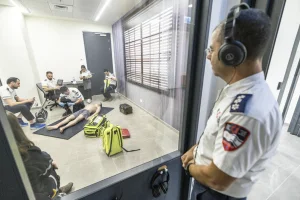
Recruits aren’t simply lectured; they’re placed inside environments engineered to feel like the emergencies they’ll one day face, including a mobile intensive care unit built for training, complete with a mannequin onto which instructors can project wounds, burns or distressed breathing.
“We cannot allow the people of Israel to get something which is less than the best of the best,” Shacham said.
The realistic training extends outdoors, too. Preparing teams for wartime conditions, MDA sometimes borrows structures slated for demolition, placing mannequins inside before the wrecking begins, so “when they encounter destroyed buildings, it’s not the first time they see it,” he explained.
The goal is to compress the shock of a real emergency so paramedics’ hands already know what to do. “The tension factor is much reduced,” he said. “They have the confidence that they are able to cope.”
Underground and ready for anything
A short drive away from the training center sits the new Marcus Blood Services Center, Israel’s national blood bank. From the outside, it’s unassuming; below ground are labs and vaults holding a vast blood supply.
“During routine times, we have enough storage for about a month. During war, we increase,” Shacham said, supplemented by blood drives across the country.
MDA supplies not only hospitals but the army – and over the last three years, its whole-blood units for wounded soldiers have cut battlefield mortality by half.
“That’s the future of the Holy Land,” Shacham said. Nearby stood a model of what comes next: a planned National Emergency Center, a war room for the country’s ambulance service, built underground to keep functioning through missile fire. “This will ensure Israel’s security from a medical perspective for decades."
A 15-year-old who wanted to ride with the sirens
Shacham's own connection to the organization began for reasons a little less noble than the ones he now champions. At fifteen with a desire to give back, he signed up. “Just between you and me, I came because of the ambulances – sirens – as a 15-year-old boy. But I fell in love with the mission.”
That love became a family tradition. His wife is a former volunteer and both daughters volunteer today. Roughly 15,000 volunteers across Israel are trained each year to the same standard as a paramedic.
As chief of staff, Shacham also oversees the technology that connects MDA’s 39,000 paramedics and volunteers to those who need them – off-duty lawyers, businesswomen and everyday citizens who receive a text when someone collapses nearby, asking simply, "Are you willing to go?"
“It’s amazing how many people are willing to go and help,” he said.
A debt to the world
Magen David Adom’s name draws on a teaching central to Jewish tradition: whoever saves one soul is as if they have saved an entire world. A child saved today might become a doctor, a parent, a Nobel laureate.
“Sometimes our intervention is not that heroic,” Shacham said, “but we are shaping a future – for a person, for a family, for a nation.”
None of it happens in isolation. “We couldn’t have done this without support from the world,” Shacham said, pointing to Christian communities abroad that have embraced the same 'golden rule' principle its volunteers practice: treat every human being as you would want to be treated.
“Your support enables us to be there in a matter of minutes to save lives.” His invitation is simple: come see it for yourself. “Come and see how miracles happen in Israel through the activity of Magen David Adom.”
You might also like to read this: