Inside Magen David Adom’s cutting-edge training center preparing paramedics for war and terror




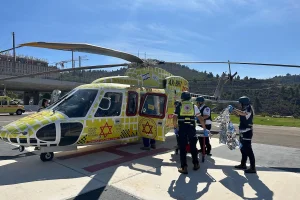
Israel’s national emergency medical service, Magen David Adom (MDA), which serves as Israel’s equivalent of the Red Cross, has acquired unparalleled experience over the years in saving lives amid wars and terror attacks. Now, the organization’s new education center is taking that expertise to the next level by training Israeli paramedics to respond to complex wartime emergencies.
The center’s overall goal is to prepare paramedics to make high-pressure, life-saving decisions in chaotic and unpredictable situations, including battlefields, missile attacks and more conventional medical emergencies.
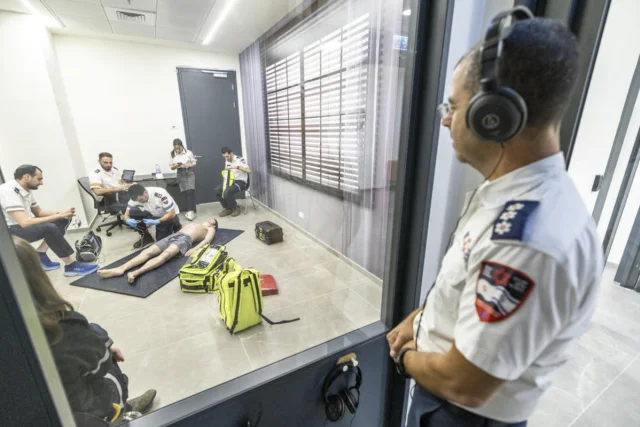
Realistic simulation plays a crucial role at the advanced training center, which opened in January in the central Israeli city of Ramla. Paramedic trainees are exposed to scenarios ranging from delivering a baby and treating a patient who has collapsed in the shower to caring for a critically injured person inside a full-scale ambulance simulator.
Dr. Shafir Botner, who was in charge of planning the new center based on a decade of training paramedics, stressed the importance of realistic training scenarios.
“If you make the wrong decision, the instructor kills your patient,” Botner said.
A realistic mannequin serves as the “patient” and responds to the decisions made by trainees. Like in the real world, the mannequin’s condition can improve or deteriorate depending on the circumstances.
“If you need to ventilate or perform a procedure, you do it on the mannequin,” Botner explained. “If you don’t do it correctly, the mannequin dies. The instructor presses a button and the patient dies."
“This is one of the most advanced centers in the world for training paramedics and emergency medical personnel,” Botner argued.
MDA trains thousands of paramedics and emergency medical personnel each year to perform rapid lifesaving procedures in complex field situations. The new education center is designed to familiarize trainees with unfamiliar scenarios that require rapid, life-saving decisions by recreating a variety of environments.
“Each one has a different character and represents a different working environment,” Botner revealed. “One looks like a clinic, one like a gym, one like a supermarket, one like a kindergarten and one like a beach."
The simulations are designed to make trainees physically respond to emergencies rather than simply discuss them in a classroom.
“If you say a patient collapsed in the shower, then he really is in the shower – not just theoretically,” Botner said. “Now treat him inside the shower and get him out.”
Botner also emphasized that Israeli paramedics are trained to deal with dangerous materials, a task that is often carried out by specialized units in other countries.
“All of our ambulance crews know how to do this,” he said. “When you come to work in the morning in a regular ambulance, you don’t know where you may be required to respond to. Everyone is trained to do it,” Botner added.
The training center also exposes trainees to simulated battlefield scenarios.
“You can put them right on a battlefield, with gunfire, explosions, aircraft and fire,” Botner explained. “They train with the equipment they actually have, but inside the scenario,” he stressed.
The training then moves on to a full-scale ambulance simulator designed to replicate the experience of working inside a real ambulance.
“The ambulance is one-to-one like a real ambulance,” he said. “The driver gets in, the paramedic is in the back, the driver starts it and drives. It sits on a hydraulic platform, so the ambulance moves according to how the driver is driving.”
Botner stressed that repeated training is critical for developing advanced skills and preparing paramedics to make effective decisions under pressure.
“The more times I perform the same procedure, again and again, the more skilled I become,” Botner explained. “Then, when I take all of those things together, I will be able to make good decisions.”
In addition to realistic simulation training, MDA trainees also receive hands-on experience alongside experienced paramedic personnel.
Botner concluded that Israeli paramedics are “the most combat-exposed in the world.”
“Paramedics in Israel put on body armor and helmets and enter threatened scenes – areas where missiles or rockets have fallen, explosions,” Botner said. “That is something that exists less elsewhere in the world. It changes things, because we are in the State of Israel. This is our reality."
In June, Magen David Adom celebrated its 96th anniversary while continuing to prepare its medical teams for future challenges.
Please take a moment to join believers worldwide praying for Israel right now. Add your light to the live prayer map—and show the world one more watchman praying for the peace of Jerusalem.

You might also like to read this: