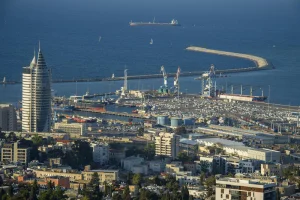
Haifa Port poised to become key link in India-Middle East-Europe trade corridor



Israel’s Haifa Port could eventually become a key link in the planned India–Middle East–Europe Economic Corridor (IMEC), a proposed trade route connecting India with Europe through the Middle East and Israel.
The large-scale project envisions a combination of maritime shipping and overland rail transportation. Under the proposed route, goods from Asia would be shipped by sea from India to Gulf states before being transported by rail through Saudi Arabia and Jordan to Haifa. From there, the goods would be shipped by sea to European markets.
“We are talking here about a major strategic project, envisioned as an alternative and complementary trade route to the Suez Canal, combining both maritime and overland transportation,” said Shams Abu Fares, Container Terminals Operations manager at Haifa Port.
Haifa has served as a major Mediterranean maritime hub for decades, with thousands of containers passing through its port. In 2023, the Indian Adani Group purchased Haifa Port for $1.15 billion.
With its modern facilities and strategic location in the eastern Mediterranean, Haifa has long been positioned as a hub for trade between East and West.
“For many years, Haifa Port defined itself as a port that was also intended for countries east of the State of Israel,” Haifa Port Vice President Zohar Rom said. “But no one thought until recent years that Haifa Port could also be a gateway, a connection, between the Far East and the hearts of Europe and the United States.”
Rom said the envisioned IMEC corridor could significantly reduce transit times between India, the Far East and Europe.
Haifa officials are cautiously optimistic that the trade corridor could stimulate the local economy and benefit northern Israel.
“Once IMEC is realized, there is no doubt that we will become a very strategic city,” Haifa Mayor Yona Yahav said. “Because everything will pass through it and it will actually be a very important and dominant transit point in our region.”
The realization of the IMEC vision will ultimately depend on political cooperation among multiple countries. Meanwhile, Fares said Haifa Port is already well positioned to serve as a major commercial hub, citing its advanced facilities, technology and workforce.
“All these capabilities enable the Port of Haifa to compete with leading ports in the Middle East and strengthen its position as a major commercial gateway connecting the region with Europe and global markets,” Fares said.
If realized, the IMEC corridor would complement existing international trade routes. Its success would depend on factors including regional stability, transit times, infrastructure capacity and transportation costs.
Haifa could also benefit from expanding economic ties under the U.S.-brokered Abraham Accords. The Financial Times reported in April that some Gulf states are considering oil pipelines to Haifa to bypass the Strait of Hormuz, which faces threats from Iran.
Last month, Haifa Municipality unveiled plans for a $1 billion waterfront development featuring hotels, entertainment and conference facilities.
You might also like to read this: