









Israeli drone makers expand in competitive global market
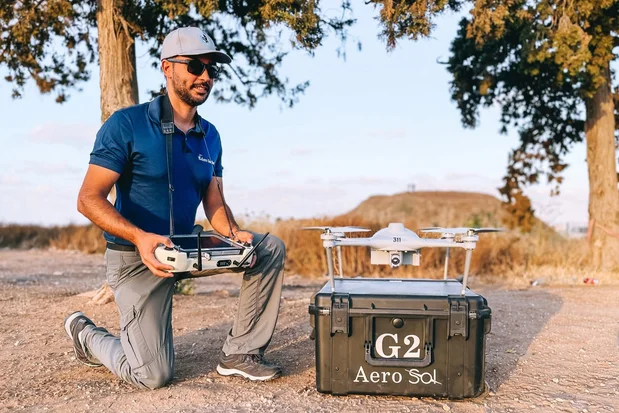
Israeli drone and autonomous-systems manufacturers are expanding their capabilities and international presence as demand grows for unmanned technologies that can operate in increasingly complex combat environments.
Petach Tikva-based Aero Sentinel announced this week that its G2 unmanned system had completed a week of exercises with the Romanian Land Forces, conducting reconnaissance missions lasting up to 75 minutes in day and night conditions and various types of weather.
The exercises also subjected the drone to a “demanding and progressively challenging” electronic warfare environment, including heavy jamming and countermeasures designed to simulate conditions the system could encounter in combat.
While the electronic jamming severely affected other equipment used during the exercise, the G2’s safety features were automatically activated, allowing the drone to return to its home base for recovery and reuse rather than crashing and being lost, as can happen with similar systems.
In a separate development, Rosh HaAyin-based Elbit Systems announced this week that it is introducing FUSE, a new structure bringing its autonomous air and ground vehicle production lines under a single portfolio.
The new structure is built on Dominion-X, a software package that lets a single human operator manage multiple autonomous aircraft and ground vehicles simultaneously, including in GPS-denied environments. Elbit has dubbed the capability “One2Many.”
“Military forces are entering a new operational era in which combat effectiveness will increasingly depend not only on autonomous platforms themselves, but on the ability to integrate and coordinate large numbers of autonomous systems within existing maneuver forces in real time,” said Eyal Dahan, CEO of FUSE.
“FUSE was established to deliver that capability today, combining autonomous platforms, operational AI and scalable One2Many command capabilities into integrated operational solutions that can be rapidly deployed and integrated into modern combat formations," he continued.
According to an Elbit statement, the software has already been used in combat and is being deployed by several unnamed military units in the United States, Israel and European countries.
Elbit also announced this week that its U.S. subsidiary based in Fort Worth, Texas, will be renamed “Twenty-Six Defense.”
According to Luke Savoie, president and CEO of Twenty-Six Defense, the number 26 corresponds to the placement of iron on the Periodic Table of the Elements and is meant to symbolize “resilience and durability.”
“Launching Twenty-Six Defense underscores our growth in the American market and reinforces our commitment to supporting U.S. warfighters, wherever the mission takes place,” Savoie said.
The rebranding comes as Israel faces declining support in many Western countries, including the United States.
According to the company website, Twenty-Six Defense has 3,300 employees in the United States working at several facilities, primarily at its Fort Worth headquarters. The facility includes manufacturing operations for tactical aircraft that Elbit Systems of America purchased from General Dynamics in 1993.
The company began producing avionics equipment for F-16 aircraft at the plant and later absorbed six other companies producing technologies ranging from aircraft helmet-mounted displays and night-vision systems to precision-guided seekers and laser-targeting systems.
Earlier this summer, Elbit announced a large contract to supply equipment to the U.S. Customs and Border Protection agency.
Popular article:

interview Easter message of resurrection hope amid war at Jerusalem's Garden Tomb

biblical commentary Let my people go: a Passover message for today
4 IDF soldiers killed, 2 wounded in fighting in southern Lebanon, as Israel eliminates dozens of Hezbollah terrorists

Receive latest news & updates
A message from All Israel News
Help us educate Christians on a daily basis about what is happening in Israel & the Middle East and why it matters.
For as little as $10, you can support ALL ISRAEL NEWS, a non-profit media organization that is supported by readers like you.
Latest articles:

North American Jewish organizations to recruit 100 professionals to combat antisemitism

‘No need’ for pre-election Iran strike, IDF chief says as gov’t, opposition trade blame for potential escalation – report

terror attack 2 Israeli soldiers killed, 2 terrorists eliminated in Hebron shooting; IDF says much larger attack was prevented
analysis A people dwelling securely? Israel’s strategic standing, 3 years after Oct 7
Hamas on wheels: What I found in Dearborn reveals a troubling history and a battle over Israel