The selective moral outrage behind Britain’s boycott of Israeli settlements


Diplomatic shockwaves have rippled through relations between Israel and some of its closest Western allies last week after Great Britain led a push to boycott goods produced in Jewish settlements in Judea and Samaria (West Bank) and threatened action against those involved in their expansion.
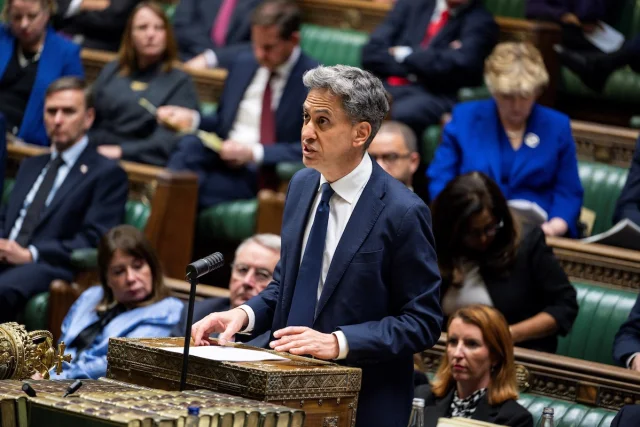
British Foreign Secretary Ed Miliband announced that the government will introduce legislation banning imports from Israeli settlements, while companies and individuals providing construction, infrastructure, finance, real estate and other services connected to settlement development may also face sanctions. Britain also plans restrictions on arms exports it considers to be contributing materially to the current situation in the region. France and Canada have said they will take similar action, while nine other European countries have committed to introducing national restrictions, supporting measures at the European level or actively considering further steps.
The coordinated move by 12 countries marks a significant change in Western policy. Governments that previously required settlement products to be labelled differently from goods produced inside Israel are now moving towards banning them altogether and penalising businesses associated with settlement activity.
Britain presents the policy as a carefully targeted measure: punish the settlements without boycotting Israel itself, protect Palestinians and preserve the possibility of a two-state solution. On paper, everything appears to be straightforward. In the real economy, it may prove much harder to implement.
The direct trade affected by the ban is relatively small. The latest figures suggest that the exports to the United Kingdom from Judea and Samaria (West Bank) are around $48 million. But its consequences could extend well beyond the settlements, harming the Palestinians who work there and creating legal and compliance risks for Israeli companies that operate entirely within the Green Line.
This is not yet a single, fully operational 12-country embargo. Britain says it intends to put its framework into law within six to nine months, while each participating country will determine the scope of its own restrictions. But businesses do not need to wait for every legal detail before reacting. Settlement-related commerce is already moving from a matter of labeling and reputational judgment into the realm of legal and sanctions risk.
Amid this uncertainty over how the measures will work, one consequence has received remarkably little attention: the fate of the Palestinians who earn their living in the businesses Britain intends to hurt.
According to the Palestinian Central Bureau of Statistics, approximately 17,600 Palestinians from the West Bank were employed in Israeli settlements in the first quarter of 2026. During the same period, unemployment in the West Bank stood at 27.9%, which is about 284,000 people without work.
This “small” detail has been completely disregarded by the politicians sitting in London. Those 17,600 individuals support households and inject wages into an economy already suffering from severe unemployment. If the boycott succeeds on its own terms – reducing sales, investment and activity in settlement businesses – some of the first people to suffer will be Palestinian employees.
The SodaStream case shows how this may develop into reality. Its former factory at Mishor Adumim – just east of Ma’ale Adumim, in the West Bank – employed roughly 500 Palestinians alongside Israeli Jews and Arabs. When the company consolidated production at a new facility in the Negev, most Palestinian employees could not simply follow the jobs because they required Israeli work permits. SodaStream disputed claims that boycott pressure caused the move, and it would be dishonest to present the closure as a straightforward victory for the boycott campaign. Yet the outcome is undeniable: production moved, the company survived and hundreds of Palestinians lost access to their employment.
A surgical boycott can become a blunt instrument
The larger risk lies in compliance. British ministers insist that the action is aimed at settlements rather than Israel and have explicitly rejected a broader Boycott, Divestment, Sanctions (BDS) campaign. Corporate legal departments, banks, insurers, distributors and procurement officers will have to turn that political distinction into operational decisions.
Unfortunately, that will not always be simple. Many Israeli banks, telecom companies, logistics providers, retailers and utilities serve customers on both sides of the Green Line. A manufacturer based inside pre-1967 Israel may use a distributor, lender or contractor with some exposure to settlements. A British company may not be able to establish confidently where every component originated or whether a service indirectly facilitated prohibited activity.
When the cost of getting the answer wrong includes regulatory investigation, financial penalties and reputational attack, companies often do not perform delicate moral surgery. They simply eliminate the exposure to such endeavors.
This is precisely what concerns Israeli economic officials. Ofer Forer, deputy director of the Foreign Trade Administration at Israel’s Economy Ministry and a former economic attaché in Britain, has warned that British importers and distributors may lack the tools to determine whether an Israeli supplier operates inside the Green Line or beyond it. The result, he argues, could be a broader cooling of their willingness to trade with Israeli companies.
The imbalance between the small direct target and the much larger commercial relationship makes that risk significant. Israeli exports originating in Judea and Samaria amount to only tens of millions of dollars a year. By comparison, Israel exports approximately $4.6 billion in goods and services to Britain annually. British companies have also invested more than $23 billion in Israel, while 48 British multinationals maintain operations in the country.
This risk is not merely hypothetical. Norway’s sovereign wealth fund excluded Israel’s five largest banks in 2025 over financial services connected to settlements. These are national institutions whose operations extend far beyond Judea and Samaria. The precedent demonstrates how a supposedly territorial policy can reach companies at the centre of Israel’s domestic economy.
The government may write “settlements only” into the law. The private sector may translate it into “Israel is not worth the compliance risk.” That is how a narrow boycott acquires a wider economic shadow without any government formally declaring a boycott of Israel. In other words, until the legislation defines how corporate groups, subsidiaries, and financing arrangements will be treated, assurances that companies inside Israel face no risk are worth little.
The Turkey test
The policy also exposes the selective nature of Western moral outrage. Turkey has maintained forces in northern Cyprus since 1974. The self-declared Turkish Republic of Northern Cyprus is recognised only by Turkey, while UN Security Council resolutions have treated the attempted secession as legally invalid. Turkey’s military action against Kurdish groups in Syria and its record on Kurdish political rights, journalists and opposition figures have repeatedly been condemned by European institutions. The European Court of Human Rights has issued multiple rulings against Ankara, including over the prolonged detention of Kurdish political leader Selahattin Demirtaş.
Yet Britain is not drafting comparable restrictions on ordinary trade with Turkey. Quite the opposite. In July, the British government celebrated progress towards an enhanced free-trade agreement with Turkey. Bilateral trade reached £28.4 billion ($38.4 billion) in the four quarters to the end of 2025. The EU likewise counted Turkey as its fifth largest goods trading partner in 2025.
This raises an obvious question: why is the same standard not applied with equal determination to Ankara?
The uncomfortable answer is that Western foreign policy is rarely governed by moral consistency. Turkey is a large NATO member, a gatekeeper on migration, a major trading partner and an important regional military power. Confronting it carries a substantial strategic and economic cost. Singling out Israel is easier and the bill is far cheaper to swallow.
Then there is domestic politics. It cannot be proved that the Labour government adopted this policy simply to win back Muslim voters. But only the politically ignorant would pretend that electoral pressure played no part in its calculations. In Britain’s 2024 election, Labour’s vote share fell by an average of 10 points in constituencies where Muslims made up more than 10% of the population, while pro-Gaza independents defeated Labour candidates in several seats. More recent polling has continued to show Gaza ranking unusually high among Muslim voters.
That electoral arithmetic gives the government an obvious incentive to demonstrate that it is acting against Israel. Elsewhere in Europe and in Canada, Israel has likewise become a relatively low-cost target through which politicians can display moral conviction to electorates increasingly mobilised by the Palestinian issue. Turkey, by contrast, can retaliate through trade, migration, NATO and regional security. As ironic as it sounds, political principles tend to be firmest when enforcing them comes cheap.
However, the proposed boycott is unlikely by itself to halt settlement construction. With direct exports from Judea and Samaria estimated at only $48 million, the measure is too small to exert serious pressure on an economy of Israel’s size. Even supporters acknowledge that only the United States possesses the leverage capable of forcing a major change in Israeli policy. The immediate value of the measure is therefore largely political and symbolic.
Its unintended effects, however, may have much wider repercussions. Palestinian workers could lose jobs in an economy where more than one in four people is already unemployed. Israeli companies operating entirely inside the Green Line could be caught by over-compliance, financial de-risking or poorly defined supply-chain rules. Relations with Britain, Canada and other European states will deteriorate, while settlement policy itself may remain unchanged.
The deeper failure is both political and moral. Britain claims that its purpose is to preserve the possibility of peace, yet the pressure it applies runs almost entirely in one direction. Israel is expected to surrender territory, absorb the resulting security risks and submit to economic punishment when diplomacy fails. No comparable price is demanded of the Palestinian leadership, nor are equally forceful measures proposed to secure reciprocal concessions or enforceable guarantees for Israel.
Peace cannot be built by treating Israel as the only party with obligations while absolving the Palestinian leadership of responsibility for perpetuating the conflict. That is not a peace process. It is one-sided diplomatic and economic pressure without reciprocity.
You might also like to read this: